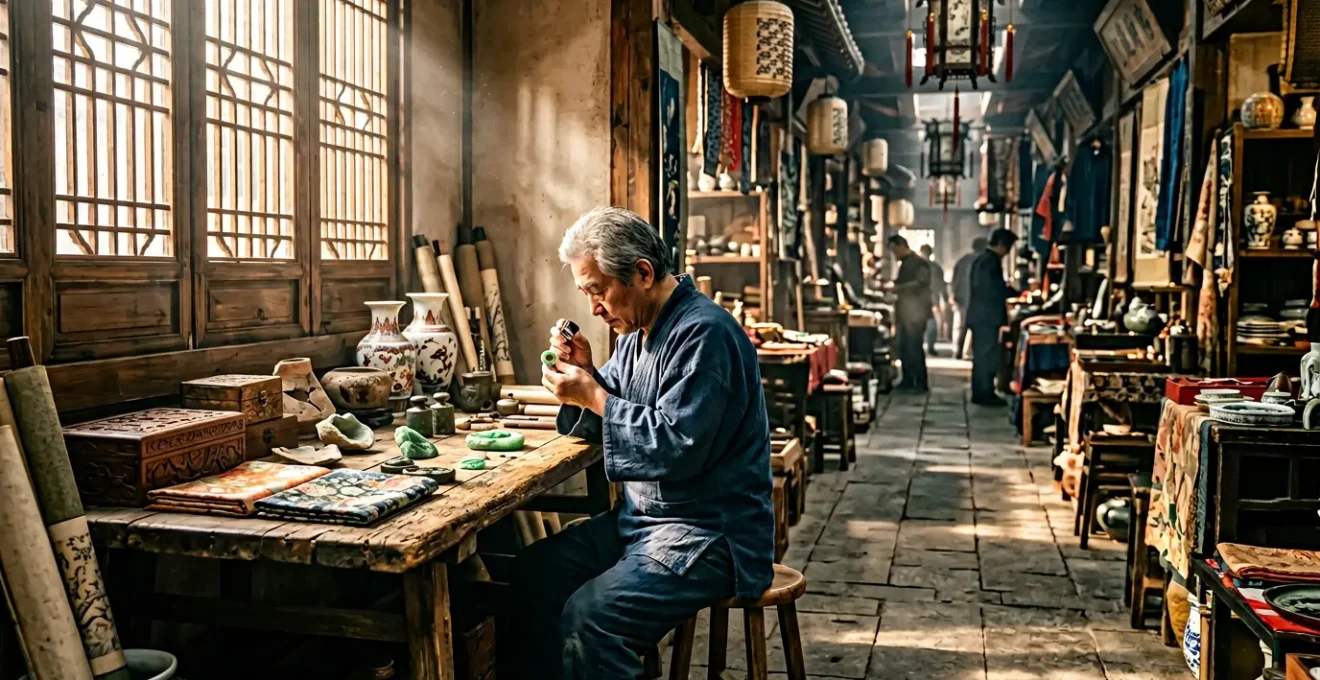
Authenticating an artifact is less about finding a single ‘tell’ and more about reading a consistent story across its material, history, and wear.
- Learn to use sensory tests that machines can’t easily fake, like the cool touch of real jade or the resonance of period porcelain.
- Understand how a region’s specific climate, like Hong Kong’s humidity, becomes an unconventional but powerful tool for verification.
Recommendation: Start by training your senses on the most common materials—jade and porcelain—before attempting to appraise complex textiles or furniture.
Standing on Hollywood Road, surrounded by the ghosts of dynasties and the hum of commerce, a collector feels a unique thrill. Every object in every stall seems to whisper a story. But which stories are true, and which are convincing fictions? For the enthusiast or budding collector, the challenge is immense. The common advice—to “check for a maker’s mark” or “look for signs of age”—is often the first trap. Marks can be forged, and wear can be artificially induced with alarming skill.
The true path to identification is not a simple checklist. It’s about learning to read the material narrative of an object. It requires shifting your perspective from hunting for a single flaw to assessing an object’s holistic integrity. Does the material behave as it should? Does its story align with its supposed history? Does it bear the authentic, subtle fingerprints of time that mass-production can never truly replicate?
This guide moves beyond the platitudes. We will not just list what to look for; we will explain the principles behind authentication. We’ll delve into the sensory signatures of genuine jade, decipher the anatomy of period porcelain, understand what textile patterns truly signify, and navigate the legal and environmental risks of collecting in a unique climate. By the end, you will have a new framework for seeing—transforming you from a hopeful buyer into a discerning appraiser.
To navigate this complex world, this article is structured to build your expertise step by step, from foundational materials to advanced contextual analysis. The table of contents below provides an overview of your journey.
Summary: An Appraiser’s Guide to Authentic Artifacts
- Why Is Jade More Valuable Than Gold in Traditional Culture?
- Fake or Real: How to Spot Replica Porcelain on Hollywood Road?
- What Do the Embroidered Patterns on Traditional Costumes Signify?
- The Export Risk: Which Artifacts Are Forbidden to Take Out of China?
- How Are Humidity and Mold Managed for Private Collections in HK?
- How to Map Your Own Route to See the Best Hollywood Road Murals?
- The Souvenir Trap: Distinguishing Authentic Crafts from Mass Production
- PMQ and Beyond: Where to Find Authentic Hong Kong Handicrafts?
Why Is Jade More Valuable Than Gold in Traditional Culture?
In traditional Chinese culture, jade’s value transcends the monetary. While gold represents wealth, jade embodies virtues like wisdom, purity, and longevity. It is a spiritual and philosophical touchstone, believed to connect the physical and metaphysical worlds. This deep cultural reverence is precisely why the market is saturated with imitations. For an appraiser, authenticating jade is the first fundamental skill, as its value is tied directly to its genuineness, not just its carat weight.
Beyond its cultural weight, true jade (Nephrite or Jadeite) has distinct physical properties that forgers struggle to replicate. Your own senses are the first and most important line of defense. Before you even consider price or provenance, conduct these sensory tests to establish a baseline for authenticity.
- Cold Touch Test: Press the piece to your cheek. Real jade is a poor conductor of heat and will feel distinctly cold, like a stone from a riverbed. It will slowly warm but should retain a coolness longer than glass or plastic imitations.
- Density Test: Gently toss the item in your hand. Authentic jade has a high density (2.90-3.38 g/cm³) and should feel surprisingly heavy for its size. This heft is difficult to replicate with lighter materials like resin or serpentine.
- Sound Test: If you have two pieces, tap them together gently. Real jade produces a high-pitched, clear, bell-like chime. A fake will produce a dull, plastic-sounding thud.
- Light Test: Hold the jade up to a strong light source. You should see a fibrous, interlocking internal structure, like felted asbestos. Glass or quartz imitations will appear too uniform or contain tiny bubbles.
- Temperature Retention: After holding the piece for a minute, a fake will have warmed to your body temperature. Authentic jade will still feel comparatively cool to the touch.
However, be aware that these tests are for initial screening. A controlled study revealed a 40% misidentification rate even with visual cues, as polymer-impregnated jade and high-quality quartzite can fool the untrained. For any significant purchase, these sensory checks should be followed by professional lab verification.
Fake or Real: How to Spot Replica Porcelain on Hollywood Road?
After jade, porcelain is the second great pillar of Chinese antiquities. Hollywood Road is lined with shops offering everything from delicate teacups to grand dynastic vases. The challenge here is distinguishing a centuries-old treasure from a modern replica that was fired last year. The secret lies not in the painted surface, which can be copied, but in the parts of the object that tell the story of its creation and use—specifically, the unglazed foot-rim.
An authentic antique foot-rim should feel smooth and silky to the touch, a result of decades or centuries of being moved across wooden surfaces. Replicas often have a gritty, sandy texture, or show signs of being artificially aged with acid or grinders. Look for the subtle, natural irregularities of a hand-thrown piece versus the perfect, cold symmetry of a molded replica. The image below highlights the texture to look for.
As the macro photograph shows, a genuine foot-rim tells a story of its life. You might see tiny iron spots from impurities in the clay, a natural patina from handling, and authentic kiln adhesion marks. These are the fingerprints of time. A modern fake is often too clean or features unnaturally uniform “aging.” This comparative analysis is a foundational skill for any collector browsing the stalls of Hong Kong.
To aid in your on-the-ground assessment, this table summarizes the key differences. According to an analysis of vintage shopping on Cat Street, these characteristics are the most reliable indicators for initial triage.
| Feature | Authentic Antique | Modern Replica |
|---|---|---|
| Foot-rim texture | Smooth, silky feel with minor irregularities | Gritty, sandy, or artificially aged |
| Weight distribution | Slight variations from hand-throwing | Perfect symmetry from molds |
| Crazing patterns | Natural, irregular network | Uniform, artificially induced |
| Price range (HK$) | $1,000-100,000+ | $20-500 |
What Do the Embroidered Patterns on Traditional Costumes Signify?
Embroidered textiles are a vibrant and deeply symbolic area of collecting. The patterns on a traditional robe are a language in themselves, signifying the wearer’s rank, social status, and the occasion for which the garment was intended. Dragons, cranes, and phoenixes were reserved for the imperial court and nobility, while floral motifs like peonies (wealth) and lotuses (purity) were more common. Before you can even begin to decipher this language, however, you must first ensure the textile itself is authentic to its period.
A forger can copy a pattern, but it’s much harder to replicate the materials and techniques of a bygone era. Your examination should focus on the threads, dyes, and stitch work. Flip the garment over; the back tells a more honest story than the front. Hand embroidery will show small knots and slight irregularities in tension, while machine work is flawlessly uniform. Pre-20th century vegetable dyes fade subtly and differently from modern synthetic dyes, often showing more fading in creases.
The most skilled forgers are aware of these details, but they can still make critical errors in historical context. This is where an appraiser’s knowledge becomes a powerful tool.
Case Study: Anachronistic Symbols Reveal Modern Forgeries
A frequent red flag in textiles marketed as 18th-century is the presence of anachronistic elements. An analysis of common forgery techniques shows that forgers often introduce motifs that only gained popularity in the Republican era (post-1912). They might also use machine-perfect “forbidden stitches” that were technically impossible with pre-modern needles, or color combinations that reflect 20th-century aesthetics rather than the strict color hierarchies of dynastic China. A robe telling a historically inconsistent story is almost always a modern creation.
This “contextual integrity” is paramount. If a robe features a symbol that wasn’t used until 200 years after its supposed creation date, you have uncovered a forgery without even needing a microscope. It’s a reminder that historical knowledge is as crucial as material analysis.
The Export Risk: Which Artifacts Are Forbidden to Take Out of China?
Beyond authentication, a responsible collector must be a legal one. When browsing markets in Hong Kong, you are at a global crossroads of the antiquities trade. It is crucial to understand that purchasing an artifact does not automatically grant you the right to take it home. Many countries, including mainland China, have strict laws protecting their cultural heritage, and Hong Kong’s status as a free port does not exempt items from these regulations upon export.
The guiding principle for international law is the 1970 UNESCO Convention, which restricts international trade in cultural property deemed to be of national importance. In China, any artifact dated pre-1911 is generally considered a cultural relic and requires a special permit (a red wax seal) to be legally exported. Items from the Cultural Revolution (1966-1976) also fall into a protected category. Ignorance of these laws is not a defense, and attempting to export a restricted artifact can lead to its confiscation and severe penalties.
Be extremely wary of any seller who uses export restrictions as a high-pressure sales tactic, claiming “you must buy it now before it’s forbidden.” This is often a red flag used to rush a buyer into purchasing a convincing fake at an inflated price. A reputable dealer will be transparent about an item’s provenance and its legal export status. If a deal feels rushed or illicit, it’s a signal to walk away. The true value of a collection lies not only in its authenticity but also in its ethical and legal acquisition.
How Are Humidity and Mold Managed for Private Collections in HK?
In most collecting circles, humidity and mold are the enemies. In Hong Kong, however, they can be an appraiser’s unlikely allies. The city’s subtropical climate, with humidity levels often exceeding 80%, leaves an unmistakable fingerprint on organic materials. This “humidity fingerprint” is one of the hardest things for a forger to replicate, making it a powerful tool for authentication.
An antique wooden carving, paper scroll, or textile that has spent a century in Hong Kong should not look pristine. A complete lack of aging is a major red flag. As an expert guide to the local market notes, authentic pieces should show age-appropriate exposure. This includes minor “foxing” (small brown spots) on paper, a gentle warping in wooden furniture, or a subtle, earthy, musty scent. These are not flaws; they are signs of a genuine life lived in this specific climate. A modern replica will often appear too perfect or display crude, uniform artificial aging that fails to capture the nuance of decades of slow moisture absorption.
You can train your senses to recognize these signatures. Observe how reputable vendors protect their valuable stock—they use dehumidifiers and climate-controlled glass cases. If you see a seller with delicate paper items piled in a damp corner, it suggests either a profound ignorance of preservation or that the items are worthless reproductions. Use your senses to read the environment and the object together.
Your Checklist: Verifying Humidity-Aged Artifacts
- Smell Test: Does the object have a subtle, earthy, musty aroma of old wood or paper, or does it smell of acrid chemicals, glue, or fresh lacquer?
- Touch Test: Does aged paper feel slightly soft and supple from decades of absorbed moisture, or is it crisp and brittle like modern paper?
- Visual Check: Look for natural, spider-web-like foxing patterns on paper. Uniform, tea-stain-like discoloration is a common sign of artificial aging.
- Metal Examination: On items with metal fittings, look for irregular rust pitting that spreads from crevices. Uniform, surface-level rust is often artificially applied.
- Storage Observation: Assess the vendor’s setup. Are they using climate control for similar items? Be wary of valuable organic artifacts stored in obviously damp conditions.
How to Map Your Own Route to See the Best Hollywood Road Murals?
Hollywood Road’s global fame, recently cemented when it was named one of the world’s coolest streets, is now intertwined with its vibrant street art. The murals are a spectacular backdrop, creating a captivating atmosphere of old-meets-new. For the collector, however, this very atmosphere can be an “atmosphere trap.” The romance of the setting can cloud judgment, making a buyer less objective. The real art for an appraiser is to see past the dazzling murals to the history beneath.
Therefore, mapping a route is not about finding the best photo opportunities, but about creating a strategic itinerary for education and evaluation. A smart route builds your knowledge progressively, allowing you to apply what you’ve learned at each stop. Instead of wandering aimlessly, consider a more structured approach. Start your journey at a museum-quality establishment like the Liang Yi Museum, where you can see and learn about authenticated masterpieces. This provides a mental and sensory baseline for what genuine huanghuali wood or Ming dynasty lacquer should look and feel like.
From there, move to the bustling stalls of Upper Lascar Row (Cat Street). With your recently acquired knowledge, you can now triage items more effectively. A good strategy is to visit on a weekday afternoon (2-5 PM) when vendors are more available to talk. Finally, end your route at a place like the PMQ complex. Here, you can compare the historical artifacts you’ve seen with contemporary Hong Kong crafts, helping to solidify your understanding of material and technique evolution.
The Souvenir Trap: Distinguishing Authentic Crafts from Mass Production
As you move through the markets, you’ll encounter a vast sea of objects. A significant portion of these are not antiques or even handmade crafts, but mass-produced souvenirs designed to look the part. Falling into the “souvenir trap” is a common misstep for tourists, but a collector must learn to identify these items instantly to conserve energy and focus on potential treasures. The key is to spot the tell-tale signs of industrial manufacturing.
The most obvious clue is duplication. If you see dozens of identical items in one stall, or the same “unique” object in multiple stalls down the street, you are looking at a mass-produced product. Beyond that, train your eye for the unnatural perfection of machines. Handcrafted items have character; they have slight asymmetries, variations in tool marks, and inconsistencies in weight distribution. A machine-made item is often perfectly symmetrical, perfectly balanced, and flawlessly uniform. Look for mold lines on resin or plastic pieces, which are a dead giveaway of casting. A quick 10-second triage can often save you minutes of pointless examination.
Understanding the difference in value is also critical. A mass-produced souvenir has decorative value only. An authentic handicraft, made by hand for the tourist market, has cultural value as a representation of a craft. A true antique artifact has historical value. Knowing what you are looking at allows you to pay a fair price for the correct category of object.
| Category | Characteristics | Price Range | Value |
|---|---|---|---|
| Mass-produced souvenir | Perfect copies, synthetic materials | HK$10-50 | Decorative only |
| Authentic handicraft | Handmade for tourists, slight variations | HK$50-500 | Cultural representation |
| Antique artifact | Historical use, authentic aging | HK$500-10,000+ | Historical significance |
Key takeaways
- True authentication is about reading an object’s holistic “material narrative,” not just finding a single flaw.
- Your senses are your primary tools; learn the specific sensory signatures (touch, sound, weight) of materials like jade and porcelain.
- Use the local context: Hong Kong’s high humidity is an authentication tool, as pristine organic artifacts are highly suspicious.
PMQ and Beyond: Where to Find Authentic Hong Kong Handicrafts?
After navigating the complex world of antiques, where stories are murky and provenance is often a matter of debate, there is a refreshing alternative for the collector who values authenticity above all: contemporary handicrafts. And in Hong Kong, the epicenter of this movement is PMQ. This restored 1960s Police Married Quarters has been transformed from a historical building into a vibrant hub for local artisans and designers.
What PMQ offers is the ultimate form of provenance: direct creator access. Unlike the anonymous stalls of an antique market, here you can meet the maker. You can ask them about their process, the materials they use, and the inspiration behind their work. This transforms the act of shopping from a high-stakes treasure hunt into a meaningful cultural exchange. Many artisans even demonstrate their techniques on-site, providing an invaluable education in craftsmanship. It is the perfect place to reset your palate and appreciate the skill that goes into creating objects of beauty, whether they were made yesterday or 200 years ago.
This principle of seeking out the creator extends beyond PMQ into the digital realm. A modern, digital-first strategy can uncover authentic artisans who may not have a physical retail presence. You can search Instagram for hashtags like #hkhandmade or #香港手作, filter Etsy by location to find Hong Kong-based creators, or follow local creative blogs to learn about pop-up markets in less-touristed areas like Sham Shui Po. By seeking out the source, you are not only guaranteed an authentic item, but you are also directly supporting the continuation of these vital cultural crafts.
Your journey as a collector is a continuous process of learning. To apply these principles effectively, the next logical step is to begin training your senses with known, authentic pieces, building the experience needed to identify true treasures in the wild.
Frequently Asked Questions on Artifact Collecting
How does CITES affect antique purchases?
CITES (the Convention on International Trade in Endangered Species of Wild Fauna and Flora) governs trade in specific materials, regardless of an artifact’s age. This is particularly relevant for antiques containing ivory, tortoiseshell, certain corals, and rare woods. Even if an item is a legitimate 18th-century artifact, if it contains CITES-listed materials, its transport across international borders is heavily restricted or illegal without extensive permits. Always verify the material composition before buying.
Should buyers trust sellers claiming urgency due to export restrictions?
You should be extremely wary of this sales tactic. It is a classic high-pressure strategy often used to rush a buyer’s decision and justify an inflated price. A reputable dealer will be transparent about an item’s legal status and provide the necessary documentation. An urgent, under-the-table offer is a significant red flag that you may be dealing with either a fake, a stolen item, or a seller trying to offload a problematic piece.