Authentic Hong Kong cuisine is not a list of dishes to try; it’s a philosophy of flavour, technique, and social ritual that most guides miss.
- True Cantonese cooking prioritises the natural taste of ingredients (yuan wei), a stark contrast to the heavily sauced clichés.
- The most coveted flavour, wok hei, is an elusive, smoky essence born from a chef’s skill, not a recipe, and can be sensory-identified.
Recommendation: To eat like an insider, stop chasing dishes and start understanding the context—from the bustling energy of a late-night supper to the subtle codes of a local tea house.
For the uninitiated, Hong Kong’s culinary landscape can feel like a dizzying checklist of must-try items: dim sum, wonton noodles, egg tarts. While delicious, these greatest hits barely scratch the surface. They are the entry point, not the destination. Many a foodie arrives, ticks off the boxes, and leaves without ever truly understanding the soul of the city’s gastronomy. They experience the ‘what’ but miss the ‘why’ and the ‘how’. The real journey begins where the tourist guides end, moving beyond the plate to the philosophy that shapes it.
The common misconception is that all Cantonese food is a homogenous entity. But the reality is a complex tapestry of regional influences, refined techniques, and deeply ingrained social rituals. The true connoisseur knows that the genius of Hong Kong food lies not in heavy sauces or overpowering spices, but in a relentless pursuit of yuan wei (原味)—the pure, original flavour of an ingredient. This principle is the invisible thread connecting a perfectly steamed fish to the electrifying breath of a searing hot wok.
But if the secret isn’t in the recipe, where is it? It’s in the hands of the sifu (師傅), the master chef whose control over heat can impart the legendary wok hei. It’s in the unwritten rules of the table, where chopstick etiquette speaks louder than words. It’s in the rhythm of the city, which dictates that supper after 10 PM is not about hunger, but about connection. This guide is your invitation to go deeper. We will decode the differences between cooking styles, demystify culinary myths, and reveal the sensory cues that separate the masterful from the mundane. Prepare to transform from a tourist who eats into a connoisseur who understands.
This article will guide you through the essential philosophies and practices that define the city’s authentic food culture. The following sections break down everything from regional culinary distinctions to the art of ordering like a seasoned local.
Table of Contents: A Foodie’s Roadmap to Hong Kong’s Culinary Heart
- Cantonese vs Chiu Chow Cuisine: What Is the Difference?
- How to Use Chopsticks Correctly to Avoid Table Taboos?
- The MSG Risk: Is It Really Bad for You or Just a Myth?
- What Makes Roast Goose the Crown Jewel of BBQ Meats?
- When to Go for ‘Siu Yeh’ (Late Night Supper) Like a Local?
- How to Order in a Local Tea Restaurant Like a Pro?
- How to Identify Dishes with ‘Wok Hei’ (Breath of the Wok)?
- Why Eating at a Dai Pai Dong Is the Ultimate Hong Kong Experience?
Cantonese vs Chiu Chow Cuisine: What Is the Difference?
A fundamental error for any serious eater is to lump all Chinese food in Hong Kong under the single banner of “Cantonese.” While Cantonese cuisine is indeed the city’s dominant culinary language, another powerful dialect is spoken here: Chiu Chow (also known as Teochew). Understanding the distinction is the first step in culinary code-switching. Traditional Cantonese cooking, influenced by neighboring Guangdong, is an exercise in restraint. It is built upon the philosophy of yuan wei (原味), or highlighting the original, natural flavour of the ingredients. This is achieved through delicate techniques like steaming and light stir-frying, with minimal seasoning, often just a touch of soy sauce, ginger, and spring onion.
Chiu Chow cuisine, originating from the Chaoshan region of Guangdong, operates on a different principle. It is assertive and transformative. Chefs use stronger marinades, an array of preserved vegetables, and complex spice blends featuring star anise and five-spice powder. Where a Cantonese chef seeks to reveal an ingredient’s soul, a Chiu Chow chef aims to imbue it with a new one. This contrast is most evident in their signature dishes. Cantonese cuisine is celebrated for its fresh seafood, delicate dim sum, and clean-tasting roast meats.
Chiu Chow, on the other hand, is famous for its deeply flavourful braised goose, iconic cold crab, savory oyster omelets, and an extensive family of lou mei—meats simmered in master brine. A Cantonese meal whispers; a Chiu Chow meal sings. Knowing when to expect a subtle harmony versus a bold chorus is a mark of a true aficionado. It’s about recognising that the city’s food scene is a dialogue between these distinct, yet related, culinary traditions.
How to Use Chopsticks Correctly to Avoid Table Taboos?
In Hong Kong, table manners are a subtle language, and chopsticks are the primary tool of expression. Wielding them correctly is not just about getting food to your mouth; it’s about showing respect and cultural awareness. The most critical rule, especially at a shared meal, is the use of communal serving chopsticks, or gong kuai (公筷). Using your personal chopsticks to pick from a shared platter is a major faux pas. If no serving utensils are provided, the polite move is to turn your own chopsticks around and use the clean, wider end to serve others or yourself.
Beyond this, several taboos are strictly observed. The most serious is never sticking your chopsticks vertically into a bowl of rice. This act directly mimics the appearance of incense sticks burned at a funeral, an action laden with morbid symbolism and considered extremely disrespectful. Proper technique involves mastering three primary movements: jia (夾) for clamping and lifting, tiao (挑) for levering or prying apart, and bo (撥) for separating or pushing food. This dexterity allows you to handle everything from a slippery noodle to a delicate piece of fish with grace.
The ritual extends to the order of service. Deference to elders is paramount; you must always wait for the most senior person at the table to take food first before you begin. When eating, it is also perfectly acceptable to use your chopsticks to guide food onto your spoon, especially with saucy dishes, preventing drips and ensuring a clean bite. Mastering these small but significant details is a powerful, non-verbal way to show you are not just a visitor, but a respectful participant in the local dining culture.
The MSG Risk: Is It Really Bad for You or Just a Myth?
The fear of Monosodium Glutamate (MSG) is a Western narrative that often clashes with the reality of Asian kitchens. In Hong Kong, the conversation is far more nuanced. While cheaper establishments might use it as a shortcut, authentic, high-quality Cantonese cuisine actively avoids it, not out of health concerns, but out of philosophical pride. The entire principle of yuan wei is about celebrating natural tastes, which stands in direct opposition to using an artificial flavour enhancer. This is a point of honor for any reputable sifu.
As culinary guide Silvana Leung notes in National Geographic Education, the focus of the cuisine is on achieving depth through other means:
Traditional Cantonese cuisine is a lot of stir-fried dishes and steamed dishes. The focus is on fresh, natural flavors, avoiding heavy oil and strong spices.
– Silvana Leung, National Geographic Education – Hong Kong Foodie Tours
So, how do they create that savory, mouth-watering ‘fifth taste’ known as umami? The answer lies in a pantry of premium, naturally umami-rich ingredients. Upscale restaurants build incredibly complex flavour profiles by masterfully layering components like dried scallops (conpoy), aged Jinhua ham, fermented bean pastes, and a variety of dried mushrooms. A superior stock, simmered for hours with these ingredients, is the secret weapon of the Cantonese kitchen, providing a profound, lingering savouriness that MSG could never replicate.
Therefore, judging a restaurant by the “No MSG” sign out front is a rookie mistake. A truly great establishment doesn’t need to advertise it; their commitment to quality ingredients and time-honored techniques makes the use of MSG completely redundant. The real mark of quality is not the absence of a chemical, but the palpable presence of natural, painstakingly developed umami.
What Makes Roast Goose the Crown Jewel of BBQ Meats?
In the pantheon of Cantonese barbecue, or siu mei, while char siu and crispy pork belly are beloved, the roast goose sits on the throne. It is a testament to the art of the sifu, a multi-day process that transforms a simple bird into a masterpiece of texture and flavour. The commercial significance is immense; Chinese restaurants specializing in these roasted delicacies are a cornerstone of the city’s food economy, a sector where Hong Kong restaurant purchases totaled $4.5 billion in 2024, with siu mei demand remaining consistently strong.
What elevates the goose is the sheer complexity of its preparation. Unlike chicken or duck, a goose possesses a richer flavour and a layer of fat that, when rendered correctly, is sublime. The process begins with a meticulous seasoning of the cavity with a secret blend of spices. The goose is then blanched, coated in a maltose-vinegar solution, and air-dried for hours, sometimes days. This critical step ensures the skin becomes taught and paper-thin, ready to crisp up to a glass-like brittleness in the searing heat of a custom-built charcoal oven.
Internationally renowned eateries like Yat Lok in Central have built their fame on this painstaking craft. The result is a trifecta of sensory perfection: a glistening, mahogany-hued skin that shatters at the lightest touch; a succulent, juicy layer of meat underneath; and a deep, gamey flavour that is both primal and refined. The final flourish is the rich, savory juice from the cavity, which is often drizzled over the bird or served with rice. A perfect slice of roast goose offers a complete experience in a single bite—crisp, tender, fatty, and deeply flavourful. It is not merely cooked; it is sculpted.
When to Go for ‘Siu Yeh’ (Late Night Supper) Like a Local?
Siu yeh, the late-night supper, is one of Hong Kong’s most cherished rituals, but it’s a concept often misunderstood by outsiders. It’s not simply a late dinner or a greasy post-bar snack. For locals, siu yeh is a distinct, fourth meal of the day, typically consumed any time after 10 PM. It’s a social institution, a time to decompress and deepen connections after a long day at work, a movie, or a gathering. The focus is less on satiating hunger and more on the act of sharing conversation over food.
The atmosphere is a key part of the experience. A proper siu yeh spot should be filled with yit naau (熱鬧)—a bustling, hot, and noisy energy. The epicenters of this culture are neighborhoods like Mong Kok, Jordan, and Causeway Bay, where neon lights illuminate streets packed with diners huddled around metal tables. The food served is specific to this time of night. Popular choices include Chiu Chow congee accompanied by an array of small, savory side dishes; sizzling, spicy skewers (chuan); and, for a sweeter ending, warming dessert soups known as tong sui.
There’s even a logic to the ordering, rooted in traditional Chinese medicine concepts. After indulging in fried or greasy foods, it’s common to order a cooling herbal tea, or leung cha (涼茶), to balance out the ‘hot air’ or yit hei believed to be generated by such foods. To truly experience siu yeh like a local is to embrace the noise, share small plates with friends into the early hours, and understand that you are participating in the city’s collective exhale at the end of a long day.
How to Order in a Local Tea Restaurant Like a Pro?
The cha chaan teng, or tea restaurant, is the quintessential Hong Kong diner—a fast, loud, and gloriously efficient institution. For the city’s millions, it’s an indispensable part of daily life, and for visitors, it’s a primary attraction, contributing to why 46-50 million tourists are expected in 2024. But navigating one during peak hours requires insider knowledge. The first rule is to be decisive. Service is lightning-fast, and hesitation is not part of the culture. Expect to share a table with strangers; it’s standard practice.
The real key to unlocking the cha chaan teng is mastering its unique linguistic shorthand. Want your iced lemon tea with no ice? That’s “Zau Seoi” (走雪). No sugar in your milk tea? “Fei Saai” (飛砂). Need an extra portion of rice or noodles with your meal? That’s “Gai Daan” (加底). Using this jargon not only ensures you get what you want but also signals to the staff that you’re in the know. For the best value, aim for the afternoon tea sets, typically offered between 2 PM and 6 PM, which bundle a main dish with a drink at a discounted price.
Be aware of the ‘minimum charge’ or zui dai siu fai (最低消費), an unwritten rule that every person at the table is expected to order at least one drink. Don’t just stick to the familiar; this is the home of “Canto-Western” fusion, so be adventurous and try classics like Baked Pork Chop Rice or Swiss Sauce Chicken Wings. When you’re ready to leave, simply catch a server’s eye and make a scribbling motion in the air to signal for the bill (“mai daan”). Embracing the speed, the noise, and the codes of the cha chaan teng is to experience the city’s beating heart.
How to Identify Dishes with ‘Wok Hei’ (Breath of the Wok)?
Wok hei is the most revered, yet most misunderstood, concept in Cantonese cooking. It is not a flavour in itself, but an elusive, smoky essence imparted to food by a seasoned wok over an intensely hot flame. It is the hallmark of a true sifu and what separates a good stir-fry from a transcendent one. For a serious eater, learning to identify wok hei is like a wine lover learning to detect terroir. It requires engaging all your senses, as the evidence is both subtle and profound.
The first clue is the aroma. A dish with true wok hei will have a distinct, smoky fragrance that hits you before you even take a bite. This is not the acrid smell of burnt food, but a complex, seared scent born from the perfect caramelization of sugars and the Maillard reaction. Visually, look for vibrant colors, especially in vegetables, which should appear bright and glossy, not dull or stewed. You might see a slight, beautiful charring on the edges of ingredients, but there should be no excess oil pooling on the plate; a key sign of wok hei is a dry surface texture.
Finally, the taste. It’s a specific ‘seared’ quality that permeates the entire dish, adding a layer of complexity that is utterly addictive. The best dishes to test for this are often the simplest, like a dry-fried beef noodle (Gon Chow Ngau Ho) or a basic stir-fried gai lan. In these dishes, there are no heavy sauces to hide behind, making the presence—or absence—of wok hei unmistakably clear. Recognizing it is to appreciate the pinnacle of a chef’s skill.
Your Action Plan: The Wok Hei Audit
- Aroma Check: Before tasting, inhale deeply. Do you detect a subtle, smoky scent that is distinct from the ingredients themselves? It should be alluring, not acrid.
- Visual Inspection: Examine the dish. Are the vegetables vibrant and glossy? Is there a slight charring on the edges of the meat or noodles? Crucially, is there an absence of oil pooling on the plate?
- Texture Analysis: Take a bite. Does the food have a ‘dry’ surface texture, even if it’s coated in a light sauce? The ingredients should feel distinct and not mushy.
- Taste Identification: Focus on the aftertaste. Can you identify a lingering, seared flavour that is separate from the soy sauce or garlic? This is the essence of wok hei.
- Dish Selection: Practice on classic ‘test’ dishes. Order a Gon Chow Ngau Ho (dry-fried beef noodles) or a simple stir-fried vegetable. These expose the chef’s skill most clearly.
Key takeaways
- Authentic Cantonese food values ‘yuan wei’ (original flavour) over heavy sauces, using masterful techniques to enhance natural tastes.
- ‘Wok hei’ is the signature of a skilled chef, a smoky essence you can identify through specific visual, aromatic, and textural cues.
- Hong Kong’s food culture is deeply ritualistic, from the social role of late-night ‘siu yeh’ to the unwritten codes of a ‘cha chaan teng’.
Why Eating at a Dai Pai Dong Is the Ultimate Hong Kong Experience?
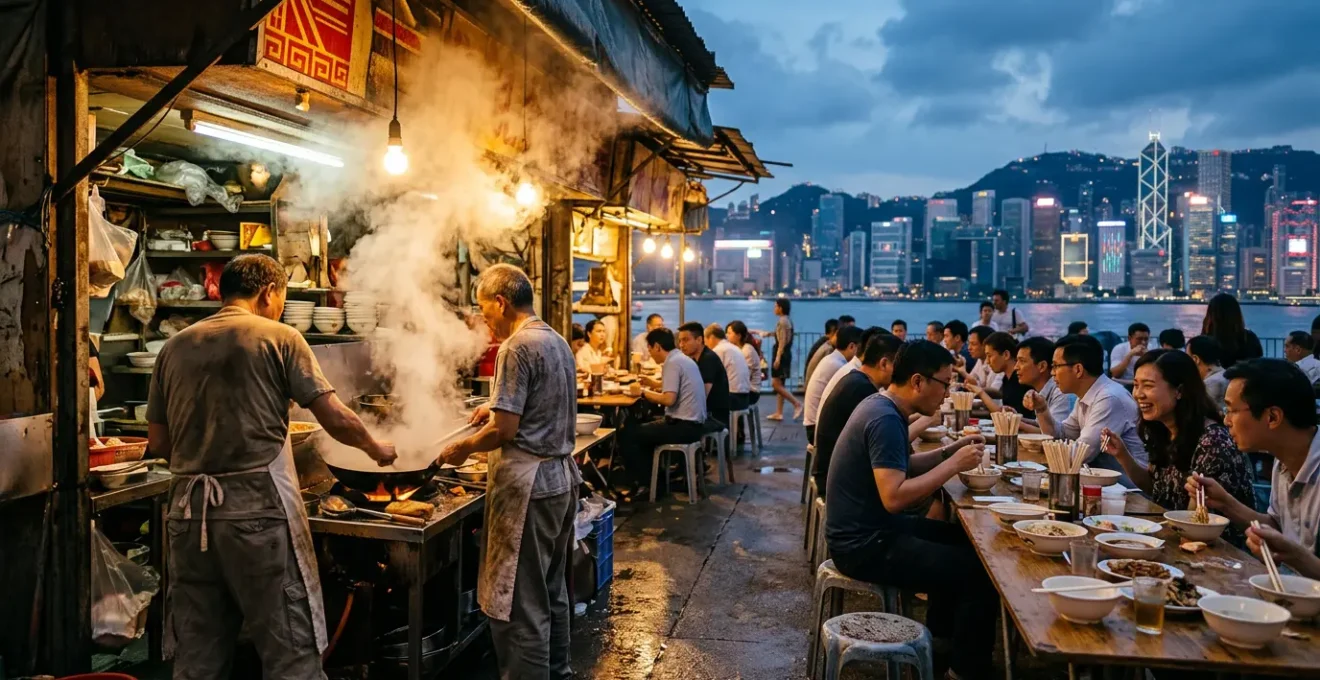
If the cha chaan teng is the city’s heart, the dai pai dong is its soul. These open-air food stalls are the living embodiment of Hong Kong’s scrappy, resilient, and unapologetically vibrant spirit. To eat at a dai pai dong is to experience the convergence of all the elements that define authentic local cuisine: masterful wok hei, the boisterous energy of yit naau, and a direct connection to the city’s culinary heritage. It is the final-act performance where all the skills and philosophies you’ve learned come together on one stage.
What makes this experience so essential is its fleeting nature. Dai pai dongs are an endangered species. While 17,154 restaurant licenses were active in Hong Kong as of early 2025, the government has severely restricted the issuance of new dai pai dong licenses for decades, meaning the existing stalls are irreplaceable relics. Many are closing due to high rents and the physically demanding nature of the work, making each meal a taste of disappearing history. This scarcity imbues the experience with a sense of urgency and preciousness.
Here, seated on a plastic stool at a rickety metal table, you will taste the most profound wok hei imaginable, generated by seasoned chefs working over roaring, jet-engine-like burners. The menu is a roll call of Cantonese classics, executed with raw power and precision. The cacophony of clanging woks, shouting cooks, and laughing diners is not a distraction; it is the soundtrack. It is the ultimate test for a serious eater—to look past the lack of polished decor and find the exquisite substance in the food, the energy, and the heritage. It is the most honest, unfiltered, and exhilarating meal the city has to offer.
Now that you are equipped with the foundational knowledge, the next step is to go out and apply it. Explore the back alleys, brave the noisy stalls, and start tasting with a newfound understanding, moving beyond the checklist and into the heart of the culture.