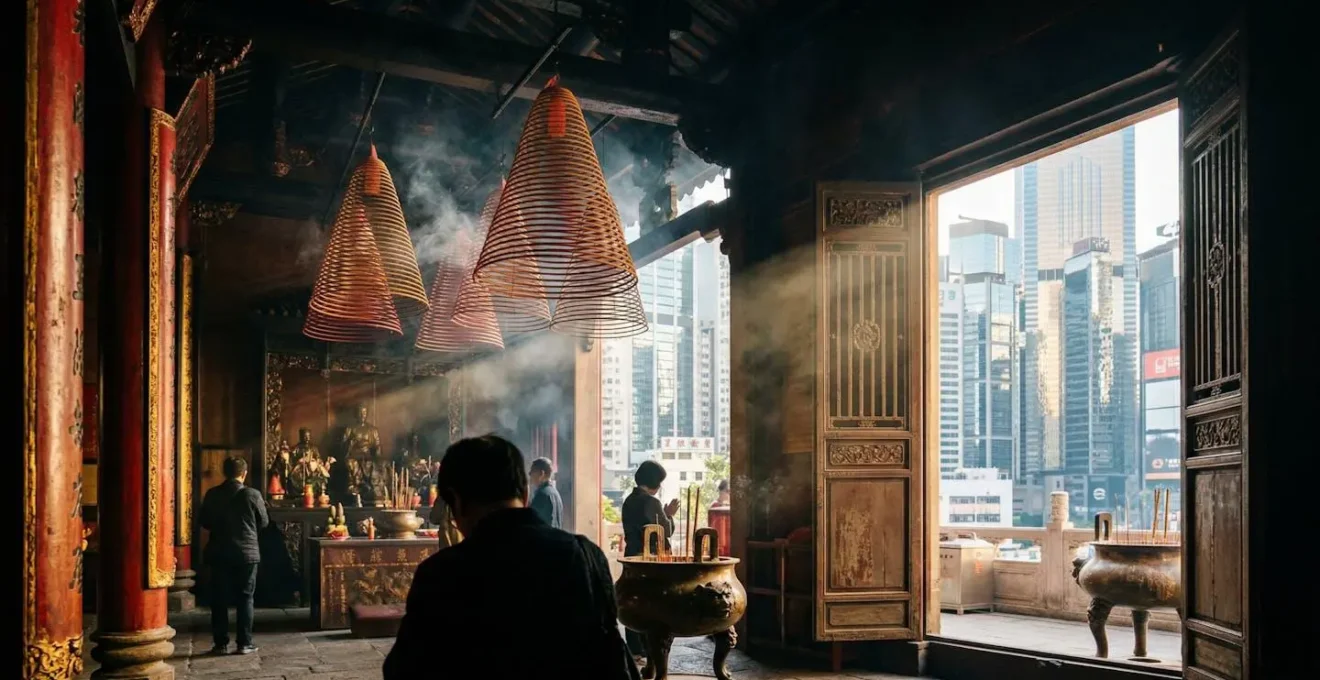
Many travelers see Hong Kong’s traditions as quaint photo-ops. The reality is that each ritual, from the smoke-filled temples to the very shape of skyscrapers, operates on a deep ‘spiritual grammar’. Understanding this hidden cultural logic is the key to moving beyond a passive observer to a respectful participant, truly connecting with the city’s ancient soul that thrives within its modern shell.
The first impression of Hong Kong is almost always its breathtaking, vertical skyline—a forest of glass and steel that proclaims its status as a global financial titan. For many cultural travelers, the journey begins here, with a checklist of modern marvels and panoramic views from Victoria Peak. The search for the “real” Hong Kong often leads to a tour of its famous temples, a glimpse of a street market, and a feeling that something essential remains just out of reach.
The common advice is to simply observe, to tick boxes on an itinerary. But this approach often misses the point entirely. These traditions are not relics in a museum; they are living, breathing parts of the city’s identity. The true soul of Hong Kong is not merely seen but felt and understood. It lies in the invisible currents of energy considered when constructing a skyscraper, the silent language of offerings in a temple, and the communal joy of a festival.
But what if the key to unlocking this deeper experience wasn’t about seeing more, but about understanding better? This guide is built on that premise. We will move beyond the superficial to explore the ‘spiritual grammar’ of Hong Kong—the underlying cultural logic that gives meaning to its most fascinating traditions. It’s an invitation to shift from being a tourist who looks, to a traveler who comprehends.
This article will provide you with the context needed to not just witness these traditions, but to appreciate the intricate web of beliefs, history, and social practices that they represent. From decoding architecture to participating respectfully in ancient rituals, you will learn how to engage with the city on a more profound level.
Summary: Unlocking the Cultural Code of Hong Kong’s Traditions
- Why Do Skyscrapers Have Holes? The Feng Shui Explanation
- How to Behave in a Taoist Temple Without Offending Locals?
- What Is the ‘Villain Hitting’ Ritual Under Canal Road Flyover?
- The Disrespect Error: Photographing Worshipers Without Permission
- How to Join Traditional Festivals Even as a Foreigner?
- St John’s Cathedral vs Wong Tai Sin: What Do They Say About Faith?
- Why Is Jade More Valuable Than Gold in Traditional Culture?
- Visiting Man Mo Temple: How to Navigate the Incense Smoke and Rituals?
Why Do Skyscrapers Have Holes? The Feng Shui Explanation
One of the most striking features of Hong Kong’s skyline isn’t a new tower, but the deliberate, often massive, holes built into them. These aren’t architectural quirks; they are ‘dragon gates’, a powerful and practical application of feng shui. The cultural logic here is that mountains behind the city are the homes of celestial dragons. These dragons must have a clear path to the water to drink and bathe. Blocking their path with a solid wall of a building is believed to bring misfortune and bad financial luck.
By creating these openings, architects ensure the free flow of positive energy, or ‘qi’, carried by the dragons from the mountains to the harbor. This isn’t just a quaint belief; it’s a serious consideration in the city’s high-stakes real estate and corporate world. The iconic HSBC Main Building, for example, is famous for its open ground floor and carefully angled escalators, all designed to welcome positive qi. This practice demonstrates that in Hong Kong, ancient beliefs are not at odds with modernity but are integrated directly into its fabric.
The financial investment in this practice is substantial, confirming its importance beyond mere superstition. It is a common practice where, according to urban design research, many corporations in Hong Kong allocate a significant part of their annual budget for feng shui consultations. This is a testament to the enduring power of this tradition, proving that ensuring harmony between the built environment and the natural world is considered a sound business strategy.
How to Behave in a Taoist Temple Without Offending Locals?
Stepping into a Taoist temple like Wong Tai Sin is to enter a world of swirling incense, quiet devotion, and intricate ritual. For a visitor, the line between respectful observation and unintentional offense can be thin. Understanding the ‘spiritual grammar’ is crucial. The first principle is to recognize you are in a sacred space, not just a tourist attraction. This understanding should inform your every action, starting with your voice and demeanor. Maintain a contemplative and quiet presence.
Gestures carry significant weight. One of the most common errors is pointing at deities or altars with an index finger. This is considered highly disrespectful. Instead, if you need to gesture, use a full, open hand. Similarly, when navigating the temple, be mindful of thresholds. You should not step directly on the raised wooden thresholds of doorways, as they are believed to house guardian spirits. Step over them, ideally leading with your left foot when entering.
Participating in the rituals, even in a small way, is a profound gesture of respect. Here are some key guidelines for proper etiquette:
- Purchase incense at the temple entrance. Lighting and placing three sticks in a burner is an act of participation that is welcomed, even for non-believers.
- If you have questions, approach temple keepers during quiet periods, not when they are busy or in prayer.
- Learning a few basic Cantonese phrases like ‘m̀h’gōi’ (excuse me/thank you) and ‘jó sàhn’ (good morning) shows effort and is deeply appreciated.
These actions move you from a passive observer to a respectful participant, acknowledging the living spirituality of the place.
What Is the ‘Villain Hitting’ Ritual Under Canal Road Flyover?
Beneath the chaotic roar of the Canal Road Flyover in Causeway Bay, a unique and cathartic folk ritual takes place: ‘da siu yan’, or villain hitting. Elderly women, known as ‘poh pohs’, sit on small stools, armed with old shoes and stacks of paper effigies. For a small fee, they will perform a ceremony to curse your enemies, dispel bad luck, and protect you from nefarious influences. This might seem like a relic from a bygone era, but it is a powerful example of a living tradition adapting to modern anxieties.
The ritual is a visceral experience. The practitioner takes a paper representing your ‘villain’—which could be a specific person, a concept like ‘gossip’, or general misfortune—and beats it relentlessly with a shoe while chanting curses. The location itself is significant; the chaotic, dark ‘yin’ energy under the flyover is considered the perfect environment for dispelling evil spirits. The ceremony concludes with a blessing ritual to bring good fortune to the client.
Case Study: The Modernization of an Ancient Grudge
Is a difficult boss or a troublesome ex-partner causing you stress? The villain hitting ritual has evolved to accommodate such contemporary grievances. Practitioners now readily accept photos of antagonists shown on a smartphone, displaying them to the paper effigy before the beating commences. This adaptation demonstrates the incredible flexibility of Hong Kong’s folk traditions, proving they are not static but are constantly evolving to serve the emotional and psychological needs of a modern, high-stress society.
The service offers a fascinating glimpse into the symbolism of folk beliefs. The following table breaks down the components of the ritual, showing how traditional elements are now interpreted in a modern context, as detailed in cultural guides by the Hong Kong Tourism Board.
| Service Element | Traditional Purpose | Modern Adaptation |
|---|---|---|
| Paper Tiger Beating | Subdue the ‘White Tiger’ star governing disputes | General stress relief and catharsis |
| Old Shoe Usage | Traditional tool for hitting paper effigies | Symbolic ‘stepping on’ problems |
| Photo/Name Paper | Written names on paper | Smartphone photos accepted |
| Blessing Ritual | Conclude with protection prayers | Positive affirmations for client’s future |
The Disrespect Error: Photographing Worshipers Without Permission
In the visually stunning environment of a temple, it’s tempting to start snapping photos indiscriminately. However, one of the most significant cultural blunders a visitor can make is photographing worshippers during their private moments of devotion without their explicit permission. This isn’t just about privacy; it’s about a deep-seated spiritual belief that the act of photography can be disruptive to the sacred connection being made. A camera is seen not as a neutral observer, but as an active intruder.
The cultural logic here is multifaceted. For many, prayer is an intensely personal and vulnerable act. Intruding upon it with a lens is seen as profoundly disrespectful. More than that, there are spiritual implications. As the Hong Kong Tourism Board explains in its official guidelines, the act of being photographed can be seen as an interruption of a spiritual process. This belief underscores the importance of viewing a temple as a house of worship first and a photo opportunity second.
For some worshippers, a camera flash can be seen as disturbing the spirits, interrupting a prayer’s connection to the divine, or capturing a part of someone’s soul.
– Hong Kong Tourism Board, Hong Kong Temple Etiquette Guidelines
This doesn’t mean your camera must stay in its bag. The key is to shift your focus from people to place. Temples are rich with detail that tells a story of faith and history. Instead of capturing faces, document the atmosphere and artistry of the space itself. Here are some respectful alternatives:
- Capture the rich texture of ancient wood darkened by decades of incense smoke.
- Photograph the vibrant colors and careful arrangements of fruit offerings on the altars.
- Focus on the intricate patterns on bronze incense burners and other ceremonial objects.
- Document the architectural details, like the beautifully carved beams and painted ceilings.
- Shoot the massive, spiraling incense coils from a low angle, avoiding anyone praying beneath them.
–
How to Join Traditional Festivals Even as a Foreigner?
Hong Kong’s calendar is punctuated by vibrant, noisy, and colorful festivals that offer an unparalleled window into its cultural heart. From the raucous dragon boat races to the solemn reverence of the Tin Hau Festival, these events are not just for locals. Foreigners are often welcome to join, provided they do so with an attitude of respectful curiosity rather than as mere spectators. The key is to understand the meaning behind the celebration.
The Tin Hau Festival, celebrating the Goddess of the Sea, is a perfect example. With over 60 Tin Hau temples across Hong Kong, this festival is a testament to the city’s deep maritime roots. Celebrations often involve colorful ‘fa pau’ (floral wreaths) parades, Cantonese opera performances, and lion dances. To participate, simply find a local temple during the festival period (the 23rd day of the third lunar month) and respectfully observe the proceedings. Buying a small offering or simply watching the opera with the neighborhood crowd is a form of participation.
For more active participation, the Cheung Chau Bun Festival is legendary. While climbing the bun towers is reserved for trained competitors, visitors can immerse themselves in the carnival-like atmosphere, watch the Piu Sik (Floating Colours) Parade featuring children in elaborate costumes, and sample the ‘ping on’ (peace) buns. The best way to join is to arrive early, be patient with the crowds, and show appreciation for the performers and organizers. Your enthusiasm and respect are your ticket to being welcomed into the fold.
St John’s Cathedral vs Wong Tai Sin: What Do They Say About Faith?
The spiritual landscape of Hong Kong is a study in contrasts, beautifully encapsulated by two of its most significant religious sites: the Anglican St. John’s Cathedral and the Taoist Wong Tai Sin Temple. They are more than just places of worship; their very architecture and the rituals performed within them tell a story of the city’s dual heritage. One represents the stoic, ordered legacy of British colonialism, while the other embodies the vibrant, eclectic nature of Chinese folk religion.
St. John’s, with its Gothic style, directs the eyes and soul upward, toward a single, transcendent God. Worship is structured, communal, and often characterized by silent contemplation and harmonious hymns. Wong Tai Sin, on the other hand, is a sprawling complex of 18,000 square meters, designed not for a single deity but for a pantheon. It is a syncretic temple, housing elements of Buddhism, Taoism, and Confucianism under one roof. Its energy is loud, chaotic, and deeply personal, with individuals engaging in loud, personal rituals involving incense, offerings, and the shaking of ‘kau chim’ (fortune-telling sticks).
This comparison reveals two fundamentally different approaches to faith. The Cathedral is a symbol of a structured, institutionalized Western tradition, while the Temple represents a grassroots spiritual center that has long served the local Chinese population’s daily needs—from healing to fortune-telling. The table below highlights these key distinctions.
| Aspect | St John’s Cathedral | Wong Tai Sin Temple |
|---|---|---|
| Architectural Style | Gothic – directs eyes upward to single God | Traditional Chinese – sprawling complex for multiple deities |
| Religious Approach | Monotheistic, structured worship | Syncretic – houses Buddhism, Taoism, Confucianism |
| Prayer Style | Silent contemplation, communal hymns | Loud, individual rituals with incense and kau chim sticks |
| Historical Significance | Symbol of British colonial rule and Western tradition | Grassroots spiritual center for local Chinese population |
Why Is Jade More Valuable Than Gold in Traditional Culture?
In the West, gold is the ultimate symbol of wealth and status. In Chinese culture, that honor belongs to jade. To understand this, one must look beyond monetary value to the stone’s profound spiritual and philosophical significance. Jade is not merely an adornment; it is considered a bridge between heaven and earth, embodying virtues like purity, wisdom, and immortality. It’s a belief beautifully captured in a timeless proverb.
Gold has a price, but jade is priceless.
– Traditional Chinese Proverb
This “priceless” nature is rooted in its perceived properties. It is believed that jade absorbs the ‘qi’ of its wearer, becoming a part of them and protecting them from harm. A jade bangle that breaks is thought to have sacrificed itself to protect its owner from an accident. The stone’s cool, smooth texture is associated with tranquility, and its subtle, inner glow is seen as a reflection of the wearer’s inner virtue. This is why a piece of heirloom jade, passed down through generations, carries an emotional and spiritual weight that gold can never match.
Case Study: The Hutton-Mdivani Necklace Auction
In 2014, the ‘priceless’ nature of jade was given a very specific price tag at a Sotheby’s auction in Hong Kong. The Hutton-Mdivani necklace, a remarkable Cartier piece featuring 27 exquisite jadeite beads, was sold for over $27.4 million, more than double its estimate. This set a world record for the most expensive jadeite jewel ever sold, demonstrating that the cultural reverence for high-quality jade translates into staggering financial value in the modern marketplace.
Your Action Plan: Verifying Authentic Jade
- Check for translucency: Hold the jade up to a light source. Quality jade should have a radiant glow that seems to come from within.
- Test the texture: Run your finger along the surface. It should feel smooth, dense, and cool to the touch.
- Listen to the sound: Gently tap it with another hard object. High-quality jadeite produces a clear, high-pitched chime, almost like a small bell.
- Look for even color: Examine the color distribution. While natural variations exist, be wary of blotches or unnaturally uniform colors that could indicate dye.
- Examine for ‘Grade A’ designation: Ask the seller if the piece is ‘Grade A’ jadeite, which means it is 100% natural, having only been carved, polished, and waxed, with no chemical treatments.
Key takeaways
- Hong Kong’s traditions are a living force, constantly adapting to the modern world, as seen in business-focused feng shui and modernized folk rituals.
- The core of a meaningful cultural experience lies in respectful participation—understanding and adhering to local etiquette—rather than passive observation.
- True immersion comes from understanding the “why” behind each practice, whether it’s the spiritual value of jade or the layout of a temple.
Visiting Man Mo Temple: How to Navigate the Incense Smoke and Rituals?
Man Mo Temple on Hollywood Road is one of Hong Kong’s oldest and most atmospheric temples. The air inside is thick with smoke from giant, suspended incense coils, creating a mystical, otherworldly environment. Navigating this space requires an understanding of its dual purpose. The temple is dedicated to two deities: Man Tai, the God of Literature, and Mo Tai, the God of War. This dedication makes it a popular site for students praying for academic success and for those seeking strategic wisdom or justice.
The most overwhelming sensory experience is the incense. The large conical coils, which can burn for weeks, are purchased by patrons as long-term offerings. To navigate the smoke, simply move slowly and be mindful. If you find it too intense, you can step into the small courtyards for fresh air. The smoke is not just a byproduct; it is the vehicle that carries prayers and wishes up to the heavens. By being present in the space, you are witnessing thousands of hopes made tangible.
Case Study: The Two Scholars of Man Mo
The temple, dating from 1847, is dedicated to two figures believed to have been real people. Man Tai is a 3rd-century bureaucrat named Cheung Ah Tse, represented holding a calligraphy brush. Mo Tai is the 2nd-century warrior Kwan Wan Chung (also known as Kwan Yu), depicted holding a sword. This warrior deity is also revered as the patron of restaurants, pawnshops, and even the secret Triad societies. Inside the main hall, you can see two ornate sedan chairs, historically used to carry the statues of these gods during festivals, grounding the divine in tangible, processional ritual.
Observing the rituals here provides a final lesson in Hong Kong’s spiritual grammar. You will see people shaking ‘kau chim’ sticks until one falls out, then taking it to a soothsayer to have their fortune told. You will see offerings of food and paper money. Rather than interrupting, find a quiet corner to stand and watch. Witness the fusion of personal devotion, historical reverence, and the raw, smoky power of collective faith. It is in these quiet moments of informed observation that the soul of the city truly reveals itself.
Now equipped with an understanding of this cultural grammar, your next visit to a Hong Kong temple or market is no longer just a tour. It’s an opportunity for a meaningful connection. Approach these sacred and traditional spaces not just with your camera, but with informed respect and curiosity.