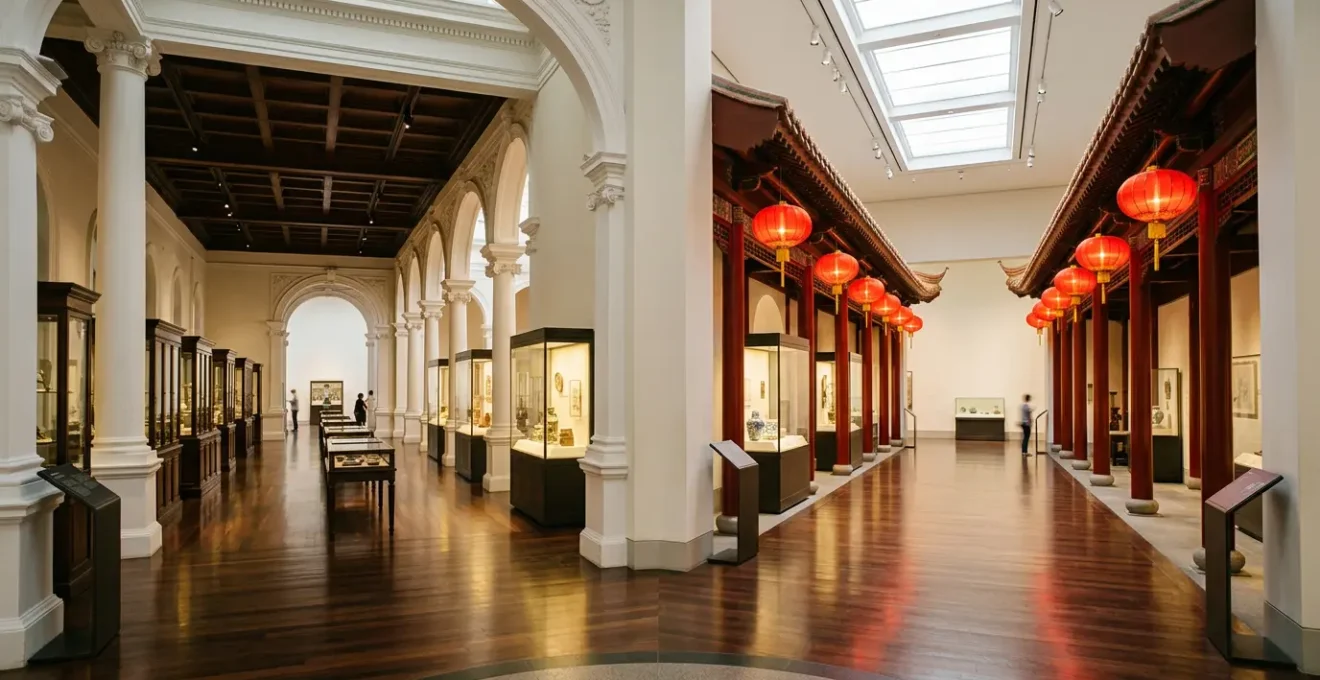
Hong Kong’s museums are not passive archives but active battlegrounds where the city’s identity is constantly being redefined through curatorial choices.
- The colonial-era “barren rock to metropolis” story is being systematically replaced by a narrative emphasizing a “monolithically Chinese” identity rooted in national history.
- Key historical events are often strategically omitted or reframed to support the dominant political narrative of the moment, revealing as much in their absence as in their presence.
Recommendation: When visiting, analyze not just what is displayed, but how it is framed and, most importantly, what is missing to truly understand the competing visions for Hong Kong’s past and future.
The phrase “East meets West” has long been the default descriptor for Hong Kong, evoking images of a seamless blend of cultures, a dynamic hub where colonial heritage and Chinese tradition coexist. This convenient summary, however, masks a far more complex and contentious reality. History in Hong Kong is not a settled matter; it is a fluid, contested space, and nowhere is this struggle more apparent than within the quiet, climate-controlled halls of its museums. While many visitors seek a simple timeline of events, they are instead stepping into an arena of profound political and ideological significance.
The common narrative of a “barren rock” transformed into a global metropolis by British ingenuity is a story that has long defined the colonial perspective. Yet, this view is increasingly challenged by a national narrative that reasserts Hong Kong’s deep-rooted, uninterrupted connection to China. This is not merely an academic debate. It is a deliberate process of narrative displacement, where one version of history is actively dismantled to make way for another. This article deconstructs how these conflicting narratives are presented, examining the specific curatorial choices, strategic omissions, and semantic shifts that reveal the ongoing battle for Hong Kong’s soul.
This analysis will guide you through the key exhibits and historical periods, revealing the subtle and overt ways in which history is curated. We will explore how the city’s past is framed, what stories are amplified, and which are silenced, providing you with a critical lens to see beyond the glass displays.
Table of Contents: Navigating the Dueling Histories in Hong Kong’s Museums
- Why Is the ‘Barren Rock to Metropolis’ Narrative Considered Simplistic?
- How Does the Opium War Exhibit Shape Local Identity Today?
- What Remains of the WWII Japanese Occupation in the City’s Memory?
- Where to Listen to Oral Histories of the Boat People (Tanka)?
- How Has the Historical Narrative Changed Since the Handover?
- How to Navigate the Massive Exhibits in Under 3 Hours?
- Why is Hong Kong Called the Place Where ‘East Meets West’?
- Why Living in Hong Kong’s Vertical City Changes Your Perspective on Space?
Why Is the ‘Barren Rock to Metropolis’ Narrative Considered Simplistic?
The “barren rock to metropolis” narrative served as the ideological foundation of British colonial rule in Hong Kong. It portrays the island as an insignificant, sparsely populated landmass before the arrival of the British, who then single-handedly engineered its transformation into a thriving global financial center. This framing legitimizes colonial intervention as a project of creation and modernization. However, this perspective is a deliberate oversimplification that erases a rich and complex pre-colonial history.
This narrative is fundamentally challenged by extensive archaeological evidence. Far from being barren, the region has a history of human activity and settlement with archaeological findings dating back 6,000 years. These discoveries point to sophisticated Neolithic cultures and a long history of maritime trade and settlement that predates the British by millennia. The colonial narrative’s endurance was less about historical accuracy and more about political expediency.
The lack of focus on this deeper history during the colonial period was not an oversight but a feature of policy. As one academic analysis points out, the colonial administration was largely uninterested in fostering a local cultural identity that could challenge its authority. This resulted in a state of what has been described as curatorial neglect.
The prolonged absence of public museum services stemmed from the colonial government’s indifference and disorientation towards cultural provision.
– R.K.W. Tsang, The ‘death’ and ‘rebirth’ of museums in colonial Hong Kong
By minimizing the pre-1841 past, the colonial government could position itself as the sole author of Hong Kong’s success story. Today, museums are actively working to dismantle this simplistic view, bringing the region’s ancient history to the forefront to build a narrative of long-standing Chinese heritage.
How Does the Opium War Exhibit Shape Local Identity Today?
The Opium Wars (1839-1860) represent a critical juncture in Hong Kong’s history and are a focal point of narrative conflict. For the British, the conflict was primarily about free trade and opening Chinese markets. For China, it marks the beginning of the “Century of Humiliation,” a period of foreign subjugation and territorial loss, with the ceding of Hong Kong as its original wound. Museum exhibits on this topic are therefore not just historical displays; they are powerful tools for shaping contemporary identity.
In the post-handover era, the narrative has decisively shifted to align with the national perspective. The wars are framed as a clear act of British aggression fueled by the immoral opium trade. Artifacts are curated to emphasize Chinese resistance and the devastating social impact of opium addiction. This interpretation serves to reinforce a victim narrative and bolster patriotic sentiment, positioning Hong Kong’s “return” to the motherland as the righting of a historical wrong. This represents a form of semantic warfare, where the language of “trade conflict” is replaced with “imperialist aggression.”
The visual presentation of these exhibits is key. As suggested by the image, lighting, placement, and labeling can create starkly different atmospheres. One side might emphasize the economic context, while the other focuses on national suffering. This dualism is at the heart of Hong Kong’s identity struggle. For older generations who grew up under British rule, the legacy of the Opium Wars may be viewed through a more economic or pragmatic lens, while for younger generations educated under the post-1997 system, it is an unambiguous story of national humiliation and resilience.
What Remains of the WWII Japanese Occupation in the City’s Memory?
The Japanese occupation of Hong Kong during World War II is another cornerstone of the city’s historical memory, one that is often curated to fit a broader political narrative. After a brief but fierce battle, the colony endured occupation for three and a half years, from December 1941 to August 1945. This period was marked by extreme hardship, food shortages, and brutal military rule. While a shared trauma for all residents, its presentation in museums has evolved to serve different purposes.
Under British rule, the narrative often centered on the valiant but doomed defense by British, Canadian, and Indian troops, and the subsequent resistance efforts supported by the colonial administration. In recent years, the emphasis has shifted. The story is now increasingly framed within the larger context of China’s nationwide War of Resistance against Japan. The role of mainland-backed guerrilla fighters, such as the East River Column, is given greater prominence, highlighting a narrative of unified Chinese patriotism.
Case Study: The Hong Kong Museum of Coastal Defence
A prime example of this narrative reframing is the Hong Kong Museum of Coastal Defence. The museum is located in a restored British colonial fortress at Lei Yue Mun, a key defensive position. Its permanent exhibition focuses heavily on the 1941 Battle of Hong Kong, where Japanese forces ultimately overran the fortifications. By housing this story in a British-built structure, the museum performs a powerful act of narrative displacement. The colonial-era fort becomes the stage for a story of Chinese national struggle, subtly subordinating the British role to the broader anti-Japanese war effort led by mainland China.
This shift serves to strengthen Hong Kong’s connection to the national identity, presenting its wartime experience not as a separate colonial event but as an integral chapter in China’s modern history. It allows the memory of the occupation to be used as a tool for patriotic education, emphasizing shared struggle and eventual liberation as part of a unified nation.
Where to Listen to Oral Histories of the Boat People (Tanka)?
Beyond the grand narratives of colonial power and national destiny lies the history of communities like the Tanka, or “boat people.” As a distinct ethnic group with a maritime culture stretching back centuries, their story fits uneasily into either the British or the mainland Chinese version of Hong Kong’s past. They are neither colonizers nor Han settlers, representing an indigenous layer of history that is often overlooked. Listening to their oral histories offers a crucial counter-narrative, a perspective from the margins that enriches and complicates the official accounts.
The Tanka have historically faced discrimination from land-based society and were often excluded from the official chronicles. Their memories, passed down through generations, speak of a different Hong Kong—one defined by typhoons, fishing seasons, and a deep connection to the sea. These stories are part of the unspoken archive of the city, existing outside the formal museum context. Accessing them requires a more proactive approach, moving beyond the main exhibition halls to engage with living heritage and specialized archives.
Finding these voices is an act of historical recovery. It allows one to understand the lived experiences of those who were present long before Hong Kong became a geopolitical focal point and whose identities continue to be negotiated in the face of rapid modernization. Fortunately, several institutions and community initiatives are working to preserve and share these invaluable perspectives.
Action Plan: Accessing Tanka Oral Histories
- Contact Points: Start by visiting the Hong Kong Memory Project’s online archives, which often feature digitized oral history recordings from various communities.
- Inventory Collection: Explore the Hong Kong Heritage Museum’s permanent collections, which focus on living traditions and may include artifacts and stories related to the Tanka.
- Assess Coherence: Access the research archives of the Hong Kong Museum of History, which hold materials on the lives of ordinary people in 19th and 20th-century Hong Kong.
- Identify Uniqueness: Schedule a guided tour in traditional fishing villages like Aberdeen or Tai O for direct cultural immersion and opportunities to hear stories from community members.
- Integration Plan: Connect with local NGOs and heritage groups dedicated to preserving Hong Kong’s maritime culture, as they often run community programs and oral history projects.
How Has the Historical Narrative Changed Since the Handover?
The 1997 handover of Hong Kong from British to Chinese sovereignty was the single most significant catalyst for the revision of its historical narrative. Since then, there has been a systematic and deliberate effort to re-center Hong Kong’s story within the grand narrative of the Chinese nation. This process accelerated significantly following a major renovation of the Hong Kong Museum of History, which had previously welcomed a vast audience.
The pre-renovation permanent exhibit, “The Hong Kong Story,” was widely praised for its nuanced and comprehensive portrayal of the city’s past, including its colonial development and unique local culture. After receiving over 10 million visitors, the exhibit was closed in 2020 for a major overhaul. The new exhibits, rolled out in phases, reflect a clear ideological shift. The emphasis is now placed on Hong Kong’s ancient past as part of China, its role in national development (such as the Reform and Opening-Up), and its integration into the Greater Bay Area.
This shift is not subtle. It is a conscious project of identity-building, designed to foster a sense of national belonging. Key events that complicate this narrative, such as the 1967 anti-colonial riots or the annual vigils for the 1989 Tiananmen Square crackdown, are conspicuously absent from the new displays. This curation by omission is a powerful tool. What is left unsaid is often as important as what is displayed. This has led critics and academics to point out the move towards a more singular, state-approved version of history.
Identity as monolithically Chinese and rooted in a unilinear narrative of the local past.
– Mark Vickers, International Journal of Heritage Studies 2024
This curatorial direction aligns with the political goals of integrating Hong Kong more deeply into the mainland, moving away from a distinct local identity towards a unified national one. The museum has transformed from a space that reflected a hybrid, complex identity into one that primarily projects a singular, patriotic one.
How to Navigate the Massive Exhibits in Under 3 Hours?
For a critical thinker, visiting a museum like the Hong Kong Museum of History is not about passively absorbing information but about actively deconstructing it. Given the extensive collections and the underlying political currents, a strategic approach is essential to gain a meaningful understanding in a limited time. It’s not about seeing everything, but about knowing *how* to look. The key is to treat your visit as an analytical exercise, focusing on comparison and identifying narrative priorities.
Start by prioritizing the galleries that are most ideologically significant. The new National Security Exhibition Gallery, for instance, offers a direct window into the state’s current priorities and how it wishes to frame concepts of stability and foreign interference. From there, move to exhibits on different historical periods and compare the terminology used. Does a label describe an event as a “riot,” a “protest,” or an “uprising”? This semantic warfare reveals underlying biases. Pay close attention to the amount of space and prominence given to different topics—this is the museum’s spatial politics at play.
A crucial part of this critical navigation is documenting what is missing. The “Hong Kong Story” was notable for including difficult topics like the 1967 riots and the 1989 Tiananmen Square crackdown’s impact on the city. Note their absence in the new galleries. For a more guided perspective, consider joining one of the museum’s free guided tours, which are often available on weekends. While these tours present the official narrative, listening to the docent’s explanations can be highly revealing. Note that these guided tours accommodate up to 20 participants, so booking in advance may be wise.
Why is Hong Kong Called the Place Where ‘East Meets West’?
The “East meets West” cliché is the most enduring and popular narrative of Hong Kong. It suggests a harmonious fusion, a city that successfully synthesized British administrative and legal systems with Chinese culture and entrepreneurial spirit. This narrative was particularly potent during the late colonial era, as it celebrated Hong Kong’s unique status and economic success. Museums have historically played a key role in promoting this image, showcasing the city’s multicultural fabric and its role as a global bridge.
The museum’s official stance often reflects this ideal of balance, with curatorial teams aiming to present a complex history without overt bias. As one research team noted, there is a conscious effort to handle these intersecting stories with care. This is often achieved through dedicated exhibits that explore the diverse communities contributing to Hong Kong’s development.
Case Study: The ‘Multifaceted Hong Kong’ Exhibition Series
The Hong Kong Museum of History’s ‘Multifaceted Hong Kong’ exhibition series is a direct attempt to explore this complexity. It moves beyond a simple British-Chinese binary to explore the contributions of various ethnic groups. For example, it has featured exhibitions on the Hong Kong Portuguese (Macanese) community and the deep connections between Hong Kong and overseas Chinese communities, such as those in California. These exhibits provide a more granular and nuanced understanding of the “East meets West” concept, showing it to be a web of global connections rather than a simple two-way street.
However, for the critical observer, the “East meets West” narrative can also function as a form of curatorial anesthesia. It presents a sanitized, marketable version of history that downplays the inherent power imbalances, racial tensions, and political struggles of the colonial period. While celebrating multiculturalism, it can inadvertently obscure the fact that for most of its history, Hong Kong was a society with a clear racial and class hierarchy. The narrative is appealing because it is simple and positive, but it risks glossing over the very conflicts that truly shaped the city.
Key Takeaways
- Historical narratives in museums are not neutral; they are actively constructed to support specific political and cultural identities, shifting from a colonial to a national focus.
- A critical analysis of museum exhibits requires paying attention to omissions, terminology changes (semantic warfare), and the physical layout of displays (spatial politics).
- The popular “East meets West” cliché, while appealing, often masks the deep-seated political tensions and power imbalances that have truly defined Hong Kong’s history.
Why Living in Hong Kong’s Vertical City Changes Your Perspective on Space?
Hong Kong’s physical reality as a “vertical city” offers a powerful metaphor for understanding its layered history. Just as the city’s limited land forces it to build upwards, creating dense, superimposed layers of life, its history is composed of superimposed narratives—colonial, national, and local—all competing for space within the same finite territory. The Hong Kong Museum of History, occupying a vast 17,500 square meters, is a microcosm of this dynamic, attempting to contain these sprawling, overlapping stories within its walls.
Living in or visiting such a dense urban environment reshapes one’s perception of space and relationships. Neighbors live separated by mere inches of concrete, and public and private spaces bleed into one another. This physical experience parallels the historical one: different eras and ideologies are not neatly separated but are pressed up against each other. A colonial-era police station stands next to a Bank of China skyscraper; a traditional Taoist temple is shaded by a luxury apartment complex. The museum’s archives function as the city’s memory bank for this very process.
Case Study: Understanding Urban Evolution Through Archives
The museum’s research into the development of districts like Tsim Sha Tsui and Yau Ma Tei demonstrates how historical archives are used to understand this vertical and horizontal layering. By examining land reclamation, transport development, and commercial trade patterns, researchers can trace how the city’s “changing facets” have been built one on top of the other. This archival work provides the raw material for the narratives—conflicting or otherwise—that are ultimately presented to the public.
Ultimately, to understand Hong Kong is to understand the art of reading these layers. It requires seeing the city not as a flat timeline but as a vertical cross-section, where the foundations of an ancient past support a colonial structure, which is now being incorporated into a new national edifice. Each layer remains visible, and the tension between them is what gives the city its unique, and often fraught, character.
This critical, layered perspective is your most powerful tool. The next time you visit a museum—in Hong Kong or anywhere else—look not only at what is displayed, but question how it is framed, what is absent, and whose story is being elevated. That is how you truly begin to read history.