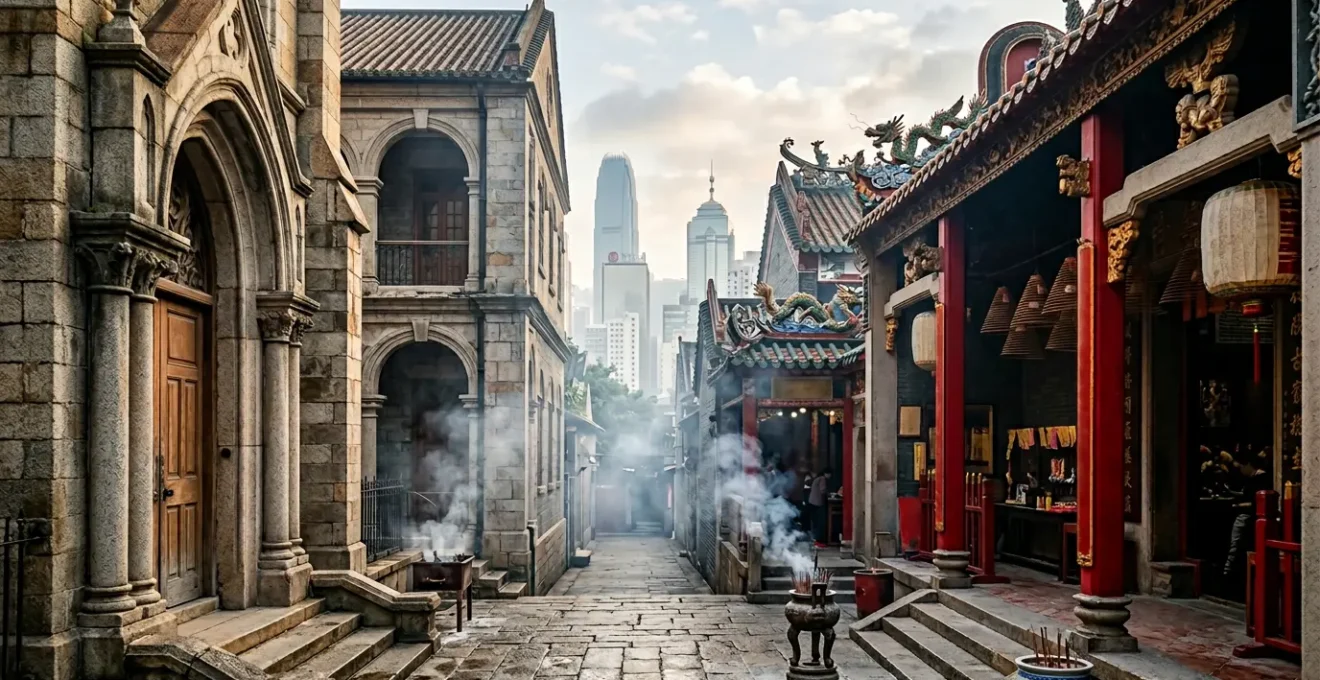
Hong Kong’s architecture is not a simple “East meets West” fusion but a readable text of ongoing power negotiations and contested identity.
- Colonial structures and Chinese heritage sites are not separate attractions but participants in an architectural dialogue about history and authority.
- Viewing these monuments is a politically relevant act, as their meanings are constantly being redefined in post-colonial Hong Kong.
Recommendation: Approach the city as a “cultural detective,” looking for points of friction and fusion in buildings, museums, and even public spaces to decipher its true, complex soul.
To walk through Hong Kong is to be caught in a fascinating architectural crosscurrent. The stern, neoclassical façade of a former colonial administrative building stands just streets away from a temple courtyard swirling with incense smoke and the murmur of prayers. The common narrative simplifies this into the convenient, almost tired cliché of “East meets West.” It paints a picture of a harmonious melting pot, a city where two cultures coexist peacefully, side-by-side. This postcard image, however, is a profound oversimplification that a history buff cannot accept at face value.
The truth is far more complex and compelling. This is not a static collage but a dynamic, and often tense, negotiation of power, memory, and identity, physically inscribed onto the very fabric of the city. The colonial buildings were not just shelters; they were proclamations of power and order. The temples and ancestral halls are not mere relics; they are anchors of a civilization and identity that long predated the arrival of the British. To truly understand Hong Kong’s dual soul, one must move beyond admiring the aesthetics and learn to read the story being told by its built environment—a story of friction, fusion, and the continuous struggle to define what it means to be Hong Kong.
This guide provides a historian’s framework for doing just that. We will explore how these seemingly disparate structures are in constant dialogue, examining their role in shaping faith, identity, and the city’s narrative. By learning to see the city this way, you will transform a simple visit into a deep, intellectual engagement with one of the world’s most complex urban landscapes.
The following sections provide a structured path to decode this architectural dialogue. From the sacred spaces that define faith to the museum exhibits that shape memory, we will dissect the layers of meaning embedded in Hong Kong’s most significant sites.
Summary: A Historian’s Framework for Reading Hong Kong’s Urban Narrative
- St John’s Cathedral vs Wong Tai Sin: What Do They Say About Faith?
- Why is Hong Kong Called the Place Where ‘East Meets West’?
- How to Walk the Ping Shan Heritage Trail to See Ancient Clans?
- The Mistake of Ignoring the Colonial Past When Viewing Monuments
- When to Visit Museums to Catch Special Historical Exhibitions?
- Why Did Colonial Dignitaries Always Stay at These Hotels?
- How Does the Opium War Exhibit Shape Local Identity Today?
- How to Navigate the Massive Exhibits in Under 3 Hours?
St John’s Cathedral vs Wong Tai Sin: What Do They Say About Faith?
The spiritual landscape of Hong Kong is a powerful starting point for understanding its dual identity. It’s a city where, according to official statistics, there are over 1 million Buddhists and over 1 million Taoists living alongside hundreds of thousands of Christians. This demographic reality finds its physical expression in the city’s places of worship. Consider the stark contrast between St. John’s Cathedral, an Anglican bastion of Gothic Revival architecture, and the Sik Sik Yuen Wong Tai Sin Temple, a vibrant hub of Taoist, Buddhist, and Confucian practice. The former embodies a colonial legacy of ordered, quiet contemplation within its stone walls and vaulted ceilings. Its very design speaks to a structured, hierarchical faith imported from the West.
In contrast, Wong Tai Sin is a multi-sensory explosion of colour, sound, and smell. It is not just a place for worship but a bustling community centre for spiritual guidance. Here, faith is an active, participatory experience, most famously through the practice of ‘kau cim’ or fortune-telling, where devotees seek divine answers to everyday problems. The architectural dialogue is clear: one represents a faith brought by a colonial power, emphasizing order and solemnity; the other represents an indigenous, syncretic spirituality that is deeply integrated into the daily, practical lives of its followers. They are not just buildings; they are competing philosophies of the sacred made manifest.
Why is Hong Kong Called the Place Where ‘East Meets West’?
The phrase “East meets West” is the most common and least insightful description of Hong Kong. It suggests a simple, harmonious blending, like two colours mixing neatly. A more critical historical perspective reveals a far more complex reality. As writer Brian Cheng noted in the Hong Kong Free Press, this is a misleading oversimplification. He argues:
‘East meets West’ is an oversimplification. It’s not a harmonious meeting but a constant, dynamic negotiation.
– Brian Cheng, Hong Kong Free Press
This concept of “dynamic negotiation” is the key to understanding the city. It wasn’t a meeting of equals, but an interaction defined by the power structures of colonialism. Nowhere is this more visible than in the ‘Tong Lau’ or shophouse architecture. These iconic buildings, which emerged in the late 19th and early 20th centuries, are a perfect example of architectural fusion born from necessity and cultural exchange. They combine Southern Chinese typologies—with shops on the ground floor and residences above—with European elements like moulded cornices, large windows, and small balconies. This was not a purely aesthetic choice; it was a practical adaptation of living styles, a hybrid form that speaks volumes about the daily interactions and compromises between Chinese inhabitants and colonial governance.
How to Walk the Ping Shan Heritage Trail to See Ancient Clans?
To understand the impact of colonialism, one must first appreciate what was there before. The Ping Shan Heritage Trail in the New Territories offers a rare and immersive journey into Hong Kong’s pre-colonial past. This is not just a collection of old buildings; it is the ancestral heartland of the Tang clan, who settled here in the 12th century. The trail itself spans just 1.6 kilometers, linking 14 historic buildings that map out a powerful feudal society. A walk along this trail is a walk through a landscape of power, education, and spiritual belief that existed long before the Union Jack was raised.
Your journey should begin at the Ping Shan Tang Clan Gallery, housed in the former police station, to gain crucial historical context. From there, the trail leads you to the magnificent Tang Ancestral Hall, a 700-year-old structure that was the centre of clan governance and worship. Nearby, the Yu Kiu Ancestral Hall served a similar purpose for other branches of the clan. A crucial stop is the Tsui Sing Lau Pagoda, Hong Kong’s only ancient pagoda, built not for worship but for improving the area’s feng shui—a clear testament to the cosmological beliefs that shaped the landscape. Finally, visiting the Kun Ting Study Hall, where scholars prepared for imperial civil service examinations, and the walled village of Sheung Cheung Wai provides a complete picture of a self-sufficient, highly organized society. This trail reveals the deep roots that the British colonial project was superimposed upon.
The Mistake of Ignoring the Colonial Past When Viewing Monuments
Viewing a colonial-era building in Hong Kong as a mere historical artifact is a profound error. These are not static objects in a dusty museum; they are living monuments whose meanings are actively being contested and renegotiated in the 21st century. As Hong Kong architectural historians have argued, the interpretation of these sites is a politically relevant act. The narrative surrounding them is constantly shifting, reflecting the city’s evolving relationship with its own past.
A prime example of this is the Tai Kwun Centre for Heritage and Arts. This sprawling complex was once the nexus of colonial law and order: the Central Police Station, Central Magistracy, and Victoria Prison. For decades, it was a symbol of British authority and control. Today, it has been meticulously restored and transformed into a vibrant cultural hub, hosting art exhibitions, performances, and chic restaurants. This transformation is a physical manifestation of post-colonial identity negotiation. The site doesn’t erase its past; it repurposes it, forcing a dialogue between its grim history and its contemporary cultural function. By preserving the architecture while completely changing its use, Tai Kwun forces visitors to confront the complex legacy of colonialism, making it, as one analysis notes, a site where the meaning of monuments is not static. To ignore this political dimension is to miss the most important story the building tells.
When to Visit Museums to Catch Special Historical Exhibitions?
Hong Kong’s museums are not neutral repositories of facts; they are battlegrounds of narrative, actively shaping how the city understands its own history. Visiting them requires a strategic approach, akin to a detective searching for clues about identity formation. The sheer scale of the museum landscape, with the West Kowloon Cultural District covering 40 hectares alone, means a focused plan is essential. Rather than visiting randomly, timing your visit and choosing your focus can reveal the subtle ways Hong Kong’s dual soul is curated and presented to the public.
Special exhibitions are often where the most pointed historical arguments are made. Look for temporary exhibits during major cultural festivals like Chinese New Year, as they often explore specific facets of heritage. Similarly, rotating thematic displays on topics like the tea trade or export porcelain provide direct insight into the material culture of East-West exchange. It is also crucial to visit multiple institutions to see the “contested memory” in action. For instance, the perspective on the Opium Wars presented at the Hong Kong Museum of History might subtly differ from the narrative at the Hong Kong Maritime Museum. This comparison is where the real story lies.
Your Action Plan: A Strategic Museum Visiting Approach
- Focus on Trade Goods: Seek exhibitions on export porcelain, tea, and silk to find tangible evidence of the East-West economic and cultural exchange.
- Compare Narratives: Visit both the Hong Kong Museum of History and the Maritime Museum to observe contrasting perspectives on pivotal events like the Opium Wars.
- Explore Contemporary Art: Check contemporary art galleries for current artistic interpretations of the colonial legacy, which often offer the most critical viewpoints.
- Time Your Visit: Plan trips around cultural festivals like Chinese New Year for special exhibitions that connect heritage to living traditions.
- Look for Thematic Displays: Prioritize rotating exhibitions that explore specific topics like regional tea traditions or the Silk Road, as they often provide deeper, more focused insights.
Why Did Colonial Dignitaries Always Stay at These Hotels?
The grand hotels of the colonial era were far more than just luxurious accommodations; they were crucial instruments of “soft power.” Places like The Peninsula or the former Repulse Bay Hotel were integral parts of the colonial infrastructure, designed to project an image of British prestige, permanence, and sophistication. As colonial history researchers note, these establishments were meticulously designed stages for conducting informal diplomacy, reinforcing social hierarchies, and creating an exclusive social world that mirrored the one back in Britain.
The architecture and rituals of these hotels were carefully curated to achieve this. Grand lobbies, opulent ballrooms, and strict dress codes all served to distinguish the colonial elite from the local population. The enduring tradition of afternoon tea at The Peninsula is a perfect living example of this legacy. This ritual, with its tiered stands of scones and finger sandwiches served in sumptuous surroundings, was a quintessential British cultural export. Its continuation today is not just a nod to tradition; it is the performance of a colonial fantasy, a tangible link to an era when these hotels served as unofficial embassies of imperial culture. To stay or dine in these establishments was, and to some extent still is, to participate in the performance of colonial prestige.
How Does the Opium War Exhibit Shape Local Identity Today?
No single event is more foundational to the story of modern Hong Kong than the First Opium War. It is the city’s origin story, the moment that cleaved its destiny from mainland China and set it on a unique historical trajectory. As one historical analysis puts it, Britain’s occupation of Hong Kong Island in 1841 created a foundational narrative that remains deeply contested. How this event is remembered and presented in museums is therefore a crucial indicator of the city’s current sense of identity.
An exhibit on the Opium War is never just a collection of artifacts; it is an argument. A narrative that emphasizes British military aggression and the immorality of the opium trade constructs an identity based on colonial injustice and victimhood. Conversely, a narrative that downplays the war and focuses on the subsequent economic prosperity and establishment of free trade frames an identity rooted in pragmatism and global commerce. The curation of such an exhibit—what is included, what is omitted, and what is emphasized—is a powerful tool for shaping public memory. For any visitor, the key is to look for this “contested memory.” Does the exhibit label a treaty by its British or Chinese name? Does it feature voices of Chinese officials and merchants, or only British ones? These curatorial choices are where the ongoing battle for Hong Kong’s soul is being fought.
Key Takeaways
- Move beyond the “East meets West” cliché; instead, look for the “dynamic negotiation” of power and identity in the city’s architecture.
- View monuments not as static relics but as living sites whose meanings are constantly being contested and repurposed in post-colonial Hong Kong.
- Adopt the mindset of a “cultural detective” by comparing narratives in different museums and reading the architectural “gaps” to understand what is left unsaid.
How to Navigate the Massive Exhibits in Under 3 Hours?
Confronted with vast museum collections, the typical visitor either tries to see everything and remembers nothing, or focuses only on the most famous objects. A historian, however, uses a different strategy. The goal is not to consume but to decipher. To do this effectively in a limited time, one must become a “cultural detective,” actively hunting for specific clues of friction and fusion. This requires a focused plan.
Instead of wandering aimlessly, give yourself a mission. For example, your entire visit could be dedicated to finding just three objects: one you deem purely Chinese in origin and style, one purely British, and, most importantly, one hybrid object that tells a story of cultural synthesis. This could be a piece of Chinese-made export silver that mimics a European design, or a legal text written in both English and Chinese. Spend your time understanding the origin, use, and meaning of these few chosen objects. Another powerful technique is to read the curatorial gaps—actively notice what is not on display. Is there a lack of objects representing the voice of the working class? Is a controversial historical event given only a small plaque? These omissions are often more revealing than what is present. By focusing your attention this way, you transform a passive viewing into an active investigation.
Armed with this framework, your next visit to a Hong Kong museum or heritage site can be transformed. No longer a simple tour, it becomes a profound investigation, allowing you to read the city’s streets, buildings, and artifacts not just for what they are, but for the complex, contested, and captivating stories they tell about the city’s soul.