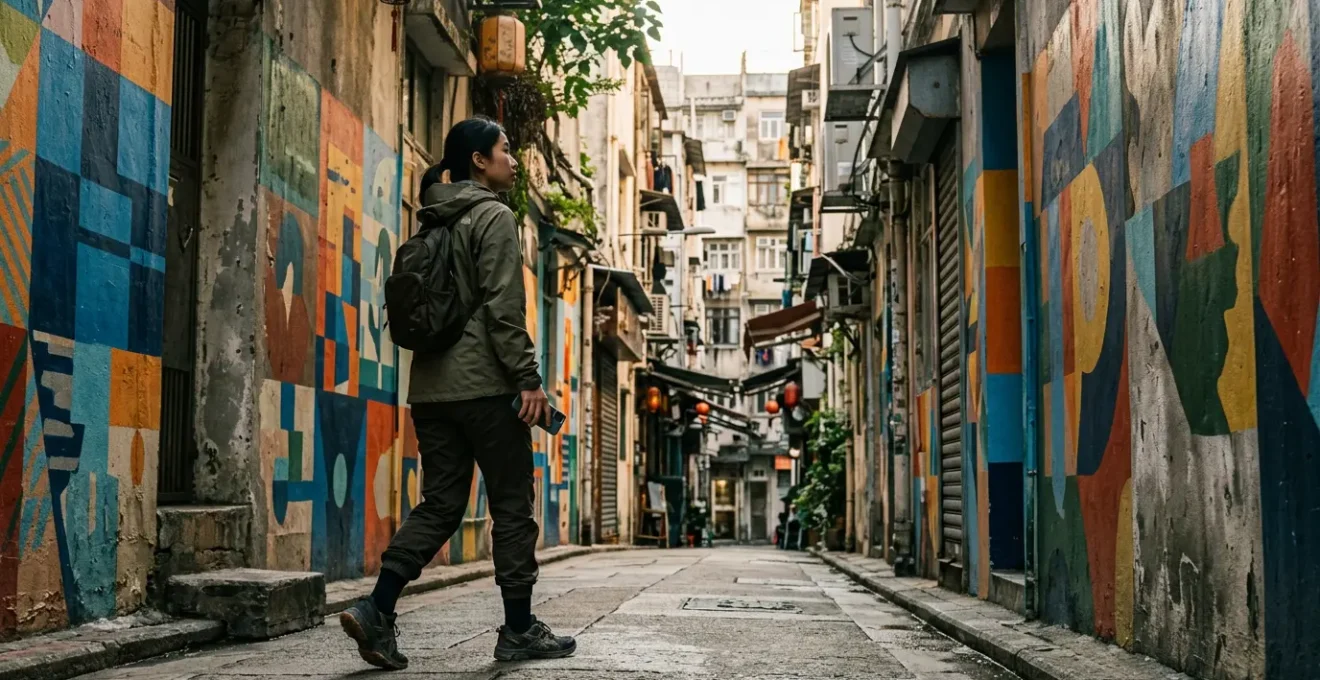
A successful DIY street art tour in Sheung Wan isn’t about having the best map; it’s about learning to read the city’s hidden language.
- True exploration comes from decoding urban rhythms, from morning light to the flow of people in alleys.
- Strategic breaks in local coffee shops aren’t just for rest; they are active moments for research and planning your next move.
Recommendation: The goal isn’t to see every mural on a list, but to curate a personal journey that reveals the creative soul of the neighborhood, one hidden discovery at a time.
The idea of a self-guided street art tour through Sheung Wan is seductive. It promises freedom from the slow pace of tour groups and the thrill of personal discovery. Yet, most advice boils down to a few predictable tips: “go early to avoid crowds” or “don’t miss the famous mural on Graham Street.” While true, this approach misses the point. It treats the neighborhood like a static, open-air museum where you simply tick items off a list. It ignores the vibrant, living pulse of the district and its unique urban typography.
This guide offers a different perspective. What if the key to a truly memorable DIY tour wasn’t just about knowing where the art is, but understanding how and why it exists in this specific environment? The real art of the independent explorer lies in decoding the city’s hidden rhythms—the flow of people, the interplay of light and shadow on hilly streets, and even the invisible currents of energy, or ‘Qi’, that shape the landscape. We’ll move beyond the map to give you the strategies of a seasoned urban explorer, turning your walk into a curated dialogue with the city itself.
This article provides a complete framework for your autonomous exploration. Follow our path from creating a dynamic route to understanding the very soul of the city’s design, ensuring your adventure is as unique as the art you discover.
Summary: Your DIY Guide to Sheung Wan’s Street Art Scene
- How to Map Your Own Route to See the Best Hollywood Road Murals?
- Paid Tour vs DIY: Which Option Reveals More Secrets of the City?
- How to Link Street Art Spots with the Best Coffee Shops for Breaks?
- The Hilly Terrain Risk: Why You Need Better Shoes Than You Think?
- When to Start Your Walk to Have the Streets to Yourself?
- Where to Find Remaining Neon Signs Before They Are Removed?
- How to Navigate the PMQ Complex to Find Emerging Designers?
- Why Do Skyscrapers Have Holes? The Feng Shui Explanation
How to Map Your Own Route to See the Best Hollywood Road Murals?
Forget static, outdated blog posts. The true urban explorer knows that the street art scene is a living entity, constantly changing. The key isn’t to find a perfect map, but to build a flexible framework for discovery. Your primary tool isn’t Google Maps; it’s Instagram. Treat it as a real-time intelligence feed. By following key hashtags like #hkwalls and #streetarthk the night before your walk, you’ll spot brand-new pieces that haven’t made it into any guides yet. This is how you get ahead of the curve.
Once you have a few fresh targets, build your route around 5-6 “anchor” murals—the well-known pieces on Graham Street, Tank Lane, and Square Street. These are your waypoints, not your final destination. The real magic happens in the spaces between. Allocate a 15-minute “spontaneity budget” around each anchor point. This is dedicated time to wander down an interesting alley, follow a set of steep stairs, or simply see what’s around the next corner. This structured improvisation is the heart of DIY discovery, ensuring you see both the famous works and the hidden gems only you will find.
This approach is validated by the success of major art events. For instance, the HKwalls festival in March 2024 demonstrated how a structured route can be a powerful discovery tool, successfully mapping 41 new murals across Central and Western Districts. This proves that having a plan is essential, but the best plans always leave room for the unexpected.
Paid Tour vs DIY: Which Option Reveals More Secrets of the City?
The fundamental question for any independent traveler is whether to go it alone or join a group. When it comes to Sheung Wan’s street art, the choice defines the very nature of your experience. A paid tour guarantees you’ll see the highlights and hear some curated anecdotes. It’s efficient, safe, and predictable. However, it trades the thrill of personal discovery for a pre-packaged narrative. You are a passive recipient of information, following a path determined by someone else, often in a group of 10-15 people.
A DIY tour, on the other hand, is an active engagement with the city. It transforms you from a tourist into an explorer. The “secrets” you uncover won’t be scripted stories about an artist’s intention; they’ll be the unscripted moments of serendipity: finding a tiny, brilliant piece in a deserted alley, the way the morning light hits a mural, or the perfect coffee shop you stumble upon by chance. This approach requires more effort—you do your own research—but the reward is a deeply personal connection to the place. You aren’t just seeing the art; you are creating your own unique story around it.
The table below breaks down the core trade-offs, but the real difference lies in a single concept: the ‘spontaneity budget’. A guided tour has none. A DIY tour thrives on it, allowing you to follow your curiosity wherever it leads.
| Aspect | DIY Walking Tour | Paid Guided Tour |
|---|---|---|
| Cost | Free | HK$150-300 per person |
| Duration | Flexible (2-4 hours at your pace) | Fixed (typically 1-3 hours) |
| Discovery Type | Personal, unscripted secrets | Curated, known anecdotes |
| Art Coverage | Mix of famous and personal finds | Guaranteed major murals |
| Flexibility | ‘Spontaneity budget’ to follow curiosity | Pre-determined route |
| Knowledge Depth | Self-researched artist stories | Professional commentary |
| Group Size | Solo or small private group | Usually 8-15 people |
Ultimately, a paid tour shows you the city’s secrets. A DIY tour lets you discover your own.
How to Link Street Art Spots with the Best Coffee Shops for Breaks?
In Sheung Wan, coffee shops are more than just a place to rest your tired feet; they are strategic hubs for the savvy urban explorer. The mistake many make is stopping randomly when fatigue hits. The pro move is to integrate breaks into your route planning, treating cafes as “mission control.” This is the “Recharge & Reflect” strategy: using this downtime to actively enhance your exploration. Instead of scrolling through social media, use the 20 minutes it takes to drink a flat white to review the photos you just took, look up the artists you discovered on Instagram, and plot the next leg of your journey.
The key is to pair the vibe of the art with the atmosphere of the cafe. After exploring the edgy, modern murals near Tank Lane, seek out a minimalist, third-wave coffee bar like Craftissimo. If you’ve been immersed in nostalgic Hong Kong-themed art near Graham Street, find a traditional ‘cha chaan teng’ for an authentic milk tea experience. This thematic pairing deepens your cultural immersion. Look for cafes that are part of the “creative ecosystem”—those that display local art, host events, or have zines for sale. These places enrich the experience far beyond a simple caffeine hit.
As one local expert from the Sassy Mama Hong Kong Street Art Guide notes, this reframes the entire concept of a break.
The ‘Recharge & Reflect’ Stop strategy frames breaks as an active part of DIY exploration, encouraging users to use coffee time to look through photos and research the artists they just saw.
– Hong Kong Tourism Expert, Sassy Mama Hong Kong Street Art Guide
By adopting this mindset, your coffee break transforms from a passive rest into an essential, productive, and enjoyable part of your art-hunting mission.
The Hilly Terrain Risk: Why You Need Better Shoes Than You Think?
The most common advice for any walking tour is to “wear comfortable shoes.” For Sheung Wan, this is a dangerous understatement. The neighborhood’s unique topography, a legacy of its colonial development, presents a specific challenge that generic sneakers are ill-equipped to handle. You aren’t just walking on flat pavement; you are navigating a relentless series of steep slopes, uneven concrete, and historic ladder streets—narrow staircases that function as public roads.
This isn’t an exaggeration. Data shows that a typical Sheung Wan walking route involves a 239.4 ft elevation gain over a relatively short distance. This is like climbing a 24-story building, but spread out over sharp inclines and endless stairs. The British colonial government literally carved residential terraces into the unforgiving terrain of Victoria Peak, connecting them with these steep paths. Ladder Street itself is composed entirely of stone steps, a testament to this urban planning challenge.
The risk isn’t just about comfort; it’s about stability and safety. The constant transition from ascending a steep slope to descending a flight of stone steps places unique stress on your ankles and knees. Your footwear needs two things above all else: excellent ankle support to prevent twists on uneven surfaces and a high-grip sole to handle potentially slick stone stairs, especially after a sudden rain shower. Thinking you can get by with flimsy fashion sneakers is the number one mistake a first-time explorer makes. Better shoes mean a longer, safer, and more enjoyable hunt.
When to Start Your Walk to Have the Streets to Yourself?
Every guide will tell you to go early to avoid the crowds. What they don’t tell you is that “early” in Sheung Wan has a specific and almost magical quality. This isn’t just about having an empty street for your photos; it’s about experiencing a completely different version of the city. The prime window is between 7:00 AM and 8:30 AM. During these golden hours, the city’s usual frenetic energy is on pause. The streets are not just quiet; they are serene.
This is when you can truly appreciate the urban landscape. The low-angle sun casts long, dramatic shadows down the narrow alleys, creating a natural spotlight that highlights the texture of the walls and the vibrant colors of the murals. It’s a photographer’s dream. You can stand in the middle of Hollywood Road—something unthinkable just a few hours later—and compose your shots without a single person walking into your frame. The only sounds are the distant rumble of the first trams and the clatter of shop gates opening.
Starting early is also a strategic advantage. It allows you to cover the most popular “anchor” murals before they become crowded Instagram backdrops. By 9:30 AM, when the tour groups start to arrive and the city awakens, you’ve already seen the main attractions. You can then retreat to the quieter back alleys for more personal discoveries or head for your first “Recharge & Reflect” coffee break, feeling like you’ve had the entire neighborhood to yourself.
Where to Find Remaining Neon Signs Before They Are Removed?
As you hunt for the latest murals, don’t forget to look up and search for their ancestors: Hong Kong’s iconic neon signs. These glowing beacons are a dying art form, rapidly being replaced by cheaper and more efficient LEDs. For the urban explorer, finding the remaining signs is an act of visual archaeology, uncovering a previous layer of the city’s street art history. These signs were, in fact, the original commissioned form of street art, turning the city’s vertical landscape into a vibrant, electric canvas long before the first spray can appeared.
Framing your search this way creates a powerful narrative of evolving urban visual culture. You’re not just looking at old signs; you’re witnessing the transition from a commercial craft to a contemporary art movement. A brilliant strategy is to plan a “Twilight Heritage Trail.” Start your street art walk in the late afternoon, and as dusk falls around 6:00 PM, shift your focus from the walls to the skies. This is when the remaining neon signs flicker to life, and their nostalgic glow creates a completely different atmosphere.
This experience is multi-sensory. Listen for the distinctive electrical “buzz” of the neon transformers. This sound is as endangered as the signs themselves and adds a unique auditory dimension to your hunt. Finding a classic pawnshop bat or a shimmering dragon sign isn’t just a photo opportunity; it’s a poignant encounter with a piece of Hong Kong’s soul before it disappears forever.
How to Navigate the PMQ Complex to Find Emerging Designers?
Your street art journey will inevitably lead you to PMQ, the former Police Married Quarters now transformed into a bustling hub for local design and creativity. But navigating this monolithic structure can be overwhelming. With two blocks (Staunton and Hollywood) and seven floors of studios, simply wandering in can lead to missing the best finds. The key is to have a system. Don’t start at the bottom and work your way up; you’ll run out of energy. The most efficient method is the Top-Down Zig-Zag.
This strategy ensures you see everything without backtracking. You start at the top floor of one block, cross the sky bridge to the other block on the same floor, and then descend one level to repeat the process in the opposite direction. This systematic approach allows you to methodically cover the entire complex.
However, the real gems are often found by breaking the pattern. Pay close attention to the central courtyard, which hosts temporary pop-ups showcasing the most innovative work. Look for “Open Studio” clues: an open door, a “Welcome” sign, or the sounds of work in progress are invitations to step inside. The designers in PMQ are there to connect, so don’t be shy. Visiting on a weekend afternoon is your best bet, as the designers are most likely to be present and open to conversation. This is your chance to go beyond the art and meet the artists.
Action Plan: The PMQ Top-Down Zig-Zag Method
- Start on the top floor of the Staunton block and work your way down systematically to avoid fatigue.
- Cross the sky bridge on each floor to cover the corresponding level of the Hollywood block in a zig-zag pattern.
- Focus on the temporary pop-ups in the central courtyard; this is where the newest, most innovative work is often found.
- Look for ‘Open Studio’ clues: open doors, ‘Welcome’ signs, or visible work-in-progress are direct invitations to engage.
- Schedule your visit for a weekend afternoon when designers are most likely to be present in their studios for interaction.
Key Takeaways
- Master a dynamic mapping strategy using Instagram for real-time updates, setting anchor murals but budgeting time for spontaneous discovery.
- Treat the city’s challenging terrain as part of the experience; proper footwear with ankle support and grip is non-negotiable.
- Embrace the “Twilight Heritage Trail” by hunting for disappearing neon signs at dusk, connecting modern murals to their visual ancestors.
Why Do Skyscrapers Have Holes? The Feng Shui Explanation
As you explore Sheung Wan, you’ll be surrounded by towering skyscrapers, and you might notice a strange feature on some of them: giant holes carved through their centers. These aren’t an architectural whim; they are “Dragon Gates,” a direct application of Feng Shui. This ancient practice is about ensuring the harmonious flow of energy, or ‘Qi’. The belief is that dragons fly from the mountains down to the water to drink, and these gates ensure their path is not blocked, preventing a build-up of negative energy.
Now, what does this have to do with street art in a narrow alley? Everything. If Feng Shui operates on a macro level to guide energy through buildings, then street art functions as a form of micro-Feng Shui for human energy. Think about it: a dark, forgotten alley feels stagnant and uninviting. It has bad Qi. But place a vibrant, compelling mural at the end of that alley, and you instantly change its energy. The art acts as a beacon, pulling people in, directing the flow of human attention and foot traffic into a space that was previously dead.
This is the “Creative Qi” of the neighborhood. The artists, perhaps unconsciously, are practicing a form of urban acupuncture, using their work to transform ‘dead’ spaces into vibrant ‘art corridors’. As you walk, stop thinking like a tourist and start feeling like a Feng Shui master. Which alleys seem to pull you in with positive energy? Does a particular mural create a sense of harmony or deliberate disruption? By letting this intuitive ‘urban Feng Shui’ guide your path rather than rigidly following a map, you are tapping into the same energy flows that shape the city’s skyline. You’re not just looking at art; you’re feeling the pulse of the city.
Your personal exploration of Sheung Wan’s creative soul awaits. The streets are ready to share their secrets with those who know how to listen.