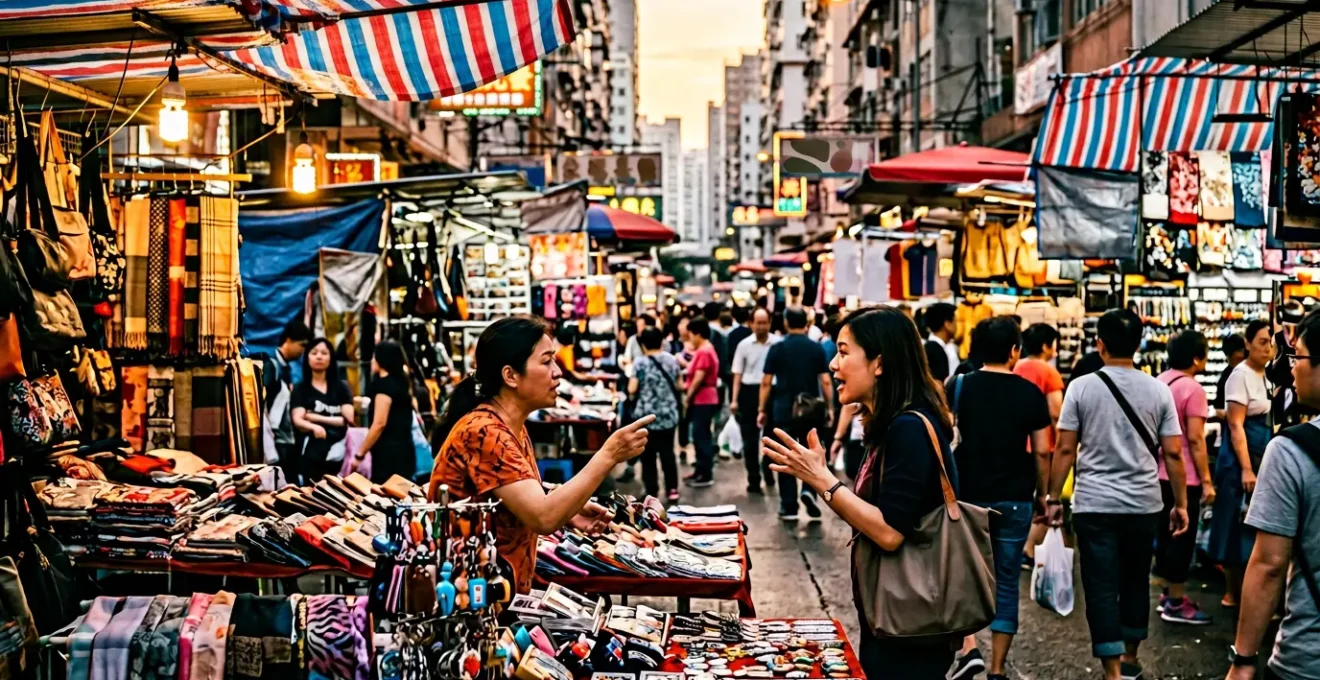
Forget the myth that haggling is a fight. It’s a street-smart theatrical performance, and you’re the star. The real win isn’t just saving money; it’s mastering the game. This guide gives you the script, the props, and the mindset to turn a stressful tourist trap into an empowering victory, where a 50% discount is simply the applause for your great performance.
The humid air, a thick cocktail of sizzling street food and cheap perfume, hits you first. Then the noise—a wall of Cantonese sales pitches, clattering mahjong tiles from a hidden alley, and the relentless hum of 100,000 daily visitors packed into a one-kilometer stretch of Tung Choi Street. This is Ladies’ Market in Mong Kok. Your guidebook told you it’s a must-see, a treasure trove of souvenirs and bargains. But right now, standing at the mouth of the market, you feel less like a treasure hunter and more like the prey.
You want the experience, the thrill of the find, but the fear of being ripped off is paralyzing. Common advice tells you to “be friendly” or “start at half price,” but these platitudes are useless without understanding the unspoken rules of the game. You’re not just shopping; you’re stepping onto a stage where every interaction is a mini-play, a well-rehearsed dance between vendor and buyer. The vendors have their script down cold. The question is, do you have yours?
This is where we change the game. The secret to walking away with a 50% discount isn’t about being aggressive or learning a few Cantonese phrases. It’s about shifting your mindset from a passive consumer to an active performer. It’s about understanding the psychology, preparing your props, and knowing when to make your dramatic exit. This guide will deconstruct the performance of haggling, giving you a step-by-step playbook. We’ll cover your single most powerful move, how to distinguish a decent gift from junk, and why the real victory is in the performance itself, not just the price tag.
In this guide, you’ll find a structured approach to transform you from a hesitant tourist into a confident market navigator. Each section builds on the last, equipping you with the tactics and the street-smart IQ needed to not only survive Ladies’ Market but to conquer it.
Summary: Your Playbook for Conquering Ladies’ Market
- The Walk-Away Technique: Why Pretending to Leave Is Your Best Weapon?
- Homage or Fake: How to Spot Illegal Counterfeits to Avoid Customs Issues?
- The Wallet Risk: How to Protect Your Valuables in Tight Crowds?
- Cheap Plastic or Decent Gift: What Is Actually Worth Buying Here?
- Why Locals Shop at Fa Yuen Street Instead of Ladies’ Market?
- How to Adjust Your Mindset From Air-Conditioned Malls to Sweaty Markets?
- Why Are Authentic Dai Pai Dongs Disappearing from the Streets?
- How to Navigate the PMQ Complex to Find Emerging Designers?
The Walk-Away Technique: Why Pretending to Leave Is Your Best Weapon?
Listen up, because this is the most important move in your entire playbook. The walk-away isn’t a sign of defeat; it’s the climax of your performance. Every vendor at Ladies’ Market has inflated their initial price to account for this exact moment. They expect it. They are waiting for it. Your job is to deliver it with conviction. The entire negotiation is a theatrical dance: you show interest, the vendor states a high price, you counter-offer low, and after a bit of back-and-forth, you deliver your big scene by turning and walking away. This is the signal that the real negotiation is about to begin.
The psychology is simple: it forces the vendor to make a final, split-second decision. Is the small profit from your purchase better than no profit at all? In 9 out of 10 cases, the answer is yes. They will call you back. When they do, their offer will be much closer to the real price. Remember, while some guides say a 50% discount is possible, a more realistic expectation for most items is that vendors typically offer a 20-30% discount, with higher markdowns reserved for bulk purchases. The walk-away is your key to unlocking that maximum potential discount.
The success of this move is detailed in numerous market guides. The bargaining dance follows a predictable pattern, a theatrical performance where vendors have already factored haggling into their pricing. This isn’t a personal battle; it’s a transactional ritual. Your feigned disinterest is the most powerful tool you have. It communicates that you are not a desperate tourist but a savvy player who knows the value of things and, more importantly, knows when to fold.
Homage or Fake: How to Spot Illegal Counterfeits to Avoid Customs Issues?
Part of the market’s thrill is the sheer variety of goods, but this is also its biggest trap. Among the quirky souvenirs and trendy clothes are mountains of illegal counterfeits. Buying a fake “designer” handbag isn’t just a waste of money; it’s supporting a criminal trade and can land you in trouble with customs back home. Your role as a smart shopper is to learn to distinguish between a harmless, unbranded “homage” and a blatant, illegal fake. The first rule is simple: if a deal on a luxury brand seems too good to be true, it absolutely is.
Look for tell-tale signs of a fake: shoddy stitching, cheap materials (plastic instead of leather), misspelled brand names, and flimsy hardware. Authentic local crafts have a different feel entirely—the texture of hand-carved wood, the weight of a ceramic tea set, the intricate weave of a silk scarf. Focus your attention on these items. Not only are they genuine, but they also make for far more interesting gifts and memories of Hong Kong.
The Hong Kong government takes intellectual property theft seriously. To give you an idea of the scale, authorities are cracking down hard on this trade. In fact, a report on enforcement shows that there were 783 IP infringement cases in 2024, with millions of items seized. While enforcement primarily targets sellers, not tourists buying for personal use, knowingly purchasing counterfeit goods fuels the industry. The smart play is to avoid it altogether and seek out the authentic gems hidden in plain sight.
The Wallet Risk: How to Protect Your Valuables in Tight Crowds?
Ladies’ Market is notoriously crowded, especially after 7 PM when the energy peaks. This tight, chaotic environment is a pickpocket’s paradise. A tourist fumbling with a wallet, distracted by a colorful stall, is an easy target. Your defense isn’t just about being alert; it’s about strategic preparation. Forget carrying a bulky wallet in your back pocket. That’s an open invitation. You need to control the environment, and that starts with controlling your cash.
The single best strategy is the “Two-Wallet” system. This is a non-negotiable rule for any serious market explorer. Your primary wallet, containing credit cards, large bills, and ID, stays hidden in a money belt or a secure inner pocket of your bag. Your second wallet—the “decoy”—is what you’ll use for all your transactions. It’s both a security measure and a powerful negotiation prop. When you open it to “reluctantly” pay, and the vendor sees only a few small bills left, it powerfully reinforces your “this is my final offer” stance. It’s a visual cue that you’ve reached your limit.
Timing your visit can also mitigate risk. While the market is most vibrant at night, experienced shoppers often visit in the early afternoon. The crowds are thinner, making it easier to navigate and keep an eye on your belongings. You’ll have more space to examine goods and engage with vendors without feeling rushed or jostled. This tactical approach to timing and cash management transforms you from a potential victim into someone who is in complete control of the situation.
Your Action Plan: The Two-Wallet Strategy for Safe Market Shopping
- Prepare a ‘decoy wallet’ with HK$500-1000 in small bills (HK$10, 20, 50, 100) for the day’s haggling budget.
- Keep your main wallet with credit cards and larger amounts hidden in a money belt or a secure inner pocket.
- Use the decoy wallet as a negotiation tool by showing limited remaining cash, stating “This is all I have left.”
- Bring a small backpack or crossbody bag to keep your hands free for examining merchandise while securing your purchases.
- Take 10-minute breaks in nearby air-conditioned shops to reset from the sensory overload and review your strategy.
Cheap Plastic or Decent Gift: What Is Actually Worth Buying Here?
The sheer volume of merchandise at Ladies’ Market can be overwhelming. Stalls are packed with everything from phone cases to “I ❤️ HK” t-shirts and questionable electronics. The key to a successful haul is knowing what to target and what to ignore. Wasting your negotiation energy on a poor-quality item is a rookie mistake. Your goal is to find the “high value” items: well-made, useful, or unique products where a good price feels like a genuine score.
Generally, steer clear of anything that promises high-tech performance for a low price, like branded headphones or smartwatches—they are almost certainly counterfeit and will likely fail. The same goes for designer-inspired handbags and wallets; the quality is typically poor and they scream “tourist trap.” Instead, focus your attention on categories where the market excels. Phone accessories like cases and cables, trendy but unbranded casual wear, and fashion jewelry are often good value. The real sweet spot, however, lies in traditional souvenirs. A well-chosen set of chopsticks or a simple ceramic tea set can be a beautiful, authentic gift that doesn’t break the bank.
To make this easier, think in terms of a value matrix. Before you even engage with a vendor, quickly categorize the item in your head. Is this a disposable trinket or something with lasting value? This mental filter will save you time, money, and a suitcase full of regret.
| Category | High Value Items | Typical Price Range | Tourist Trap Items | Why to Avoid |
|---|---|---|---|---|
| Electronics | Phone accessories, cables, cases | HK$20-100 | Branded headphones, smartwatches | Likely counterfeit, no warranty |
| Fashion | Trendy dresses, casual wear | HK$50-150 | Designer-inspired handbags | Poor quality, obvious fakes |
| Souvenirs | Traditional chopsticks, tea sets | HK$25-100 | Fake jade, ‘antiques’ | Not authentic, overpriced |
| Accessories | Fashion jewelry, scarves | HK$10-50 | Luxury brand wallets | Illegal counterfeits |
Why Locals Shop at Fa Yuen Street Instead of Ladies’ Market?
Here’s a piece of insider knowledge that will instantly elevate your street-smart IQ. While tourists flock to Ladies’ Market, many Hong Kong locals head one block over to Fa Yuen Street, also known as “Sneaker Street.” Why? Because they are playing a different game. Ladies’ Market is a theater for tourists, with prices inflated for the haggling performance. Fa Yuen Street is where people go for actual shopping, with a focus on practical goods like sportswear, sneakers, and everyday items. The pricing culture reflects this.
Bargaining at Fa Yuen Street is a different art form. As J3 Consultants Hong Kong notes in their market comparison, the negotiation is far less aggressive. They advise that a polite approach works best, such as asking for the “best price” or seeking a small discount for buying multiple items. Forget the 50% lowball offers; here, you’re dealing with prices that are already much closer to the real market value. The vendors are serving a local clientele they want to retain, not a transient tourist they’ll never see again.
Bargaining at Fa Yuen Street is less aggressive than Ladies’ Market—polite negotiation works, asking for ‘best price’ or bundle deals, with better discounts on multiples or end-of-day.
– J3 Consultants Hong Kong, Hong Kong Market Comparison Guide
Understanding this distinction is crucial. Visiting Fa Yuen Street gives you a baseline for what things *should* cost. It’s your reality check. If you’re serious about finding quality goods at a fair price, especially sportswear, start there. If you’re in it for the thrill of the haggling performance and cheesy souvenirs, Ladies’ Market is your stage. The pro move is to visit both to understand the full spectrum of Hong Kong’s street market culture.
| Aspect | Ladies’ Market | Fa Yuen Street | Temple Street |
|---|---|---|---|
| Price Culture | Heavy haggling expected (50-60% off asking) | More fixed prices, polite negotiation only | Moderate haggling |
| Product Focus | Souvenirs, accessories, tourist items | Sneakers, sportswear, practical goods | Electronics, fortune telling |
| Core Audience | Tourists (100,000+ daily visitors) | Local Hong Kong residents | Mixed local and tourist |
| Best Time | After 7 PM for full experience | Weekday afternoons | After dark (night market) |
| Price Transparency | Inflated tourist pricing | Closer to real market value | Variable by vendor |
How to Adjust Your Mindset From Air-Conditioned Malls to Sweaty Markets?
Shopping in Hong Kong’s gleaming, air-conditioned malls is a passive experience. Prices are fixed, the environment is controlled, and your role is simply to consume. Ladies’ Market is the polar opposite. It’s a full-contact sport. It’s hot, it’s crowded, and it demands your active participation. If you arrive with a passive “mall mindset,” you will be overwhelmed and overcharged within minutes. The single most important preparation is mental: you must switch from consumer to participant.
Think of it like preparing for a workout. You need a game plan. First, set a strict time limit of 90 minutes. This creates urgency and prevents decision fatigue from setting in. Second, schedule “sensory reset” breaks. Every 30 minutes, step out of the chaos and into a nearby 7-Eleven or bubble tea shop. This small pause allows your brain to cool down (literally and figuratively) and helps you stick to your strategy. Finally, come prepared. A reusable shopping bag, a portable phone charger, and a small umbrella are essential tools for any market veteran.
Your budget is also part of your mental armor. Going in without a clear spending limit is a recipe for disaster. Based on experience, you should plan on budgeting around HK$450-900 for a typical 2-3 hour session, which covers a few souvenirs, a handbag, and some clothing. Having this number in your head prevents impulsive buys and strengthens your resolve during negotiations. By treating your market trip as a planned event rather than a casual stroll, you seize control and prime yourself for success.
Key takeaways
- Haggling is a performance, not a fight. Your goal is to play the game well; the discount is your reward.
- Your most powerful negotiation tool is the “walk-away.” Use it with confidence to signal the real negotiation has begun.
- Employ the “two-wallet” strategy for both security and as a negotiation prop to show you’ve reached your budget limit.
Why Are Authentic Dai Pai Dongs Disappearing from the Streets?
As you navigate the chaotic energy of Ladies’ Market, you’re experiencing a living piece of Hong Kong’s street culture. But this raw, unfiltered experience is becoming increasingly rare. The aggressive haggling, the crowded stalls, the sheer unpredictability of it all—these are cultural artifacts. To truly understand the context of your haggling performance, it’s worth looking at a parallel story: the vanishing of the *dai pai dongs*, Hong Kong’s iconic open-air food stalls. They are the culinary equivalent of the market’s boisterous bargaining.
Just as the Ladies’ Market represents a freewheeling, unregulated style of commerce, dai pai dongs represent a raw and authentic approach to food. Both are now under threat from the same forces. As one cultural observer puts it, the connection is clear.
Both haggling culture at Ladies’ Market and Dai Pai Dongs represent raw, authentic street experiences threatened by gentrification, regulation, and the rise of sanitized, fixed-price environments
– Hong Kong Heritage Observer, The Vanishing Street Culture of Hong Kong
Government regulations aimed at improving hygiene and order, combined with the economic pressures of rising rents, are pushing these institutions to the brink. The government’s push for a more orderly city, which includes special enforcement operations against counterfeit sellers in Mong Kok, directly clashes with the chaotic charm that defines these intangible cultural heritage sites. Every time you engage in the haggling dance, you are participating in a tradition that is slowly being polished away. It adds a layer of significance to your experience; you are not just shopping, you are keeping a piece of old Hong Kong alive.
How to Navigate the PMQ Complex to Find Emerging Designers?
After you’ve mastered the chaotic art of the “Hunter” at Ladies’ Market, it’s time to evolve into the “Curator.” Your next destination is PMQ in Central. This is where your shopping journey in Hong Kong comes full circle. Having saved money through savvy haggling, you can now invest in something truly unique: a piece from an emerging Hong Kong designer. PMQ, a former Police Married Quarters, has been brilliantly transformed into a vibrant hub for local creativity. This Grade 3 heritage building now houses over 100 designer boutiques and studios across its seven floors.
The mindset here is completely different. Haggling is off the table. You are not hunting for a bargain; you are curating a collection. You are there to discover stories, appreciate craftsmanship, and connect with the creator behind the product. Many of the shops are run by the designers themselves, giving you a chance to hear about their inspiration and process. This is the antithesis of the anonymous, high-volume transactions of the street market. It’s a slower, more deliberate, and ultimately more rewarding experience.
The strategic way to approach this is to see the two experiences as complementary. Use Ladies’ Market for the fun, the performance, and the low-stakes souvenirs. Then, take the “money you saved” and channel it towards a single, high-quality piece from a PMQ designer. This strategy allows you to experience both ends of Hong Kong’s dynamic retail spectrum: the raucous energy of the street and the refined creativity of the city’s design scene. The studios are generally open from noon to 7 PM, making it a perfect afternoon follow-up to a morning market run.
Frequent questions on Haggling at Ladies’ Market: How to Drop the Price by 50%?
What are the legal penalties for selling counterfeit goods in Hong Kong?
Under the Trade Descriptions Ordinance, any person who sells or possesses for sale any goods with a forged trademark commits an offence, with a maximum penalty upon conviction of a HK$500,000 fine and five years imprisonment.
How can tourists verify product authenticity?
Customs reminds consumers to procure goods at reputable shops or websites and to check with the trademark owners or their authorized agents if the authenticity of a product is in doubt.
Are tourists at risk when carrying small quantities for personal use?
Hong Kong Customs focuses enforcement on commercial quantities, as evidenced by raids seizing thousands of counterfeit items from shops, not on individual tourists carrying small amounts for personal use.