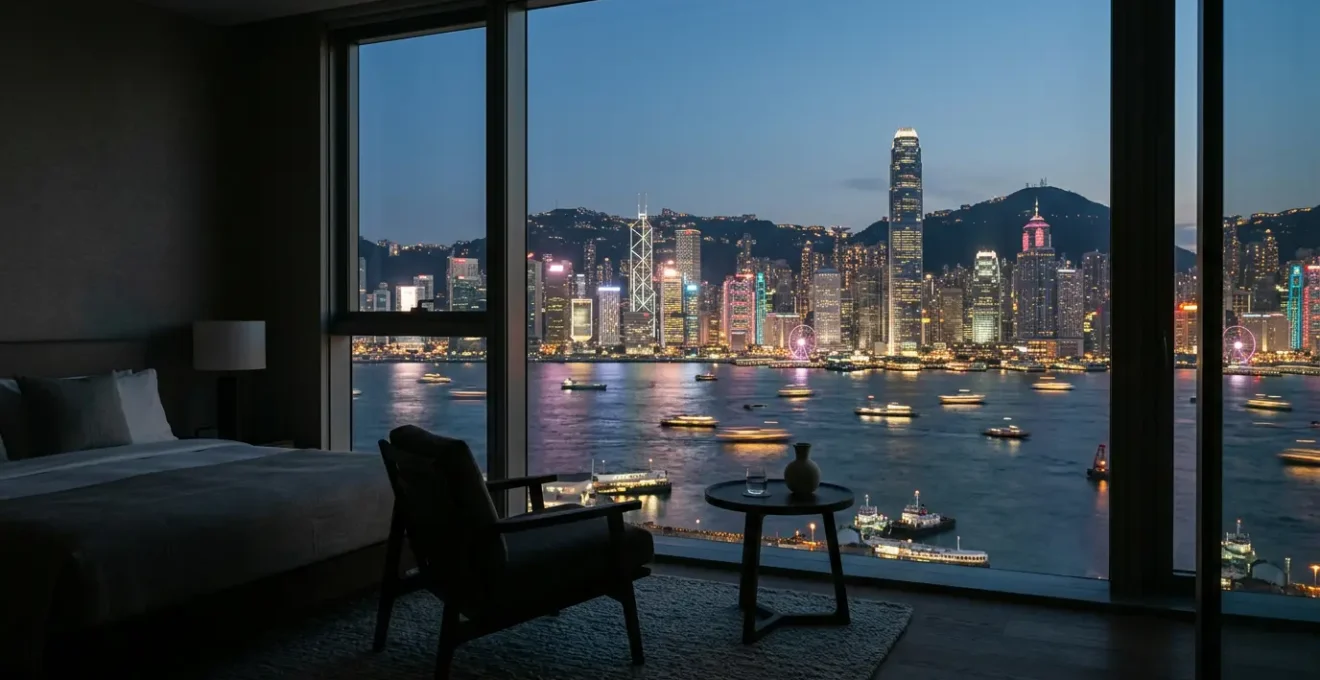
The true value of a premium harbour view room isn’t just the view itself, but the guaranteed, private access that avoids the crowds and potential chaos of public viewing spots for a truly romantic experience.
- A city view, while cheaper, can offer a unique and compelling “cyberpunk” aesthetic that shouldn’t be dismissed.
- Rooftop bars are a viable alternative for the light show, but require strategic timing to secure a good spot before they become overcrowded.
Recommendation: For the ultimate visual return on investment, focus on securing a high-floor corner suite on the Kowloon side. It offers unparalleled panoramic value that justifies the premium.
The fantasy is a powerful one for any romantic traveler visiting Hong Kong: sitting in the quiet comfort of a luxurious hotel room, glass in hand, as the city’s iconic skyline erupts in a dazzling display of light and sound. The Symphony of Lights is a world-renowned spectacle, and the allure of a private, front-row seat is immense. But this luxury comes with a hefty price tag, often a premium of $200 or more per night. This begs the critical question: is it actually worth it?
Common advice simply points to the most expensive hotels, assuming a higher price guarantees a better experience. Others suggest forgoing the room for a crowded rooftop bar or the bustling Tsim Sha Tsui promenade. This guide rejects those simple answers. We will operate as a room view evaluator, analyzing the decision not as a simple purchase, but as a calculated investment in your experience. The goal is to maximize your “visual ROI” (Return on Investment) by understanding the hidden variables, risks, and strategic alternatives.
This isn’t just about finding a room with a window; it’s about securing the best possible private viewing experience for your money. We’ll deconstruct the value proposition, weigh the pros and cons of different view types, and reveal the strategies that seasoned travelers use to guarantee an unforgettable, crowd-free spectacle. We’ll analyze everything from the specific side of the harbour to the micro-details of a room’s layout, providing a framework to help you decide if that splurge is a wise investment in romance or an unnecessary expense.
This comprehensive guide will break down the essential factors for evaluating your options. From comparing city and harbour views to assessing the true value of rooftop bars and corner suites, you’ll gain the insights needed to make an informed decision and secure the best possible private experience of Hong Kong’s famous light show.
Summary: An Evaluator’s Guide to Hong Kong’s Best Private Views
- City View vs Harbour View: Why City View Can Be More Cyberpunk?
- The Window Cleaning Risk: How to Check Schedules Before Booking?
- Hotel Rooftop Bar vs Private Room: Which is Better for Viewing?
- How to Ensure Blackout Curtains Work Against the Neon Glow?
- Why Staying on the Kowloon Side Gives the Best Island Skyline View?
- When to Board to Catch the Symphony of Lights From the Water?
- Dining at The Peak: Tourist Trap or Romantic Experience Worth the Price?
- Why Corner Suites Offer the Best Panorama Value?
City View vs Harbour View: Why City View Can Be More Cyberpunk?
The default assumption is that a Harbour View is the only option worth considering. Hotel pricing certainly reflects this, with industry data showing premiums can be upwards of $300 per night for luxury rooms with a coveted water-facing window. This creates a significant “view equity” gap. Before automatically paying the premium, it’s crucial to evaluate what you’re actually getting for your money versus the alternative. While the harbour offers a classic, expansive vista, a city view can provide a surprisingly dynamic and immersive experience that many travelers overlook.
A city-facing room plunges you into the dense, neon-saturated heart of Hong Kong. Instead of a distant, painterly landscape, you get a complex, layered scene of glowing signs, bustling streets, and the relentless energy of a metropolis. This can be a far more “cyberpunk” aesthetic, feeling less like a postcard and more like being inside the movie Blade Runner. The visual interest is constant, 24/7, not just peaked at sunset or during the 8 PM light show. For photographers and lovers of urban texture, the intricate details of a city view can be more compelling than the broader strokes of the harbour.
To make a truly informed decision, consider what kind of visual experience you value most. The following table breaks down the key differences in “visual ROI” between the two options.
This comparative analysis from recent hospitality industry insights highlights the trade-offs.
| Feature | City View | Harbour View |
|---|---|---|
| Average Premium | Standard rate | +$150-250/night |
| 24-Hour Visual Interest | Constant activity | Peak at sunset/8pm show |
| Photography Potential | Complex layered shots | Classic postcard views |
| Light Density | High neon saturation | Dark water expanses |
Ultimately, a Harbour View is an investment in a specific, iconic moment. A City View is an investment in the constant, atmospheric immersion of Hong Kong. For the romantic traveler, the choice depends on whether the preference is for a grand, shared spectacle or a more intimate, continuous urban hum. The city view presents a compelling case for being a different, not necessarily lesser, experience.
The Window Cleaning Risk: How to Check Schedules Before Booking?
Imagine paying a $200 premium for a spectacular harbour view, only to have it completely obscured by scaffolding, ropes, and the silhouettes of maintenance workers for a full day of your romantic getaway. This isn’t a hypothetical scare tactic; it’s a very real form of “experience contamination” that can decimate your visual ROI. High-rise hotels require constant facade maintenance, and window cleaning is a routine operation. The risk of your stay coinciding with this schedule is a critical factor to mitigate before you book.
Protecting your investment in “view equity” requires proactive diligence. Hotels are not always forthcoming about these schedules during the booking process. You must take on the role of the evaluator and perform your own checks. The most direct method is to contact the hotel concierge directly, preferably by email to have a written record, and inquire about any planned maintenance or window cleaning for your specific dates and the side of the building you intend to book. Do this *before* making a non-refundable booking.
Beyond direct inquiries, you can use other resources to assess potential obstructions. Scour recent guest reviews and photos on sites like TripAdvisor, filtering for those posted within the last few months. These can reveal not only temporary cleaning but also new, permanent obstructions like nearby construction projects. A thorough pre-booking verification process is essential to ensure your view is as clear as advertised.
To ensure your premium payment results in a premium view, follow this checklist:
- Email the hotel concierge 48 hours before booking to inquire about window cleaning schedules for your specific dates.
- Check recent guest photos on travel review sites (dated within the last 3 months) for any signs of obstruction.
- Use Google Earth’s 3D view to scout for potential permanent obstructions not shown in hotel marketing photos.
- Specifically request floor numbers above the 20th floor, as these are less likely to be obstructed by lower buildings.
- Directly ask about any planned building maintenance or major nearby construction projects that could impact the view.
Hotel Rooftop Bar vs Private Room: Which is Better for Viewing?
The most common alternative to paying the harbour view room premium is visiting one of Hong Kong’s famous rooftop bars. This presents a direct trade-off: the lower cost of a few drinks versus the high cost of a dedicated room. As a travel evaluator, the choice isn’t just about money, but about the quality and nature of the experience itself. As one traveler noted when justifying their room choice, the core desire is often deeply personal: “this was not our only reason for booking a view of Victoria Harbour; it looked gorgeous at night, and we wanted to see this beautiful skyline from our hotel window.”
A cost analysis shows the financial decision clearly. A visit to a panoramic restaurant or bar like Cucina can cost $100-150 per person for dinner and drinks to see the show. This is a one-time event. The $200+ room upgrade, while more expensive upfront, buys you unlimited, 24/7 private access to that same view throughout your stay. It’s the difference between renting a chair at a concert versus owning the entire box suite. The “visual ROI” of the room is amortized over your entire stay, available for sunrise, sunset, and every moment in between.
The most significant factor, however, is the crowd. The romantic privacy of a room is the antithesis of the rooftop bar experience during the Symphony of Lights. As many regular observers note, on popular viewing platforms and in bars, seats are occupied within half an hour prior to the show’s start. This means your romantic evening involves arriving early, competing for a good spot, and sharing the moment with dozens of other people. Your view might be partially blocked, and the ambiance can be loud and frantic—a significant “experience contamination” for a couple seeking intimacy.
For the romantic traveler whose primary goal is a private, unhurried, and intimate viewing of the show, the private room is unequivocally the superior choice. The rooftop bar is a valid, more social, and budget-conscious option, but it serves a different purpose. It fails to deliver the core promise of privacy and exclusivity that makes the room premium appealing in the first place.
How to Ensure Blackout Curtains Work Against the Neon Glow?
Securing a room with a magnificent view is only half the battle. The other half is ensuring you can control that view—specifically, the light it lets in when you want to sleep. Hong Kong’s skyline is an electrifying sea of neon that never truly sleeps. This constant glow, while spectacular, can become a major source of “experience contamination” known as light bleed, seeping through inadequate curtains and disrupting your rest. This is a critical detail for a romantic trip, as a poor night’s sleep can sour the entire experience.
With over 21,789 high-tariff luxury hotel rooms in the city, one would assume that high-quality blackout curtains are standard. However, the effectiveness can vary dramatically based on design and maintenance. A true blackout setup is more than just thick fabric; it’s a system designed to seal out light. When evaluating a room or making a request, you are looking for specific features that signal a superior system.
The best systems feature a dual-layer design: a sheer curtain for daytime privacy and a separate, heavy blackout curtain on a different track. Crucially, the blackout curtain should be wider than the window frame and ideally run within a channel or under a pelmet at the top. This top covering is vital, as it prevents the “halo effect” where light spills over the top of the curtain rod. The curtains should also have a significant overlap in the middle when closed. If you are sensitive to light, it is entirely reasonable to mention this when booking and request a room known for its effective blackout capabilities.
Before unpacking, perform a quick “light audit.” Close the curtains during the day and look for significant gaps of light along the edges, top, or center. Small pinpricks are often unavoidable, but large, glowing strips indicate a problem. Don’t hesitate to report this to the front desk. Sometimes, it’s a simple fix like a curtain that has come off its hook. Ensuring you can command the darkness is just as important as paying for the light.
Why Staying on the Kowloon Side Gives the Best Island Skyline View?
One of the most critical decisions in your strategic viewing plan is not just the hotel, but its location. For the quintessential, postcard-perfect view of the Symphony of Lights, there is no debate among seasoned evaluators: you must stay on the Kowloon side, looking across Victoria Harbour towards Hong Kong Island. While hotels on the island offer “harbour views,” they are views *of* Kowloon. The main event, however, is the iconic island skyline itself.
The Symphony of Lights showcases 43 buildings and two attractions, the vast majority of which are the architectural marvels of Hong Kong Island. As the Kowloon Vibes Travel Guide expertly points out, the perspective from the Kowloon side is unparalleled. As they note, “From here, you get a clear, panoramic view of the skyscrapers on Hong Kong Island, including landmarks like the IFC Two, HSBC Main Building, and the Bank of China Tower. During the show, the lights on these buildings dance in sync with the music, creating an unforgettable spectacle.” By staying on the Kowloon side, you are correctly positioned as the audience to the main stage.
This geographic advantage maximizes your “panoramic value.” The view from Kowloon encompasses the entire sweep of the island’s coastline, framed by the dramatic backdrop of Victoria Peak. You see the buildings not as individual structures, but as a cohesive, glittering ensemble. The dark expanse of the harbour in the foreground adds depth and contrast, allowing the lights of the show to reflect on the water, effectively doubling the visual impact. This is the classic, sweeping panorama that defines Hong Kong.
Choosing a hotel in Tsim Sha Tsui or along the Kowloon waterfront is the single most important strategic decision you can make to guarantee a superior visual ROI for the Symphony of Lights. You are not just getting a view of the harbour; you are getting a view of the very subject of the show, presented in its most complete and breathtaking form. It ensures your premium is spent on the best possible canvas for the nightly performance.
When to Board to Catch the Symphony of Lights From the Water?
For those who want a moving perspective, viewing the Symphony of Lights from the water itself is a popular alternative to a static hotel room. This option offers a unique, dynamic vantage point but requires its own strategic planning, especially concerning timing. The experience can range from a cheap, crowded public ferry crossing to a luxurious private cruise, each with its own “visual ROI” calculation. For instance, a 45-minute night tour on a traditional junk boat like the Aqua Luna costs around HK$330 for an adult, offering a premium, curated experience with a drink included. This stands in stark contrast to the iconic Star Ferry, which costs a mere fraction of that but is a functional transport vessel, not a dedicated tour.
The key to a successful water-based viewing is timing your boarding to ensure optimal positioning when the show starts at 8:00 PM. Different vessels have different schedules and routes, so a one-size-fits-all approach doesn’t work. The goal is to be in the middle of Victoria Harbour, equidistant from both sides, as the first lasers light up the sky. Missing this window means you could be too close to one side, at a poor angle, or still docked at the pier.
Here is a breakdown of strategic boarding times for the most common options:
- Star Ferry: For the most popular and budget-friendly choice, aim to board the ferry departing from Tsim Sha Tsui at approximately 7:45 PM. This timing is usually perfect for placing you in the center of the harbour as the show begins.
- Aqua Luna: This premium junk boat has dedicated Symphony of Lights sailings. The 7:30 PM departure from Tsim Sha Tsui Pier or the 7:45 PM departure from Central Pier are specifically timed for the show.
- Private Cruises: Most dedicated Symphony of Lights harbour cruises will schedule a departure around 7:30 PM to allow ample time to secure a prime central position in the harbour.
- Late Strategy: If you don’t mind missing the beginning, you can opt for a less crowded experience by boarding a Star Ferry at 8:05 PM. You’ll catch the final powerful minutes of the show while enjoying a more spacious deck.
An additional tip is to consider the direction of travel. Taking the Star Ferry from Tsim Sha Tsui to Central means you are moving *towards* the main skyline, offering a dramatic, approaching view as the show unfolds. This can be a more visually compelling journey than traveling in the opposite direction.
Dining at The Peak: Tourist Trap or Romantic Experience Worth the Price?
Victoria Peak offers, without question, the most expansive and highest vantage point over Hong Kong. It’s a breathtaking panorama, but its value as a primary spot for watching the Symphony of Lights is highly debatable for the romantic traveler. The core issue is the classic conflict between an amazing view and an overwhelming crowd. As numerous visitor observations indicate, at night the Peak is usually quite crowded, transforming what could be a romantic moment into a jostle for position.
Many travelers find themselves at The Peak around sunset and decide to stay for the light show, with one reviewer noting “it probably wouldn’t hurt to linger for another 30 minutes or whatever to see the Symphony of Lights.” This casual approach often leads to a subpar experience. The show is designed to be viewed from the harbour level, with synchronized music broadcast along the waterfront. From The Peak, you are too far away to hear the soundtrack, and the lasers and building lights appear as small, distant flickers. You gain height but lose all the intricate detail and synchronized power of the show. It’s an observation, not an immersion.
For a couple considering a meal with the view, the choice of restaurant is critical to avoid the “tourist trap” feel. The romance and crowd levels vary drastically depending on the location, as this breakdown illustrates.
This analysis shows a clear inverse relationship between the best views and the most romantic atmosphere.
| Restaurant Location | View Quality | Crowd Level | Romance Score |
|---|---|---|---|
| Peak Tower Main | Perfect | Very High | Low |
| Peak Galleria | Excellent | Moderate | Medium |
| Lugard Road Picnic | Stunning | Low | High |
| Mid-Levels Alternative | Good | Low | High |
The verdict for the romantic evaluator is clear: The Peak is a phenomenal spot for sunset views, but it is not an optimal location for the Symphony of Lights. The combination of distance, lack of audio, and intense crowds detracts significantly from the experience. A far more romantic and impactful option would be to enjoy the sunset at The Peak and then descend to a well-chosen hotel room or restaurant on the Kowloon waterfront for the show itself, trading altitude for intimacy and impact.
Key takeaways
- The Kowloon side of the harbour offers a vastly superior, panoramic view of the Hong Kong Island skyline, which is the main stage for the Symphony of Lights.
- Corner suites, while commanding a premium, often provide the best “panoramic value” with dual-aspect windows that dramatically increase your visual return on investment.
- Proactively verifying potential view obstructions like window cleaning or construction is a non-negotiable step to protect your investment in a premium view room.
Why Corner Suites Offer the Best Panorama Value?
In the world of room view evaluation, not all square footage is created equal. The ultimate expression of “view equity” and the single best investment for a romantic traveler is the corner suite. While standard rooms offer a single, framed perspective, a corner suite provides a sweeping, dual-aspect panorama that can fundamentally change the viewing experience from a picture on a wall to an immersive Cinerama. This is the pro-level move for securing the best possible private viewing of the Symphony of Lights.
The value proposition is backed by data. A hospitality industry analysis of the Hong Kong market revealed that while the city’s Revenue Per Available Room (RevPAR) was climbing to HKD 1,216, corner suites commanded premiums of 40-60% above standard rooms. However, the key finding was that they offered, on average, 100% more view angles. This isn’t a linear upgrade; it’s an exponential increase in “panoramic value.” You’re not just getting a view; you’re getting two different, complementary views—for example, the full sweep of the harbour *and* a dynamic city view up the Kowloon peninsula. This allows you to experience the full spectacle of the show and the ambient glow of the city simultaneously.
However, securing one of these prime pieces of real estate requires a strategic approach, especially given that with Hong Kong hotels experiencing an 87 percent hotel occupancy rate, competition for the best rooms is fierce. Simply selecting “corner suite” on a booking website is often not enough. Direct communication, loyalty status, and strategic timing are your most powerful tools.
Action Plan: How to Secure a Corner Suite
- Direct Contact: Email the hotel’s reservation department directly after booking. Mention you are celebrating a special occasion and state your strong preference for a corner unit, providing the specific room numbers if you know them from online forums.
- Timing: Book your stay during the shoulder seasons (May-June or September-November). Lower occupancy increases the availability of premium rooms and the hotel’s flexibility for granting requests.
- Leverage Loyalty: Join the hotel’s loyalty program before you book. Even entry-level status can give you priority for requests and potential complimentary upgrades over a non-member.
- Research: Use travel forums and room review sites (like FlyerTalk) to identify the exact room numbers of the most desirable high-floor corner suites in your chosen hotel.
- Request High Floor: When making your request, specifically ask for a high-floor corner unit (30th floor and above). This ensures your dual-aspect view is unobstructed by surrounding buildings.
While a corner suite represents a significant splurge, for the romantic traveler seeking the absolute pinnacle of private viewing experiences, it offers the highest possible visual ROI. It transforms the light show from something you watch through a window into an environment that surrounds you.
Now equipped with this evaluator’s framework, you can analyze your options not just by price, but by true romantic and visual value. The next logical step is to begin your own focused research, using these principles to identify the specific hotel and room type that will deliver an unforgettable, investment-worthy experience.