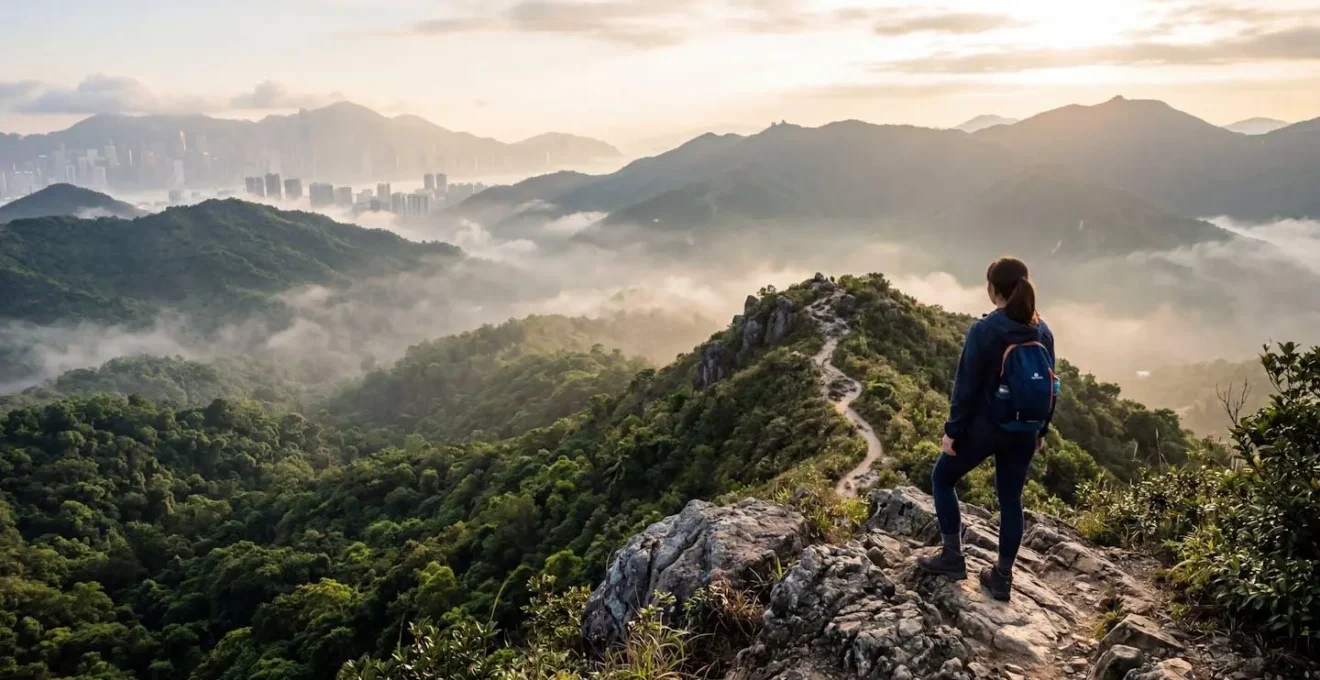
Hong Kong’s best-kept secret isn’t a hidden bar, but a hyper-efficient system for escaping its urban density into total wilderness.
- Mastering the city’s unique challenges—extreme humidity and complex transport—is the key to unlocking its best trails.
- Choosing the right trail isn’t about fame; it’s about matching your fitness and goals to Hong Kong’s specific terrain.
Recommendation: To find true solitude, think like a local trail expert, not a tourist. Prepare for the conditions, learn the transport rules, and you’ll find your escape.
The first image of Hong Kong is almost always its breathtaking skyline, a dense forest of skyscrapers packed between mountain and sea. But here’s the city’s most shocking secret: 40% of its land is protected country park. For the active traveler, this presents a mind-bending reality. How can one of the world’s most crowded cities also be a world-class hiking destination? The answer isn’t just in the trails themselves, but in understanding the unique system that connects extreme urbanism with raw nature.
Many guides will point you to the famous names like Dragon’s Back, but they often miss the point. They give you a destination without the operating manual. The real challenge and reward of Hong Kong hiking lies in mastering the urban-wilderness interface. It’s about knowing why that bottle of Pocari Sweat is more important than an extra liter of water, why your stylish sneakers are a liability, and how a tiny red minibus is your ticket to a deserted beach. Forget the generic advice; the key to finding that promised solitude is to understand Hong Kong’s specific rules of engagement.
This guide isn’t just a list of trails. It’s a strategy guide for the active traveler looking to hack Hong Kong’s system of escape. We will deconstruct the essential elements—from hydration science and gear specifics to transport mastery and seasonal timing—that turn a hike from a crowded march into a genuine adventure. Prepare to see a side of Hong Kong you never knew existed, often just a 30-minute ride from the chaos of Central.
To help you navigate this unique environment, this article breaks down everything you need to know. We’ll cover the critical safety precautions, help you choose the perfect trail, and provide the insider tips you need to explore with confidence.
Summary: Your Guide to Mastering Hong Kong’s Hiking System
- The Hydration Mistake That Sends Hikers to the Hospital in Summer
- Dragon’s Back or Lion Rock: Which Trail Fits Your Fitness Level?
- How to Pack for a Hong Kong Hike: Essentials You Might Forget
- Why Hong Kong Preserves 40% of Its Land as Country Parks?
- How to Reach Remote Trailheads Using Only Public Transport?
- Shopping Summer or Hiking Autumn: Which Season Fits Your Goal?
- The Footwear Mistake That Causes Injuries on Dragon’s Back
- MacLehose Trail Section 2:Which Skyscraper Observation Deck Offers the Best View of Victoria Harbour?
The Hydration Mistake That Sends Hikers to the Hospital in Summer
Let’s get one thing straight: hiking in Hong Kong’s summer is no joke. The biggest mistake visitors make is underestimating the humidity. This isn’t a dry desert heat; it’s a crushing, energy-sapping blanket that makes your body work overtime to cool down. The statistics are chilling: a 2023 study from a local hospital revealed that 97% of heat-related ICU admissions were hikers, with a significant mortality rate. The danger isn’t just feeling hot; it’s a serious medical risk driven by rapid fluid and electrolyte loss through sweat.
The common advice to “just drink more water” is dangerously simplistic here. When you sweat this much, you lose vital salts like sodium and potassium. Replenishing with plain water alone can dilute the remaining electrolytes in your body, leading to a dangerous condition called hyponatremia. The local strategy, born from experience, is an electrolyte-first approach. This means pre-hydrating with an electrolyte drink a few hours before your hike and carrying isotonic drinks like Pocari Sweat or Aquarius to sip alongside your water. Think of it as refueling your engine’s oil, not just its gasoline.
The Hong Kong Observatory even developed a specific Hong Kong Heat Index (HKHI) because standard metrics weren’t sufficient to capture the stress on the human body in our unique “wet-bulb” conditions. A warning is issued when the HKHI hits 30. As a guide, my rule is simple: if the HKHI is high, we either cancel the hike, choose a short coastal trail with a swim at the end, or start at dawn. Your body will thank you for respecting the invisible power of Hong Kong’s humidity.
Dragon’s Back or Lion Rock: Which Trail Fits Your Fitness Level?
So, you’ve got a free day and you’re ready to hit the trails. The two names that always come up are Dragon’s Back and Lion Rock. They are both iconic, but they offer vastly different experiences and demand different levels of fitness. Choosing the wrong one for your goals or abilities can be the difference between an epic day out and a miserable slog. This isn’t just about the view; it’s about what kind of challenge you’re looking for.
As the image suggests, you’re at a crossroads. Dragon’s Back is your scenic coastal reward. It’s an undulating ridge walk with stunning views of Shek O’s beaches and the South China Sea. It’s more of a brisk walk than a grueling hike, with a moderate and gradual elevation gain. It’s perfect for active travelers who want incredible nature photography without a lung-busting ascent. Its main downside? It’s incredibly popular. Lion Rock, on the other hand, is the city’s gritty, urban challenge. The view is arguably the best in Hong Kong—a 360-degree panorama of Kowloon’s density against the backdrop of Hong Kong Island. But you have to earn it. The final ascent is a steep, rocky scramble that requires confidence and a good head for heights. The payoff is that iconic “man vs. metropolis” photo that screams Hong Kong.
To make the decision easier, here is a direct comparison of the two trails:
| Factor | Dragon’s Back | Lion Rock |
|---|---|---|
| Distance | 8.5km | 6-8km (varies by route) |
| Duration | 3-4 hours | 3-4 hours |
| Difficulty | Intermediate (2.5/5) | Hard (3.5/5) |
| Elevation Gain | ~350m gradual | ~450m steep scramble |
| Trail Type | Well-paved, exposed ridge | Rocky scramble, forested start |
| Views | Coastal/beaches (Big Wave Bay) | 360° urban skyline |
| Solitude Score | Low (unless reverse route at dawn) | Medium (early mornings better) |
| Exit Logistics | Easy bus from Big Wave Bay | Long walk to Wong Tai Sin |
| Photo Appeal | Nature/sea shots | ‘Man vs Metropolis’ iconic shots |
How to Pack for a Hong Kong Hike: Essentials You Might Forget
Packing for a Hong Kong hike isn’t about bringing expedition-level gear; it’s about being smart and carrying a few small items that make a huge difference. Because of the city’s unique setup, your pack should be a blend of outdoor essentials and urban survival tools. Experienced hikers here have a saying: “Pack for the journey, not just the destination.” This means preparing for the transport, the humidity, and the possibility of ending your hike in a village with a single vending machine.
First, your tech is your lifeline. Your phone running a map app will drain its battery twice as fast while searching for a signal in the valleys. A fully charged power bank isn’t a luxury, it’s a critical safety item. Second, don’t forget your Octopus card. It’s your key to jumping on a minibus in the middle of nowhere or buying a cold drink from a trailside stall. Many of the green minibuses that service remote trailheads don’t give change, and the red ones are often cash-only, so having both your Octopus and some small bills is crucial.
But the real pro-level packing is about humidity management. A small, portable USB fan or a dedicated cooling towel can feel like a lifesaver during a water break on an exposed ridge. And an item that tourists find baffling but locals swear by is a travel umbrella for sun protection. On trails with no tree cover like Dragon’s Back, creating your own shade drastically reduces heat stress. It’s a practical, lightweight solution to a very real problem. Finally, always download your map for offline use before you leave. You cannot rely on having a mobile signal when you need it most.
Here are the essentials you’re most likely to forget:
- Tech Lifeline: Fully charged power bank (phone drains 2x faster with map apps and poor signal).
- Payment Essential: Octopus Card for minibuses and remote vending machines.
- Comfort Item: Portable USB fan or cooling towel for humidity management during breaks.
- Sun Protection: Travel umbrella for shade on exposed ridges (not just for rain).
- Emergency Cash: Small bills for red minibuses that don’t accept cards.
- Timing Tool: Download offline maps before departure (AllTrails Plus or similar).
Why Hong Kong Preserves 40% of Its Land as Country Parks?
For any first-time visitor flying into Hong Kong, the view is a paradox: one of the densest cities on Earth is surrounded by an ocean of green. It’s a stunning visual, but it begs the question: why? In a city obsessed with real estate and development, how has so much land been left “untouched”? The answer isn’t a simple story of environmentalism; it’s a pragmatic and fascinating piece of Hong Kong’s history.
The entire country park system, which now covers an astonishing 40% of Hong Kong’s total land area across 24 parks, was born out of a critical need: water. In the 1960s and 70s, Hong Kong faced severe water shortages. The government’s solution was brilliant in its simplicity. To protect the reservoirs and the catchment areas that fed them from pollution and erosion, they needed to protect the surrounding hillsides. By designating these areas as parks, they created a natural, low-cost water purification and collection system.
A foundational 1979 plan, detailed in studies of the parks’ origins, shows this dual purpose. The programme was primarily designed to protect these vital water resources. However, the planners also recognized the immense psychological benefit of providing “mental health relief” for residents living in extreme density. They created a system that served both the physical needs of the city (water) and the mental well-being of its people (recreation). This is the true genius of Hong Kong’s urban-wilderness interface: it’s not an accident of geography, but a masterpiece of integrated urban planning. What began as a strategy for water security has evolved into the city’s greatest recreational asset.
How to Reach Remote Trailheads Using Only Public Transport?
One of the most intimidating yet rewarding aspects of hiking in Hong Kong is mastering its public transport system. Your ability to “hack” the network of MTR trains, double-decker buses, and, most importantly, minibuses, is what separates you from the tourist trail. Having a car is a liability here; the real freedom comes from knowing how to get to a remote trailhead in Sai Kung for sunrise and be back in Central for dinner, all with an Octopus card and a bit of local knowledge.
The backbone of any hiking journey is the MTR + Minibus combo. The MTR gets you to the edge of the city, and a green minibus (GMB) takes you deep into the country parks. These GMBs run on fixed routes and you pay with your Octopus card. Your best friends here are apps like HKeMobility or the KMB app, which help you plan these multi-modal journeys. The real “final boss” of Hong Kong transport, however, is the red minibus (RMB). These are faster, more direct, and operate on a flexible, almost legendary system. You can flag them down anywhere on their route, you must pay the driver in cash (have exact change!), and you have to shout “Yau lok!” (I want to get off!) to signal your stop. It’s a rite of passage.
A crucial part of your planning is checking the last departure times. In areas like Sai Kung or the start of the MacLehose trail, the last bus can be as early as 6 or 7 PM. Missing it could mean a very expensive taxi ride or, in some remote areas, a serious problem. Always have a backup plan, like the phone number of a local taxi company, saved on your phone. This isn’t about being paranoid; it’s about being a self-sufficient and smart adventurer.
Here’s a look at how you’d access some popular trail areas:
| Trail | MTR Station | Bus/Minibus Route | Journey Time | Last Return |
|---|---|---|---|---|
| Dragon’s Back | Shau Kei Wan | Bus 9 or Red minibus to Shek O Road | 20 mins | Bus 9: ~11pm |
| Lion Rock | Wong Tai Sin | Walk or taxi to trail start | 15 mins walk | MTR until midnight |
| Shing Mun Reservoir | Tsuen Wan | Minibus 82 to Pineapple Dam | 30 mins | ~6:30pm |
| High Island Reservoir | None direct | Taxi from Sai Kung Town | 30 mins | Pre-arrange return |
| MacLehose Trail Start | None direct | Bus from Sai Kung to Pak Tam Chung | 45 mins | ~6pm weekdays |
Shopping Summer or Hiking Autumn: Which Season Fits Your Goal?
Timing is everything in Hong Kong. Choosing the right season for your hiking trip will fundamentally change your experience. Unlike places with four distinct, gentle seasons, Hong Kong operates on a more dramatic schedule, swinging between glorious hiking weather and a period so hot and humid it’s best reserved for shopping malls and air-conditioned cafes. Locals often refer to the two main hiking periods as “The Golden Weeks” and “The Sauna.”
“The Golden Weeks” (late October to December) are, without a doubt, the pinnacle of the hiking year. During this time, the brutal summer humidity finally breaks, leaving behind clear, dry days with comfortable temperatures. This is the season to tackle the high-altitude ridge walks like Sunset Peak or Lantau Peak. The visibility is often spectacular, offering those million-dollar views that stretch for miles. The air is crisp, the trails are firm, and the experience is pure joy. This is the Hong Kong from the hiking postcards.
Then there is “The Sauna” (June to August). Hiking during this period is an exercise in extreme humidity management. Temperatures soar above 30°C, but it’s the near-100% humidity that poses the real challenge. Safe hiking is limited to very early mornings or short coastal trails that end with a refreshing swim, like the path to Tai Long Wan. You also have to contend with “Typhoon Roulette” from August to September, where you must monitor the Hong Kong Observatory’s warnings daily. A T3 signal means finish your hike immediately, while a T8 brings the entire city, including all public transport, to a complete standstill. Spring (February-April) offers a misty, atmospheric alternative, perfect for forest trails but be prepared for slippery rocks.
For a more detailed breakdown, consider these micro-seasons:
- Late Oct-Dec (Golden Weeks): Target high-altitude ridge walks like Sunset Peak for clear views.
- Feb-Apr (Misty Spring): Choose atmospheric forest trails but prepare for slippery conditions.
- Jun-Aug (The Sauna): Limit to waterfall trails or coastal hikes ending at beaches like Tai Long Wan.
- Aug-Sep (Typhoon Roulette): Monitor HKO warnings daily, have flexible plans.
- Nov-Jan: Catch spectacular silvergrass blooms on Tai Mo Shan and Sunset Peak.
Key takeaways
- Hydration in Hong Kong is about electrolyte management and timing, not just the volume of water you carry.
- Hong Kong’s public transport isn’t an obstacle; it’s part of the adventure. Learning its rules is your key to remote trails.
- Your footwear choice is the single most important safety decision; lightweight trail runners are essential for Hong Kong’s unique terrain.
The Footwear Mistake That Causes Injuries on Dragon’s Back
I see it every weekend on the trails, and it’s the single most common and avoidable mistake hikers make in Hong Kong: wearing the wrong shoes. People see a popular trail like Dragon’s Back on Instagram and assume their fashionable lifestyle sneakers—Vans, Converse, Stan Smiths—will be fine. They are not. This isn’t a paved city park; the trail surfaces here are deceptively treacherous, and your footwear is your most critical piece of safety equipment.
The primary hazard on many Hong Kong trails, especially on the descent, is a surface of loose, gravel-like decomposed granite. It acts like a layer of marbles on a hard surface. Shoes with flat, smooth soles have zero grip on this. You might as well be walking on ice. This is compounded by the humidity; heavy, waterproof Gore-Tex boots, which might be great in Europe or North America, become personal saunas for your feet here. They trap sweat, leading to severe blisters and overheated feet, which is a dangerous path toward heat-related illness.
The correct choice, worn by 99% of experienced local hikers, is a pair of lightweight, breathable trail runners. Look for shoes with an aggressive tread pattern—deep lugs that can bite into the loose soil. They offer the grip you need on the granite, while their breathable mesh uppers allow sweat and heat to escape, keeping your feet cooler and dryer. They are the perfect tool for the job, designed for the very conditions you will face. Choosing trail runners over fashion sneakers is not a style choice; it’s a safety decision.
Your Action Plan: Footwear Safety Checklist for Hong Kong Trails
- Perform the ‘coin test’: Before you pack, check your shoe’s tread. If you can’t fit the edge of a coin into the grooves, the sole is too worn and unsafe for the trail.
- Prioritize breathability: Choose lightweight trail runners with mesh uppers over heavy, waterproof boots to prevent your feet from overheating and developing blisters in the humidity.
- Check the sole compound: Ask for shoes with a softer rubber compound. They provide superior grip on the smooth, hard granite surfaces common on Hong Kong’s paths.
- Ensure a proper fit: Leave a thumb’s width of space between your longest toe and the end of the shoe. This prevents your toes from jamming into the front during steep descents.
- Consider trekking poles: For descents on trails like Lion Rock or Sunset Peak, trekking poles can save your knees and provide two extra points of contact, which is where most slips and injuries occur.
MacLehose Trail Section 2:Which Skyscraper Observation Deck Offers the Best View of Victoria Harbour?
This question is a clever trap. And the answer is: neither. MacLehose Trail Section 2, one of the most famous and beautiful hikes in Hong Kong, offers absolutely no view of Victoria Harbour. It’s a common misconception for visitors planning their trips. This section of the trail is located deep within the Sai Kung East Country Park, and its world-class views are of something entirely different: the pristine, turquoise waters and white-sand beaches of Tai Long Wan bay. It’s a view of untouched nature, not the urban skyline.
This highlights a core choice every visitor to Hong Kong faces: the “Earned View” versus the “Purchased View.” A skyscraper observation deck gives you a stunning, convenient, and comfortable view of the harbour. You buy a ticket, ride an elevator, and you’re there. It’s a purchased experience. A hike like MacLehose Section 2 offers an earned experience. It takes hours of physical effort, sweat, and planning. The reward isn’t just the view at the end, but the sense of accomplishment, the silence of nature, and the refreshing swim in a deserted bay afterward. One is not better than the other, but they are fundamentally different types of travel experiences.
So what if you want both? What if you want to earn a view of the city skyline? The perfect compromise is the Morning Trail, which ascends from the urban jungle of Mid-Levels to Victoria Peak. It’s a genuine, challenging hike through dense subtropical forest that suddenly emerges at the world’s most famous city panorama. You get the physical effort and the natural immersion, and your reward is that iconic harbour view. It’s the best of both worlds—an earned view of the city, accessible yet far more satisfying than just taking the Peak Tram or a taxi.
Now you have the framework. You understand that hiking in Hong Kong is a system. It’s about respecting the humidity, choosing the right gear for the specific terrain, hacking the public transport, and timing your adventure with the seasons. Armed with this knowledge, you are no longer just a tourist following a signpost; you are an explorer, ready to unlock the wild, hidden side of this incredible city. The next step is to choose your first trail and experience the incredible urban-wilderness interface for yourself.