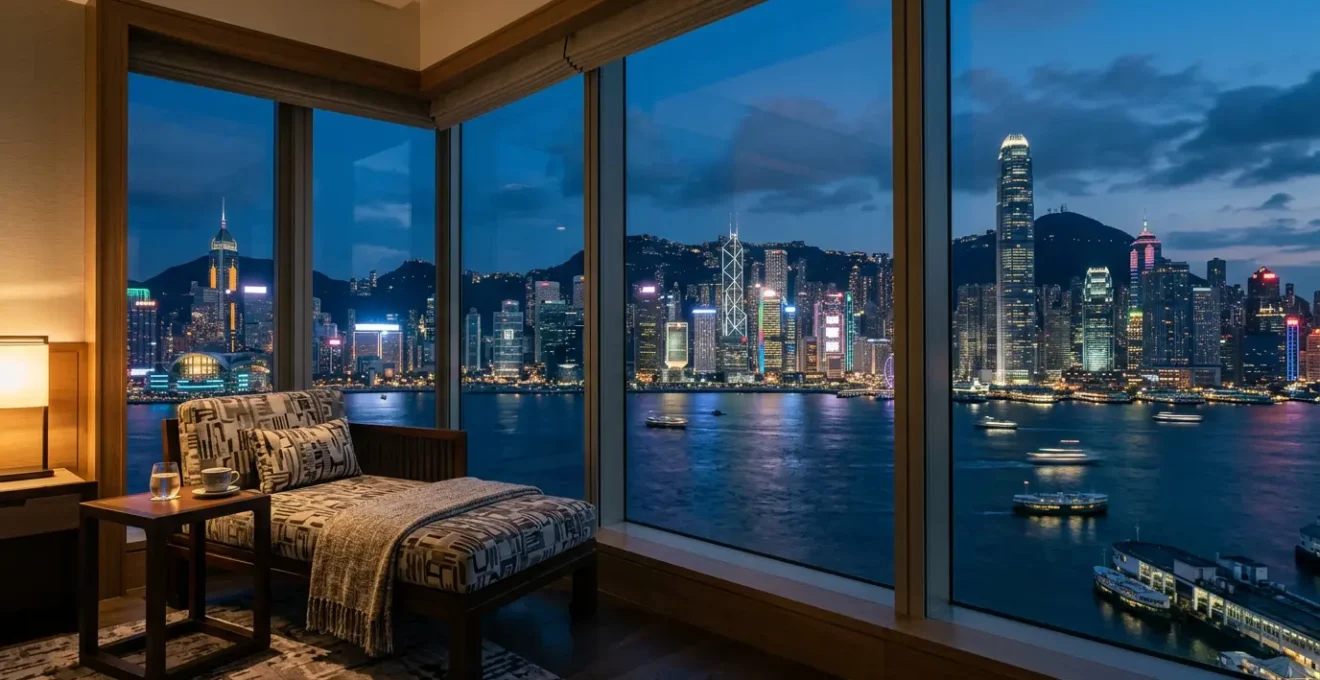
The best Hong Kong hotel view isn’t about the highest floor or even the harbour; it’s about mastering compositional power from your window.
- Kowloon offers a layered, cinematic frame of the Hong Kong Island skyline, creating superior depth and narrative.
- Your choice of floor height dictates the visual story: lower floors for texture and energy, higher floors for abstraction and serenity.
Recommendation: Use public observation decks to scout your ideal composition, then book a specific room type that allows you to capture that perfect shot in private comfort.
For the visual traveler, a hotel room in Hong Kong is more than a place to sleep—it’s a private observatory, a front-row seat to one of the world’s most dynamic visual spectacles. The question isn’t simply “which hotel has a good view?” but rather, “which room gives me the greatest compositional power over the city’s narrative?” Most guides will point you towards the highest floor with a harbour view, but this often misses the nuances that create a truly breathtaking image.
The common advice focuses on a binary choice: Kowloon side or Island side. While a valid starting point, it’s just the first brushstroke on a complex canvas. True mastery of your view involves understanding perspective, the quality of light, and the story your chosen altitude tells. It’s about deciding whether you want to frame the tranquil greens of Victoria Peak or the electric ballet of ferries on the water. It’s about knowing the difference between a static postcard and a living, breathing cinematic frame.
But what if the secret wasn’t just about what you see, but *how* you see it? This guide moves beyond the platitudes. We will deconstruct the Hong Kong skyline from a visual expert’s perspective, treating your hotel window as a camera lens. We’ll explore why a lower floor can be more compelling than a penthouse, why a mountain view might be more restorative than the harbour, and how to use light as your final, most powerful compositional tool.
This article will equip you with the principles to not just find a room with a view, but to select a private gallery from which to direct your own personal visual story of Hong Kong. Below is a summary of the key compositional elements we will dissect to help you frame your perfect shot.
Summary: A Visual Expert’s Guide to Choosing Your Hong Kong Hotel View
- Why Staying on the Kowloon Side Gives the Best Island Skyline View?
- Why Corner Suites Offer the Best Panorama Value?
- Floor 10 vs Floor 50:Leaving Hong Kong: How to Optimize Your Final Day Logistics?
- Why a Mountain View Can Be More Relaxing Than the Harbour?
- Which Hotels Offer Bathtubs With Unobstructed City Views?
- Why Are Balconies So Rare in HK Hotels and Where to Find Them?
- Blue Hour or Golden Hour: Which Lighting Suits the Neon Skyline Best?
- When to Visit Observation Decks for the Perfect Sunset Shot?
Why Staying on the Kowloon Side Gives the Best Island Skyline View?
The most foundational rule of skyline photography and appreciation is to position yourself across from your subject. For Hong Kong, this means the most iconic view of the Island’s dramatic skyline is unequivocally from the Kowloon side. This isn’t just opinion; it’s a principle of visual composition. As CNN Travel notes, from this vantage point the island’s buildings are perfectly layered against Victoria Peak’s backdrop. This layering creates a classic three-part composition: the dynamic foreground of Victoria Harbour, the dense midground of the Central district’s architectural icons, and the powerful background of the mountain range. This depth is what transforms a flat picture into a compelling narrative.
Hotels on the Tsim Sha Tsui waterfront are designed to capitalize on this exact principle. Their popularity isn’t accidental; research shows that waterfront hotels in Tsim Sha Tsui see an 86% average occupancy rate, a testament to the high demand for this premier visual access. Staying on Hong Kong Island itself places you *within* the skyline, which offers its own energetic, immersive experience, but it denies you the ability to see the city as a complete, singular composition.
Case Study: Regent Hong Kong’s Strategic Harbor Positioning
The Regent Hong Kong exemplifies the Kowloon advantage. Its location stages Victoria Harbour as the lead character in every guest experience. From its waterfront position, rooms face Hong Kong Island head-on, creating a single, uninterrupted cinematic frame that captures the constant motion of ferries, the passage of traditional red-sailed junks, and the skyline’s transformation at dusk against the silhouette of Victoria Peak.
For the visual artist, choosing the Kowloon side isn’t just about a better view; it’s about securing the correct vantage point to tell the classic story of Hong Kong: a metropolis carved between water and mountain.
Why Corner Suites Offer the Best Panorama Value?
Once you’ve chosen your side of the harbour, the next step in elevating your compositional power is selecting the right room geometry. A standard room offers a single, fixed frame. A corner suite, however, transforms your room into a panoramic camera, offering a wraparound visual experience that fundamentally changes your relationship with the city. It’s not about luxury for luxury’s sake; it’s about gaining maximum visual control.
This panoramic ability allows you to capture multiple narratives from a single point. You can witness the sun rising over the eastern part of the harbour and later watch it set behind the mountains to the west. This is the essence of a dynamic view—one that evolves throughout the day. The L-shaped window configuration of a corner suite provides a sense of immersion that a flat, single-window view cannot replicate. The city doesn’t feel like a picture on a wall; it feels like an environment you are a part of.
As the image above illustrates, the corner perspective creates leading lines that draw the eye across the entire landscape, from the harbour’s bustling activity to the distant islands. This is the ultimate tool for a visual traveler looking to capture the full scope and scale of the Hong Kong panorama.
Case Study: The Four Seasons Hong Kong’s Corner Suite Configuration
The Four Seasons Hong Kong’s corner suites demonstrate the panorama principle perfectly. Located exclusively on building corners, these accommodations offer 270-degree views encompassing Victoria Harbour, Kowloon, and Stonecutters Island. The suite’s L-shaped layout maximizes window exposure with floor-to-ceiling glass on two full walls, allowing guests to experience sunrise over the harbor and sunset behind the mountains from a single vantage point.
Floor 10 vs Floor 50:Leaving Hong Kong: How to Optimize Your Final Day Logistics?
The conventional wisdom that “higher is better” is a platitude that fails the visual expert. The choice of floor is not a simple question of altitude but a crucial decision about your desired narrative. I call this concept “Sensory Altitude.” A lower floor (e.g., 10-20) offers a view of connection and detail. You can discern the texture of the water, the movement of individual people, and the architectural details of nearby buildings. It’s an energetic, grounded composition that makes you feel part of the city’s pulse.
Conversely, an ultra-high floor (e.g., 50+) offers a view of abstraction and serenity. The city transforms into a glittering, geometric pattern. The noise and chaos melt away, replaced by a detached, god’s-eye perspective. This is a more contemplative, almost meditative experience. The choice between them depends entirely on the story you want to tell: gritty urban energy or sublime, silent scale. Furthermore, practicalities come into play. On humid days, the highest floors can be completely engulfed in clouds, leaving you with a view of pure white.
This visual comparison highlights the trade-off. The left frame shows the rich detail and texture visible from a lower altitude, while the right frame captures the abstract, ethereal quality of an ultra-high perspective. Neither is inherently “better”—they are simply different compositional choices.
Case Study: The Ritz-Carlton Hong Kong’s Extreme Height Experience
Occupying floors 102-118 of the ICC building, The Ritz-Carlton Hong Kong provides a masterclass in ultra-high floor dynamics. While the views from 490 meters are spectacular, visibility can be completely obscured on humid days, with the 80th+ floors often sitting within cloud cover. Guests also report elevator transit and wait times of several minutes during peak hours—a small but real trade-off for the extreme altitude.
Why a Mountain View Can Be More Relaxing Than the Harbour?
In a city defined by its iconic harbour, choosing a mountain view can feel like a contrarian act. Yet, for the discerning visual traveler, it’s a deliberate compositional choice that prioritizes tranquility over stimulation. While the harbour is a spectacle of man-made energy—neon, steel, and motion—the mountains offer a powerful dose of natural serenity. It’s a visual palate cleanser, a pocket of calm in a city that never sleeps. This isn’t a minor feature; according to environmental data, over 75% of Hong Kong’s territory is designated parkland, a staggering fact that is often overlooked.
Opting for a room facing Victoria Peak or the Kowloon hills allows you to frame a different kind of beauty. The composition is one of soft, organic lines, deep greens, and the subtle play of mist and light. It’s a view that invites contemplation rather than awe. Psychologically, views of nature (a concept known as biophilia) have been shown to reduce stress and improve mental well-being. After a day spent navigating the dense urban jungle, returning to a room that frames a calm, green expanse can be profoundly restorative.
The ideal mountain view is often found on mid-range floors (10-20), where you are high enough to see over immediate obstructions but low enough to perceive the texture of the foliage and the details of the terrain. For a true expert composition, consider a corner room in a hotel in Mid-Levels or Quarry Bay, which can offer a dual perspective: the calming green of the mountains on one side and the dynamic energy of the city on the other, giving you complete control over your desired visual mood.
Which Hotels Offer Bathtubs With Unobstructed City Views?
The ultimate act of immersive viewing is to combine the sensory experience of a warm bath with the visual spectacle of the Hong Kong skyline. A bathtub with a view is not merely an amenity; it’s a compositional device that creates a private, distraction-free gallery. With the lights dimmed, the ambient noise of the city muted by glass, and your body suspended in water, the view becomes the sole focus of your attention. Every flicker of light, every passing boat, is amplified.
This experience transforms passive viewing into active contemplation. It allows you to study the city’s light and movement for an extended period, noticing details you might otherwise miss. It is the visual traveler’s equivalent of a meditation chamber, where the mantra is the ever-changing skyline. It’s a moment to not just see the city, but to feel its presence in a uniquely serene and personal context.
However, securing this experience requires strategic booking. It’s a common misconception that any “harbour view” room will include this feature. As one expert guide points out, this coveted amenity is often reserved for very specific, high-tier suites.
A bath with a view is often specific to a handful of high-tier suites, not all ‘harbour view’ rooms.
– The Most Perfect View Travel Guide, Hong Kong Hotel Views Analysis 2025
Therefore, the key is to move beyond generic room categories. When booking, you must investigate the specific floor plans and photo galleries for premium suites, such as corner suites or specialty-named suites. Contacting the hotel directly to confirm which specific rooms feature a view-facing bathtub is the most reliable method for guaranteeing this unparalleled compositional experience.
Why Are Balconies So Rare in HK Hotels and Where to Find Them?
For a visual artist, breaking the glass barrier between yourself and the subject is transformative. A balcony adds sound, temperature, and scent to the purely visual experience, creating a full sensory composition. However, in Hong Kong, private hotel balconies are exceptionally rare. The reason is a simple, brutal matter of economics and physics. Research confirms that Hong Kong has the world’s most expensive real estate per square foot, making any non-enclosed space an extravagant use of hyper-valuable land. Furthermore, the city’s building codes and typhoon-related structural requirements for high-rises make cantilevered balconies complex and costly to engineer.
This scarcity makes finding a room with outdoor access a true mark of a dedicated visual traveler. It requires looking beyond standard hotels and seeking out specific properties known for this rare feature. While true, spacious terraces are the domain of a few premier suites, other forms of outdoor access exist for those who know where to look. These can range from “Juliette” balconies, which only offer standing room, to shared access to exclusive club terraces.
For those determined to add this sensory layer to their experience, the search itself is part of the journey. The following list provides a starting point for finding properties that offer a precious connection to the open air.
Action Plan: Finding Hotels with Outdoor Spaces
- True Alfresco Balconies: Prioritize hotels known for full terraces, like select suites at the Kerry Hotel Hong Kong.
- Juliette Balconies: Investigate properties like the W Hong Kong for rooms with standing-room-only glass barriers, offering fresh air without the space.
- Semi-Outdoor Terraces: Consider club-level rooms at hotels like the Rosewood Hong Kong for access to a shared outdoor deck.
- Exclusive Private Terraces: For the ultimate experience, research top-tier signature suites, such as The Peninsula Suite with its rooftop terrace access.
- Strategic Alternative: If a private balcony is unattainable, book a hotel with a spectacular rooftop pool or bar to secure that essential outdoor skyline experience.
Securing a room with a balcony allows you to compose your shot not just with light and form, but with the very atmosphere of the city itself.
Blue Hour or Golden Hour: Which Lighting Suits the Neon Skyline Best?
A master of visual composition knows that the subject is only half the story; the other half is light. Choosing *when* to view the Hong Kong skyline is as important as choosing *where* to view it from. Your hotel room becomes a director’s chair, allowing you to witness the “light choreography” that plays out over the city each day. The two most dramatic acts are the Golden Hour and the Blue Hour.
Golden Hour, the period shortly before sunset, bathes the city in a warm, soft, and directional light. It’s a romantic and nostalgic light that emphasizes the form and texture of the buildings, casting long shadows and making the glass towers glow. Compositions facing west during this time will capture the sun’s warm kiss on the skyline, creating dramatic silhouettes.
Blue Hour, the period just after sunset, offers a different magic. The sky takes on a deep, rich blue that creates the perfect contrasting backdrop for the city’s emerging neon and artificial lights. This is the moment of perfect balance between natural and man-made light, where the vibrancy of the city’s glow is at its peak without being lost against a pitch-black sky. For capturing the electric energy of Hong Kong’s nightlife, the Blue Hour is unparalleled. In fact, for the famous 8 PM “Symphony of Lights,” the Hong Kong Tourism Photography Guide suggests the optimal time to start shooting is during Blue Hour around 7:30 PM to capture the rich color of the sky as the building lights begin their show.
Having a hotel room with a view gives you the advantage of experiencing both, allowing you to decide which lighting best tells the story you want to capture. You can set up a camera for a long-exposure time-lapse and watch the entire performance unfold without interruption.
Key Takeaways
- Compositional Power: The best view comes from treating your room like a camera, actively framing the city’s visual narrative.
- The Kowloon Advantage: For a classic, layered skyline shot with depth, the Kowloon waterfront is the superior vantage point.
- Sensory Altitude: Your choice of floor height is a creative decision between detailed, energetic views (low floors) and abstract, serene panoramas (high floors).
- Light Choreography: Master the timing of your viewing by using Golden Hour for warm silhouettes and Blue Hour for the perfect neon-to-sky balance.
When to Visit Observation Decks for the Perfect Sunset Shot?
While the ultimate goal is to frame the perfect shot from the privacy of your hotel room, public observation decks like The Peak or Sky100 play a crucial role in the visual expert’s process. They are not the final destination; they are the scouting location. On the first day of your trip, you should use these public vantage points to conduct reconnaissance. This allows you to test different angles, identify key landmarks, and decide on the exact composition you wish to capture without committing to a hotel.
Think of it as a dress rehearsal. You can see in real-time how the light falls across the city, which buildings catch the sunset, and how the harbour traffic creates patterns on the water. This scouting mission informs your final, most important decision: which hotel and which specific room type will allow you to replicate and perfect that scouted view. The advantage of the hotel room is control—you can use a tripod, manage the lighting, and shoot long exposures without crowds or reflective glass issues, something impossible on a public deck.
This two-step process—scout publicly, shoot privately—is the hallmark of a seasoned visual traveler. It combines the expansive access of an observation deck with the controlled environment of a private room to create the perfect final image. To execute this strategy effectively, follow a simple pre-booking audit.
Your Pre-Booking Scouting Plan: A 5-Step Audit
- Points of Contact: Identify key observation decks (e.g., The Peak, Sky100) and a shortlist of potential hotels visible from those decks.
- Collect: Visit a deck during late afternoon. Inventory the most compelling compositions, noting angles, foregrounds, and the interplay between buildings.
- Coherence: Confront these views with your desired visual narrative. Are you seeking the serene abstraction from Sky100 or the classic layered view from The Peak?
- Memorability & Emotion: Assess which composition has the most emotional impact as the light changes from Golden Hour to Blue Hour. Note the timing.
- Integration Plan: With your ideal composition identified, research and book the specific hotel and room type (e.g., “Kowloon-side corner suite, floors 20-30”) that best replicates your scouted shot.
By adopting this mindset—treating yourself as the director of your own visual experience—you elevate a simple hotel stay into an act of artistic creation. Your next trip to Hong Kong won’t just result in memories; it will result in a perfectly composed masterpiece, framed by you.