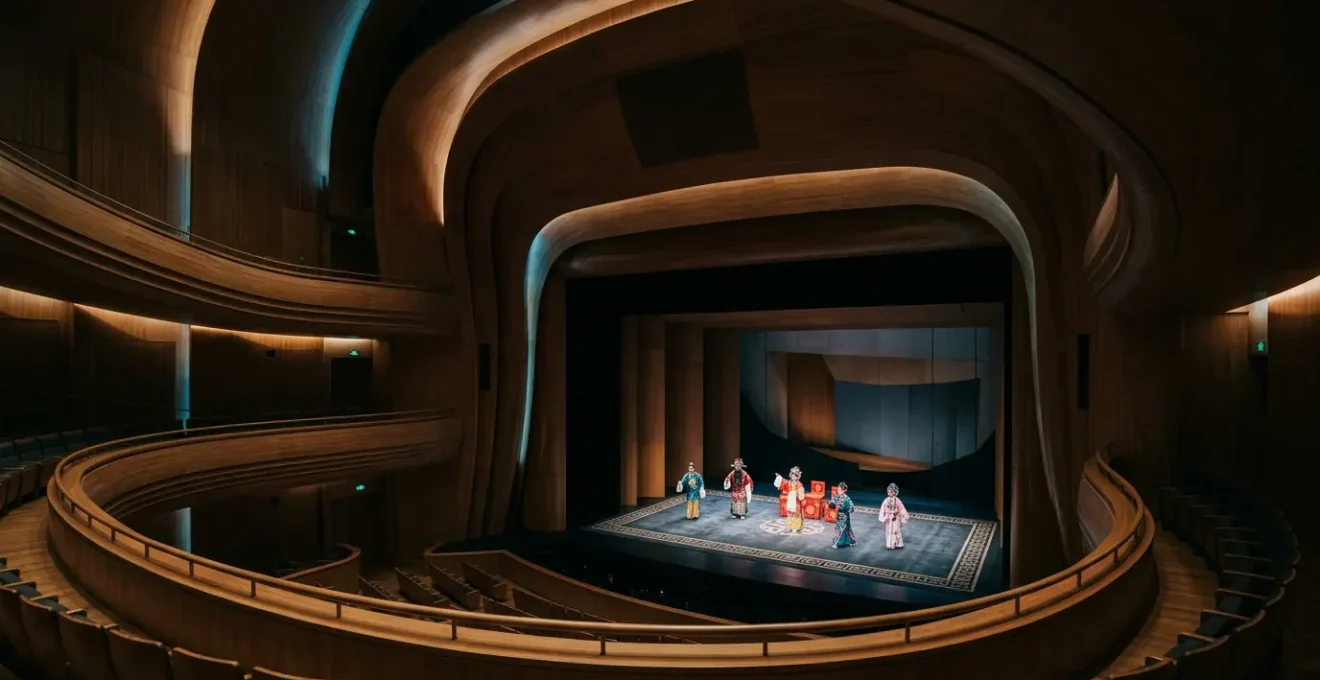
The language barrier is the most common fear preventing culture lovers from experiencing Cantonese opera. But the secret isn’t in understanding the dialogue; it’s in learning to read the rich symbolic code embedded in the performance. This guide provides the key to decoding the meaning behind every color, pattern, and gesture, transforming a potentially confusing spectacle into a deeply engaging cultural immersion at Hong Kong’s Xiqu Centre.
The first encounter with Cantonese opera can be an overwhelming symphony of sound and color. Cymbals crash, a high-pitched violin soars, and performers in fantastically elaborate costumes glide across the stage, singing in a language that, for many, is a beautiful but impenetrable wall. It’s a common experience for a foreign visitor: you are captivated by the spectacle but feel like you’re missing the story, worried that boredom or confusion will eventually set in. The typical advice is to “just read the surtitles,” but this often leads to a frantic tennis match between the stage and the screen, causing you to miss the very artistry you came to see.
But what if the language of the libretto is only one layer of the story? The true key to appreciating this magnificent art form lies not in auditory comprehension but in visual literacy. Cantonese opera is a masterclass in layered storytelling, where a deep and ancient grammar of symbols is communicated through makeup, costume embroidery, movement, and even the choice of musical instruments. It’s a code waiting to be cracked. This guide is your decoder ring. It will teach you how to read the visual clues the performers are sending, allowing you to follow the narrative, understand character motivations, and connect with the emotional core of the performance without relying solely on translated text.
This article is structured to walk you through the essential elements of this visual language. We will start by helping you follow the plot, then decode the meaning of face paint and costumes, understand the art form’s unique context, and finally, offer practical tips for choosing a performance and even participating in the festive culture that surrounds it. By the end, you’ll be equipped not just to watch, but to truly see.
Summary: A Foreigner’s Guide to Loving Cantonese Opera
- How to Follow the Plot Using Surtitles and Synopses?
- Why Do the Actors Wear Those Specific Colors and Face Paint?
- Beijing Opera vs Cantonese Opera: What Are the Key Differences?
- What Are the Pop-Up Bamboo Theatres Built for Festivals?
- The Duration Risk: How to Choose a Shorter Excerpt for Beginners?
- What Do the Embroidered Patterns on Traditional Costumes Signify?
- How to Join Traditional Festivals Even as a Foreigner?
- What Unique Souvenirs Can You Find in the Museum Shop?
How to Follow the Plot Using Surtitles and Synopses?
The fear of getting lost in the narrative is a major hurdle for newcomers. While surtitles in English and Chinese are a standard feature, treating them like movie subtitles is a mistake. Your goal is not to read every word but to use them as signposts. The real story is told through the performance itself. The key is to develop a strategy that balances glances at the screen with deep focus on the stage. Many venues, especially the Xiqu Centre, provide detailed plot synopses in their programs. Taking ten minutes to read this beforehand is the single most effective thing you can do; it pre-loads the character relationships and major plot points into your mind, freeing you to focus on the artistry.
Once the performance begins, think of the surtitles as a tool for context, not a script. They help you identify which character is speaking and the general emotional tone of the scene. Is the dialogue rapid and confrontational, or is it a long, poetic monologue? A quick glance can confirm your suspicions, which you should be gathering from the actors’ movements and the music’s tempo. For beginners, a fantastic way to ease into the art form is to start with a curated show. For instance, the Xiqu Centre’s Tea House Theatre specifically designs performances for beginners, with 90-minute introductory shows featuring English subtitles and guided commentary that explain the action as it happens.
Your Action Plan: Master the Surtitles Without Missing the Show
- Pre-Show Prep: Read the two-page synopsis provided in the program before the lights dim. This establishes the basic plot structure and character motives in your mind.
- The ‘Two-Second Glance’ Rule: When you need context, quickly scan the surtitles for a couple of seconds to get the gist, then immediately return your focus to the performers’ expressions and movements.
- Character Tracking by Costume: Instead of memorizing character names, track them by their visual code. Focus on identifying the “general in red” or the “maiden in pink” to follow their journey.
- Emotional Pacing Cues: Watch for the rhythm of the text. A rapid-fire exchange of short phrases on the screen indicates conflict, while longer, flowing passages signal an introspective song or poetic moment.
Why Do the Actors Wear Those Specific Colors and Face Paint?
Long before you read a single surtitle, the actors’ faces have already told you who they are. The intricate and vibrant face paint (臉譜, *liǎnpǔ*) is not mere decoration; it is a complex symbolic code that instantly communicates a character’s personality, moral standing, and social status. This visual shorthand is a cornerstone of Chinese opera, allowing the audience to immediately grasp the essential nature of a character the moment they step on stage. Each color carries a specific, deeply ingrained meaning that acts as a form of theatrical grammar.
This color-coded system is remarkably consistent. A hero will almost always appear with a predominantly red face, symbolizing loyalty and courage. Conversely, a cunning or treacherous villain is often painted with a white, chalky base. This immediate visual classification is one of the most powerful tools at your disposal as a non-speaker. Instead of trying to remember names, you can simply follow the “red-faced general” or the “white-faced minister” and understand their archetypal roles in the story. Even divine or supernatural beings have their own palette, often using gold and silver to signify their otherworldly nature.
The table below provides a basic guide to decoding this powerful visual language, helping you understand the heroes, villains, and gods of the story at a single glance.
| Color | Character Trait | Common Characters |
|---|---|---|
| Red | Loyalty, courage, righteousness | Guan Yu (heroic general) |
| White | Treachery, cunning, evil | Cao Cao (scheming minister) |
| Black | Integrity, straightforwardness, justice | Bao Zheng (incorruptible judge) |
| Gold/Silver | Divine, supernatural powers | Gods, Buddhas, spirits |
This system of visual literacy is fundamental. Learning to read these colors is like learning the alphabet of the opera; it unlocks a layer of meaning that dialogue alone cannot convey. It is a testament to the art form’s sophistication, where storytelling is a truly multi-sensory experience.
Beijing Opera vs Cantonese Opera: What Are the Key Differences?
For the uninitiated, “Chinese opera” can seem like a single monolithic entity. However, there are over 300 distinct regional styles, with Beijing Opera and Cantonese Opera being the two most prominent. Understanding their differences is key to appreciating what makes Cantonese opera unique. While both share a common heritage of symbolic gestures and storytelling, their origins, sound, and focus diverge significantly. Beijing opera, hailing from the imperial courts of the north, often has a more formal, martial atmosphere with a strong emphasis on acrobatics and stage combat. Its sound is dominated by the sharp, high-pitched *jinghu* violin.
Cantonese opera, conversely, was born in the bustling southern port cities around Guangzhou and Hong Kong. It is deeply rooted in folk culture and the tonal complexities of the Cantonese language, which has between six and nine tones compared to Mandarin’s four. This results in a more intricate and melodic singing style. The lead instrument is often the smoother, warmer *gaohu*, and Cantonese opera has famously incorporated Western instruments like the saxophone and violin, showcasing its adaptive and cosmopolitan nature. This cultural significance was formally recognized when Cantonese Opera was inscribed on UNESCO’s Representative List of the Intangible Cultural Heritage of Humanity in 2009.
The following table breaks down the core distinctions, helping you pinpoint the unique characteristics of the performance you are witnessing.
| Aspect | Beijing Opera | Cantonese Opera |
|---|---|---|
| Origin | Imperial court, formal atmosphere | Southern port cities, folk culture |
| Language Tones | 4 tones (Mandarin) | 6-9 tones (Cantonese) |
| Lead Instrument | Jinghu (high-pitched violin) | Gaohu, Western instruments (saxophone) |
| Performance Focus | Acrobatics and martial arts | Intricate singing and emotional acting |
What Are the Pop-Up Bamboo Theatres Built for Festivals?
While the state-of-the-art Xiqu Centre offers a pristine viewing experience, Cantonese opera’s soul is equally at home in a much more ephemeral structure: the temporary bamboo theatre. During major annual celebrations like the Cheung Chau Bun Festival or the Hungry Ghost Festival, these magnificent structures are erected across Hong Kong in a matter of weeks, using only bamboo poles and plastic ties. These performances, known as *san gung hei* (opera for the gods), serve a dual purpose as both a spiritual offering to deities and vibrant entertainment for the community. The atmosphere is electric, communal, and a world away from a formal concert hall.
Experiencing opera in this setting is a truly immersive cultural event. The air is thick with the smell of incense and festival food, and the line between audience and performer feels wonderfully blurred. You can even respectfully watch the actors apply their makeup in the open backstage areas. The architectural DNA of these temporary structures is so significant that it directly inspired the design of the modern Xiqu Centre. The grand, open atrium of the Xiqu Centre is a deliberate architectural nod to the communal, accessible spirit of the traditional bamboo theatre, connecting the art form’s past and future.
As a visitor, you are welcome at these events. The key is to be respectful. A common practice is to stand to the sides or behind the main seating area, as the front rows are often left empty, symbolically reserved for the deities who are the primary guests of honor. It is a powerful way to see the art form in its most authentic, grassroots context.
The Duration Risk: How to Choose a Shorter Excerpt for Beginners?
One of the biggest anxieties for a first-time attendee is the performance length. Traditional Cantonese operas can last for four hours or more, a significant commitment for anyone, let alone someone navigating a new art form. Committing to a full-length opera on your first try can be a recipe for fatigue. The wisest approach for a beginner is to start with shorter, curated programs or famous excerpts. This allows you to experience the full intensity and artistry of the opera in a more digestible format, leaving you energized and eager for more.
The Xiqu Centre’s Tea House Theatre is the perfect example of this beginner-friendly model. Its 90-minute shows, performed by the talented Rising Stars Troupe, are specifically designed as an accessible introduction. The experience is complete with narration to explain the plot and cultural context, all while you enjoy traditional tea and dim sum. This format brilliantly solves the duration challenge by presenting a “greatest hits” of operatic scenes rather than a full epic. It’s the ideal training ground for a future opera aficionado. When looking at programs, it’s helpful to know what kind of scenes to choose.
To help you select an excerpt that matches your taste, here is a guide to the main types of scenes:
- ‘Wu’ (martial) scenes: Choose these if you’re drawn to visual spectacle. They are packed with thrilling acrobatics, stylized stage combat, and impressive physical feats.
- ‘Wen’ (civil) scenes: Opt for these if you’re more interested in vocal artistry and emotional storytelling. They often focus on romance, poetry, and intricate singing.
- Famous Excerpts: Look for well-known stories like ‘The Monkey King’ or ‘The Peony Pavilion.’ Their popularity means they are often visually spectacular and easier to follow.
- Solo Virtuoso Performances: Sometimes, a program will highlight a performance of a single skill, such as the famous “water sleeve” dancing, offering a concentrated dose of incredible technique.
What Do the Embroidered Patterns on Traditional Costumes Signify?
Just like face paint, the costumes in Cantonese opera are a vibrant tapestry of information. The specific style of ‘Guangdong embroidery’ used is characterized by its elaborate patterns, vivid designs, and a rich palette of bright colors that reflect the lively culture of the Lingnan region. These are not just beautiful garments; they are a character’s resume, stitched in silk and gold thread. Every embroidered pattern, from the mythical creatures to the delicate flowers, contributes to the layered storytelling on stage, revealing a character’s rank, status, and even their moral alignment.
The hierarchy of the imperial court, for example, is instantly readable through this visual code. An essential rule of this theatrical grammar, as noted in analyses of the opera, is that only the emperor’s character can wear robes embroidered with five-clawed dragons. Princes and high-ranking nobles, in contrast, are permitted robes with four-clawed dragons. This subtle detail allows the audience to immediately understand the power dynamics at play. Other common symbols include peonies to signify wealth and nobility, and bats, which are a visual pun as the word for “bat” (蝠, *fú*) is a homonym for “good fortune” (福, *fú*) in Chinese.
Even the abstract patterns on a robe carry meaning. By learning to spot these key symbols, you can add another layer to your understanding of the performance. Here are a few key visual cues to look for:
- Dragon Claws: The most important status symbol. Count the claws: five for an emperor, four for a prince or top-ranking noble.
- Robe Bottom: Wavy lines and repeating curves at the hem of a robe almost always represent the earth and the sea.
- Shoulder Patterns: Swirling cloud patterns, often seen on the shoulders or chest, symbolically place the character in the celestial realm, between Heaven and Earth.
- Water Sleeves: The long, flowing silk sleeves are more than decorative. Their movements are an expressive language of their own: a sharp flick can show anger, while a gentle, poetic unfurling can signify deep thought or sorrow.
How to Join Traditional Festivals Even as a Foreigner?
Cantonese opera truly comes alive during Hong Kong’s vibrant traditional festivals. Throughout the year, especially on islands like Cheung Chau and Lamma or in areas like Tung Chung, temporary bamboo theatres become the pulsing heart of community celebrations. Attending one of these festivals offers a chance to experience the art form in its most raw and authentic state, surrounded by the energy of local worshippers and families. As a foreigner, you are not just an observer but a welcome participant in this cultural ecosystem, provided you approach it with respect and awareness.
The key to enjoying these events is to integrate gently. The atmosphere is informal and bustling, a far cry from the hushed reverence of a concert hall. Finding the theatre is often as simple as following the crowds and the enticing smells from the numerous food stalls that pop up around the performance area. Don’t be shy about making small purchases, like a stick of incense or a festival drink; it’s a simple way to participate in the local economy and become part of the event’s fabric rather than just a tourist looking in from the outside.
To ensure you participate respectfully and have the best experience, keep this etiquette in mind:
- Follow the Food: Local food vendors are a reliable sign that you are near the heart of the festival and its bamboo theatre.
- Observe Backstage Respectfully: You can often watch actors apply their makeup from a distance. Do so quietly and never use flash photography, as it can be distracting.
- Give Deities Their Space: The front rows of seats are often left empty for the gods. Never sit in them or stand directly in front of them. The best place for a visitor to watch is from the sides or behind the seated audience.
- Contribute to the Ecosystem: Making small purchases from local vendors is a great way to show support and immerse yourself in the festival atmosphere.
Key Takeaways
- Decode the Visuals: Focus on the symbolic code of face paint and costume patterns to understand character archetypes and status, rather than trying to follow every word.
- Start Small and Smart: Avoid the risk of fatigue by choosing shorter, beginner-friendly programs like those at the Xiqu Centre’s Tea House Theatre instead of a full four-hour opera.
- Use Surtitles as Signposts: Employ the ‘two-second glance’ rule to get context from surtitles, then immediately return your focus to the actors’ physical and emotional performance on stage.
What Unique Souvenirs Can You Find in the Museum Shop?
After the final curtain falls, taking home a memento is a wonderful way to cement the experience in your memory. The gift shop at the Xiqu Centre is more than just a place for generic souvenirs; it’s an extension of the artistic experience. The key to choosing a meaningful souvenir is to think strategically, selecting an item that is not just beautiful but also deepens your connection to the performance you just witnessed. Instead of a random trinket, look for something that tells a story or enhances your newfound knowledge.
Think of your souvenir as a tool for future appreciation. A book detailing the symbolism of costumes or a set of postcards illustrating different face paint styles can serve as a reference for years to come, enriching your understanding with every viewing. Alternatively, choose an item directly connected to the characters or plot you saw. If you were captivated by the empress, a pin or bookmark featuring a phoenix design would be a perfect reminder of her story. This approach transforms a simple purchase into a meaningful act of cultural engagement.
Here are some ideas for strategic souvenir shopping to find a truly unique and memorable keepsake:
- Story-Connected Items: Buy items that represent characters or motifs from the opera you saw, such as phoenix pins for an empress or bookmarks with a five-clawed dragon for an emperor.
- Learning Materials: Invest in books or guides on costume symbolism or face paint meanings. These will deepen your appreciation long after you’ve returned home.
- Interactive Souvenirs: For sharing the experience, consider items like miniature gongs, cymbals, or even practice “water sleeves” to demonstrate the artistry to friends and family.
- Wearable Art: Look for high-quality silk scarves or accessories that incorporate traditional operatic patterns, like clouds or waves, into modern, elegant designs.
Now armed with the tools to decode the spectacle, your next step is to experience it firsthand. Book a ticket to a beginner-friendly performance at the Xiqu Centre, let the magic unfold, and discover the rich stories being told right before your eyes.