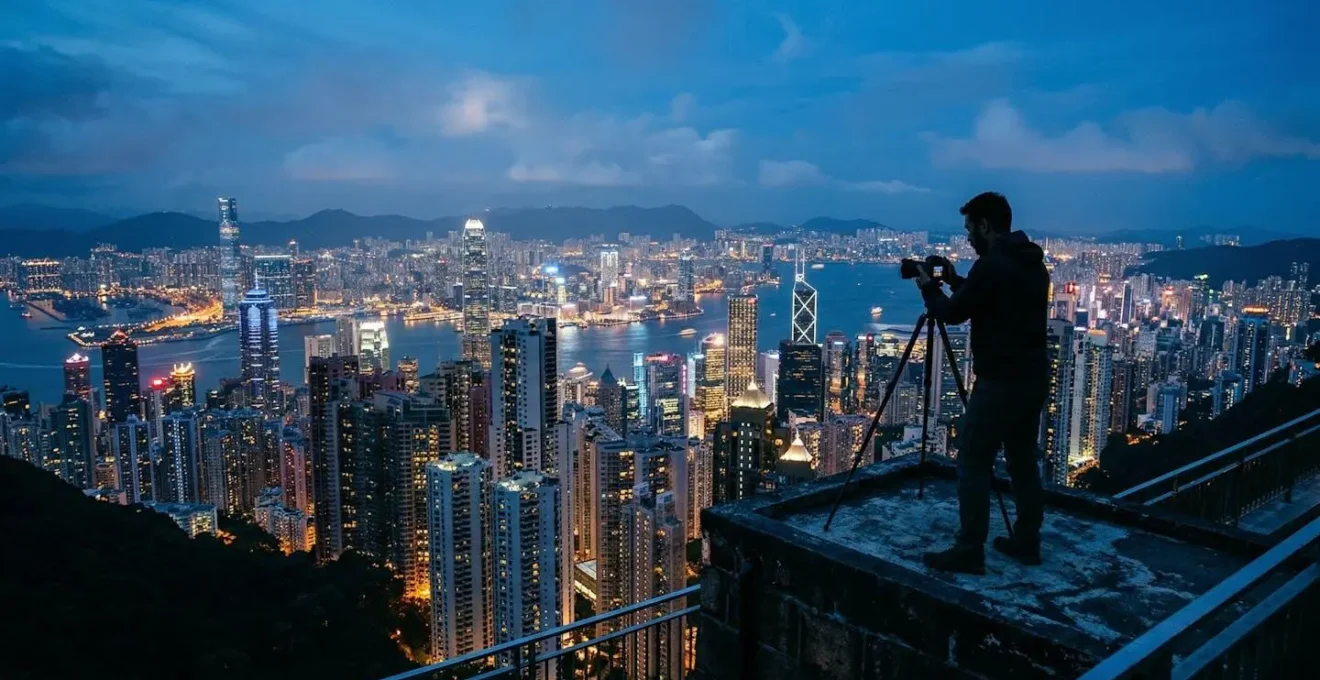
To capture unique photos in Hong Kong, stop chasing secret spots and start mastering creative control over the locations you already know.
- True originality comes from a deep understanding of light, timing, and perspective, not just a GPS coordinate.
- Even the most crowded icons can yield personal, powerful images when you learn to deconstruct the scene and see beyond the obvious shot.
Recommendation: Shift your focus from finding a new place to finding a new way to see an old one.
The endless scroll of Hong Kong photography reveals a familiar pattern: the same saturated basketball court, the same geometric facade of the “Monster Building,” the same laser-lit skyline. For the discerning photographer, the semi-pro, or the ambitious Instagrammer, this visual echo chamber is a creative dead end. You’ve arrived in one of the world’s most photogenic cities, armed with talent and equipment, only to feel the pressure to either replicate clichés or embark on a futile quest for “undiscovered” locations that are, by now, anything but.
The common advice is to use a tripod, shoot at golden hour, and find lists of “secret spots.” While not incorrect, this is surface-level thinking. It’s a painter being told to use a good brush. The real challenge isn’t about finding a new canvas; it’s about developing a unique way of seeing. What if the key to unrivaled photos wasn’t about escaping the crowds, but about seeing through them? What if the most powerful tool wasn’t a new location, but a new perspective on the iconic ones?
This guide abandons the scavenger hunt for secret spots. Instead, it offers a strategic framework for the visual artist and location scout. We will deconstruct the art of seeing in the context of Hong Kong’s unique environment. We’ll explore the alchemy of timing, the mechanics of perspective, and the mindset required to transform a tourist trap into a personal masterpiece. It’s time to move beyond imitation and begin the work of interpretation.
This article provides a complete roadmap to elevate your Hong Kong photography from a mere record to a genuine artistic statement. The following sections will equip you with the advanced strategies needed to see the city with fresh eyes.
Summary: How to Capture Unrivaled Photos of Hong Kong’s Icons, Crowd-Free?
- How to Find Secret Photo Spots That Guidebooks Don’t Mention?
- Blue Hour or Golden Hour: Which Lighting Suits the Neon Skyline Best?
- The Lens Mistake That Makes Buildings Look Distorted
- Tourist Traps vs Local Gems: What Is Truly Worth Photographing?
- How to Shoot Sharp Night Skylines Without a Heavy Tripod?
- Day or Night: When to Capture the Skyline for Maximum Impact?
- Why Corner Suites Offer the Best Panorama Value?
- Instagram vs Reality: How to Manage Expectations at Famous Photo Spots?
How to Find Secret Photo Spots That Guidebooks Don’t Mention?
The very concept of a “secret spot” in a city as documented as Hong Kong is a myth. The real secret is a methodology, not a location. Instead of chasing GPS pins, the professional develops a system for visual discovery. This means training your eye to see potential where others see chaos. It’s about understanding how light interacts with the urban canyon, recognizing the narrative potential of a closing market, and using digital tools not to find spots, but to predict how light and shadow will fall upon them. This is visual deconstruction: breaking a scene down into its core elements of light, geometry, and moment.
This approach transforms your process from passive sightseeing to active location scouting. You begin to look for elevated positions—not just rooftop bars, but car parks and pedestrian overpasses. You start to see narrow alleyways not as shortcuts, but as natural frames, perfect for capturing the interplay of shadow and neon. One powerful strategy is to explore the periphery of well-known areas. For instance, while tourists flock to the main thoroughfares, a pro knows that walking down the side aisles of Shanghai Street reveals a world of dark corners and dramatic light, offering countless unique perspectives. It’s about finding your own composition within a known zone.
Modern tools are your allies in this strategic planning. Before you even step outside, you can use applications to visualize the sun’s path, predicting exactly when and where golden light will strike the side of a specific building. The 3D views in mapping services become your virtual drone, allowing you to scout for unobstructed rooftop views or interesting architectural conjunctions from your hotel room. This isn’t cheating; it’s professional preparation. It’s how you arrive on location with a plan, ready to execute a vision rather than hoping for a lucky snapshot.
Your Action Plan: Finding Hidden Hong Kong Photography Spots
- Explore lesser-known neighborhoods like Kim Shin Lane, a narrow street between towering buildings perfect for light play in the evening.
- Visit the Bird Market in the early morning for zero tourist crowds and vibrant birdcage compositions.
- Head to Po On Road Market for an authentic 1980s atmosphere with its covered and outdoor sections, offering diverse lighting conditions.
- Utilize elevated positions like the Park-in Commercial Centre car park rooftop for unique, less-common aerial perspectives of the city.
- Time your visits for late evening (after 10 pm) when market vendors pack up, revealing a completely different character and narrative of the streets.
Blue Hour or Golden Hour: Which Lighting Suits the Neon Skyline Best?
The debate between golden hour and blue hour is a false dichotomy for the strategic photographer. The real question is not “which is better?” but “which light best serves my creative intention?” Golden hour, with its warm, soft, directional light, is superb for sculpting architectural details and creating flattering, atmospheric portraits at street level. It reveals texture and form. Blue hour, however, is where the true alchemy of the Hong Kong skyline happens. It’s a transient moment of perfect balance between the fading natural light and the emerging artificial glow of the city.
This is the time for temporal alchemy. The magic lies in a very specific, fleeting window. For the iconic skyline, arriving during golden hour is a tactical necessity—not to shoot, but to secure your position, compose your frame, and wait. The real show begins as the sun dips below the horizon. As the sky deepens into a rich, saturated blue, the city’s lights begin to compete, creating a dynamic equilibrium. Professional photographers know that the best light is often the 20 minutes of optimal lighting during blue hour just after sunset, before complete darkness erases the sky’s detail.
A classic case study is capturing the view from Victoria Peak or the Tsim Sha Tsui Promenade. The strategy is to witness the entire transition. You watch as the golden light gives way to the fiery colors of sunset, and then, the main event: the handover period. The sky holds its cobalt color while the buildings, one by one, ignite. This is the moment your camera can capture detail in both the shadows of the cityscape and the highlights of the sky, a feat impossible in the high contrast of full daylight or complete night. During this window, spectacles like the Symphony of Lights become a dramatic element within a perfectly balanced frame, rather than just bright lights against a black void.
The Lens Mistake That Makes Buildings Look Distorted
One of the most common photographic sins in a vertical city like Hong Kong is uncontrolled perspective distortion. Amateurs point a wide-angle lens upwards at a skyscraper, and the result is a building that looks like it’s about to fall over backwards—a phenomenon known as keystoning. While this can be a deliberate creative choice, it’s usually an unintentional mistake that signals a lack of perspective control. The professional’s goal is to command perspective, making buildings appear powerful and true, not comically distorted.
The counterintuitive solution is often to move further away and use a longer lens. A telephoto lens, like a 70-200mm, compresses perspective. When shooting Hong Kong Island from a distance in Kowloon, this compression has a powerful effect: it stacks the buildings on top of each other, emphasizing the city’s incredible density and creating layers of architectural texture without the distracting distortion of converging vertical lines. This technique transforms a chaotic scene into an organized, graphic composition. Another professional technique is to find mid-level vantage points, such as pedestrian overpasses or the middle floors of a car park. From here, you can shoot level with the buildings’ mid-sections, keeping the camera sensor parallel to the subject and eliminating distortion at the source.
Of course, wide-angle lenses have their place. In the tight confines of a temple interior or a narrow market alley, they are indispensable. The key is to control their effects. By stepping back as far as possible and making an effort to shoot level, you can minimize the most extreme distortion. For architectural work, post-processing tools like Lightroom’s Guided Upright feature are not a crutch, but a standard part of the professional workflow, allowing for precise digital tilt-shift corrections. The choice of lens is a choice of narrative: do you want to create a dramatic, immersive feeling from within (wide-angle), or an objective, layered tapestry from afar (telephoto)?
The following table breaks down the strategic choices between lens types for architectural photography in Hong Kong. As the comparative analysis shows, each lens has a purpose when distortion is understood and controlled.
| Lens Type | Distortion Effect | Best Use Case | Recommended Settings |
|---|---|---|---|
| Wide-Angle (16-24mm) | Strong converging verticals | Dramatic interior shots, tight spaces | Step back, shoot level at f/8-11 |
| Standard (35-50mm) | Minimal distortion | Street level architecture | Natural perspective at f/5.6-8 |
| Telephoto (70-200mm) | Compression effect, no distortion | Skyline from distance | Shoot from Kowloon to HK Island at f/4-5.6 |
Tourist Traps vs Local Gems: What Is Truly Worth Photographing?
The semi-pro photographer often feels a tension between documenting the iconic “tourist trap” and the desire to uncover an “authentic local gem.” This is a false choice. A location’s worth is not inherent; it is determined by the photographer’s vision. The Choi Hung Estate is not a cliché; a thousand identical photographs of it are. A quiet, unnamed alley is not inherently a gem; it only becomes one when your composition, light, and moment elevate it into a compelling narrative. The most crucial skill, therefore, is not discovery but observation—the ability to find the unseen narrative within any scene, famous or obscure.
What separates a postcard shot from a piece of art is the photographer’s interpretation. At a tourist-heavy location like the Man Mo Temple, instead of capturing the wide, establishing shot that everyone else is taking, focus on the details. Find a close-up of the intense concentration on a worshipper’s face, the texture of smoke curling from an incense stick, or the way a single beam of light illuminates the dust in the air. These are the small, intimate stories that exist within the larger, more obvious one. They require patience and a willingness to look past the main attraction.
This philosophy redefines what is “worth” photographing. A bustling market becomes a study of human interaction. A ferry crossing is an opportunity to capture portraits against a moving backdrop of the skyline. The true local gems are not places, but moments and interactions. They are found by slowing down, observing the rhythm of a neighborhood, and waiting for the decisive moment. As William, a professional Hong Kong tour guide and photographer, eloquently puts it:
To me, photography is an art of observation.
– William, Professional Hong Kong Tour Guide & Photographer, Streets of Hong Kong Premium Tours
This simple statement is a profound guide. It frees you from the anxiety of “missing out” on a secret spot and empowers you to create a masterpiece anywhere. Your goal is not to document what a place looks like, but what it feels like. And that feeling can be found just as readily at Victoria Peak as it can in the depths of Sham Shui Po, provided you are truly looking.
How to Shoot Sharp Night Skylines Without a Heavy Tripod?
The conventional wisdom for night photography is rigid: use a sturdy tripod. But for the location scout on the move, a heavy tripod is often impractical or outright forbidden. In Hong Kong, many of the best vantage points—rooftop bars, ferry decks, crowded promenades—are not tripod-friendly. This constraint, however, is not a dead end. It’s an invitation to practice strategic limitation, using modern camera technology and urban ingenuity to achieve sharp results.
Your first step is to see the city itself as your tripod. Hong Kong is filled with stable surfaces. Ferry railings, concrete ledges, recycling bins, and low walls become your platforms. The key is to have a small, portable support like a beanbag or even a bundled jacket. This allows you to place your camera on an uneven surface and make micro-adjustments to your composition without introducing shake. You can even place the camera directly on a ledge, using a lens cap or your phone to prop the lens up to the perfect angle. It’s a low-tech solution for high-tech results.
Your second ally is your camera’s technology. Modern cameras with In-Body Image Stabilization (IBIS) are game-changers. By bracing your body against a wall or post, controlling your breath, and gently squeezing the shutter, you can achieve surprisingly sharp handheld shots at speeds as low as 1/15th of a second. Combine this with burst mode: fire off 10 frames, and chances are at least one will be critically sharp. For ultimate quality, consider image stacking. Taking 5-10 handheld shots at a higher ISO and stacking them in post-processing software (many of which are free) can produce a final image that is both sharp and remarkably noise-free. While tripods are sometimes allowed, like at the 27th floor of The Park Lane Hong Kong or the Eyebar terrace, mastering these tripod-free techniques gives you the freedom to shoot from anywhere.
Your Action Plan: Urban Tripod Alternatives
- Use ferry railings, recycling bins, and concrete ledges as stable platforms. Use a beanbag or bundled jacket for fine-tuning the angle.
- Place the camera directly on ledges, using a lens cap or your phone to angle the lens upward with precision.
- Leverage your camera’s modern IBIS technology with burst mode; shoot 10 frames and select the single sharpest one in review.
- Stack 5-10 shorter, high-ISO handheld shots in free software for a final image that is both sharp and clean of noise.
- Use a braced body posture against a wall or post, combined with image stabilization, to reliably shoot at speeds around 1/15s.
Day or Night: When to Capture the Skyline for Maximum Impact?
The choice is not simply between a sunlit city and a neon-drenched one. A strategic photographer thinks in terms of specific lighting qualities that serve a purpose. Daytime, especially during the golden hour, is for capturing the city’s substance: the architectural detail, the immense scale, the texture of the materials. It’s the time to create warm, detailed images where the city itself is the primary subject. Full night, conversely, is for capturing the city’s energy: the abstract patterns of light, the vibrant blur of traffic, the high-contrast drama of neon against darkness. Here, light itself becomes the subject.
But the most compelling and professionally sought-after light exists in the transitions. As we’ve discussed, blue hour offers a magical balance. It’s the perfect time for the classic, breathtaking skyline shot where both the sky and the city lights are perfectly exposed and saturated with color. However, there is another, more subtle window of opportunity that many photographers miss: the “handover period.” This is the 30-minute window just after sunset when the interior lights of office and apartment buildings have turned on, but the main external neon and decorative lighting have not yet reached full power. This brief moment offers a more subtle, “lived-in” feel to the skyline, a glimpse into the city’s inner life before the grand nightly performance begins.
Even adverse weather, often seen as a hindrance, is a strategic opportunity. A foggy or rainy day is a gift for the creative photographer. From a high vantage point like Victoria Peak, fog can create a “city in the clouds” effect, with skyscrapers piercing through the mist like islands in a sea of white. At street level, rain-slicked streets reflect the city’s neon, doubling the color and creating a moody, cinematic atmosphere that is impossible to capture on a clear night. The truly professional photographer has a plan for every condition, understanding that different light and weather tell different stories.
This table provides a quick guide to aligning your photographic goals with the time of day, helping you execute with intention.
| Time Period | Best For | Lighting Character | Recommended Locations |
|---|---|---|---|
| Golden Hour (6-7pm) | Architectural detail, warm portraits | Soft, warm, directional | Victoria Peak, street level |
| Blue Hour (7-7:30pm) | Balanced skyline shots | Deep blue sky, city lights visible | Tsim Sha Tsui Promenade |
| Full Night (8pm+) | Abstract light patterns, neon energy | High contrast, vibrant colors | Mong Kok, Temple Street |
| Foggy/Rainy Day | ‘City in clouds’ effect | Diffused, atmospheric | Victoria Peak, IFC Tower |
Why Corner Suites Offer the Best Panorama Value?
For the serious photographer on a mission, a night in a well-chosen hotel room is not a travel expense; it’s a production investment. And in this calculation, the corner suite often represents the single best return on investment for capturing the skyline. A cost-benefit analysis quickly reveals its superiority: the cost of one night can be equal to or even less than the combined cost of multiple tickets for crowded, time-limited observation decks for you and your gear. But the value proposition goes far beyond simple economics. It’s about gaining complete creative control.
A corner suite is your private, all-weather, 24-hour observation deck. It offers what no public space can: the luxury of time and space. You are free from the jostling crowds, the reflective glass safety barriers, and the pressure to “get the shot” before your time is up. A corner suite with dual-aspect windows offers a staggering advantage. You can set up one camera to capture a time-lapse of the sunset over the western harbor while you are personally shooting stills of the blue hour developing over the city’s central district through the other window. It allows for a level of parallel creativity that is impossible on the ground.
Furthermore, the room itself becomes part of your creative toolkit. The window glass can be used as a reflective surface for creative compositions that blend the room’s interior with the city outside. The window frame itself can be used as a powerful compositional element, adding depth and context to your panorama. You can control the lighting, eliminate reflections, and work at a comfortable, methodical pace. From this private sanctuary, you can experiment with long exposures, time-lapses, and multiple camera setups—all in perfect comfort, without carrying a single piece of gear through the city streets. It’s the ultimate expression of strategic planning, transforming a place of rest into a hub of production.
Key takeaways
- Master the Clock: Don’t just shoot at golden or blue hour; understand the “handover period” and use weather to your advantage. True mastery is temporal alchemy.
- Control Your Perspective: Ditch the wide-angle distortion. Use telephoto compression from a distance and find mid-level vantage points to create powerful, controlled architectural compositions.
- Embrace Constraints: A heavy tripod is a liability. Learn to see the city as your support system and leverage your camera’s IBIS to turn limitations into creative freedom.
Instagram vs Reality: How to Manage Expectations at Famous Photo Spots?
You’ve seen the shot online: a lone figure on a vividly colored basketball court, framed perfectly by pastel apartment blocks. You arrive at Choi Hung Estate to find the reality: a long queue of people waiting for their 30-second turn in the “iconic” spot. This is the great disconnect of modern photography, the gap between the curated perfection of Instagram and the messy reality on the ground. For a creative, this can be a source of immense frustration. The key to surviving and thriving is to manage your expectations and arrive with a strategic mindset, not just a shot list.
First, accept that crowds are part of the scene. Instead of fighting them, you can choose to incorporate them into your narrative. The meta-story of a line of photographers waiting to capture the same image can be a more powerful and contemporary statement than the original “perfect” shot itself. This requires a shift in perspective: from documenting a place to documenting the experience of a place in the 21st century. It’s about finding the unseen narrative in the act of photography itself.
Second, have a backup plan. A professional arrives with Plan A, B, and C. A pragmatic approach is the “15-Minute Rule.” As one case study shows, photographers facing a long line should be mindful that these are residential areas where people live. If you arrive and the scene is unworkable, set a timer for 15 minutes. Use that time to scout for alternative angles—a detail shot, a reflection, a view from a different level. If you can’t get a shot you’re happy with in that time, cut your losses and move to your pre-planned alternative location. Wasting an entire golden hour waiting in a queue is an amateur mistake. A pro knows that the light is more valuable than any single location.
Finally, always remember to be respectful. These famous locations are often public spaces or people’s homes. Signs prohibiting photography may exist, and while they may not always be legally enforceable in public spaces, they are a clear signal of the residents’ frustration. Shoot with discretion, be quiet, and don’t contribute to the problem. The best photographers are invisible, capturing their vision without disrupting the life of the city around them.
By shifting your mindset from finding spots to mastering vision, you can transform your Hong Kong photography. Start applying these principles today to create a portfolio that is not just beautiful, but uniquely yours.