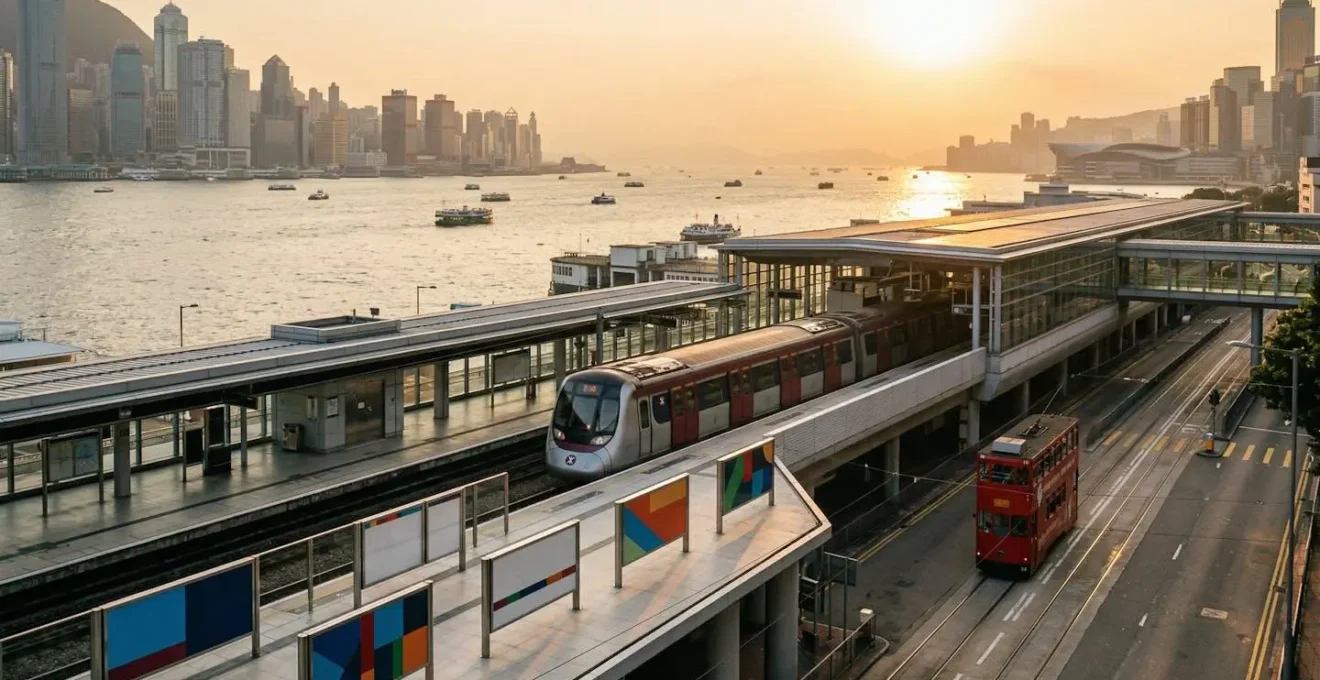
The sensory overload of Hong Kong hits you the moment you step out of the airport. The towering skyscrapers, the neon-lit signs, the sheer density of people. Then comes the financial overload: the first taxi fare. It’s a common story for budget travelers. You see the convenience of a cab and pay the price, only to realize you’ve just burned through a day’s worth of your food budget. Many guides will tell you the obvious solution: “get an Octopus card.” And they’re not wrong, but that’s like saying the key to winning a race is to “have a car.” It’s just the entry ticket.
The real secret, the one locals know, isn’t just about *using* public transport; it’s about understanding its rhythm, its unwritten rules, and its hidden synergies. It’s about mastering the commuter cadence and exploiting the system’s design for your own benefit. This isn’t just about getting from A to B. It’s about a strategic choice between MTR speed and tram views, knowing how to conquer the infamous minibus, and using your Octopus card like a financial multi-tool. It’s about seeing the city’s transport grid not as a confusing map, but as a solvable puzzle.
Forget the tourist mindset that defaults to the most obvious route. This guide will re-wire your brain to think like a frugal, street-smart Hongkonger. We’ll break down the system, piece by piece, giving you the confidence to navigate the city efficiently, affordably, and with the satisfaction of knowing you’ve outsmarted the tourist traps.
To help you navigate this intricate system, we’ve broken down the essential strategies into a clear roadmap. This guide covers everything from unlocking your Octopus card’s full potential to mastering the MTR grid like a seasoned commuter.
Summary: Your Guide to Conquering the Hong Kong Transport Grid
- How to Unlock Hidden Benefits of the Octopus Card Beyond the MTR?
- MTR Speed vs Tram Views: Which Mode Suits Your Journey Best?
- The Minibus Risk: How to Shout Your Stop Without Speaking Cantonese?
- Why Hong Kong’s Transport System Is Ranked Number One Globally?
- When to Travel to Avoid the ‘Crush Load’ on the MTR?
- Where and How to Get Your Deposit Back for the Octopus Card?
- Why Hong Kong Feels Overwhelming for First-Time Visitors?
- Navigating the MTR: How to Reach Any District in Under 45 Minutes?
How to Unlock Hidden Benefits of the Octopus Card Beyond the MTR?
Let’s get one thing straight: your Octopus card is not just a travel pass. Treating it like one is the biggest rookie mistake. For locals, this card is a de facto debit card for the entire city, and its ubiquity is staggering—in fact, an incredible 99% of Hong Kong residents aged 16-65 use Octopus cards daily, making it one of the most successful payment systems on the planet. To save money and time, you need to start Octopus Hacking—using it for everything.
Beyond the MTR turnstiles, your Octopus is your key to convenience stores, supermarkets, bakeries, vending machines, and even fast-food chains. Every dollar you spend through the card is a dollar you don’t have to fumble for in cash. More importantly, using it widely helps you track your daily spending through the dedicated app. This transforms it from a simple fare card into a powerful budget-management tool, giving you a real-time overview of where your money is going.
But the real pro move is to leverage the transport-specific discounts that are built into the system. The MTR corporation wants you to travel, and they reward you for it with subtle, easy-to-miss fare-saver machines and interchange discounts. Mastering these perks is the difference between a standard commuter and a savvy one.
Your Action Plan: Maximize Your Octopus Card Benefits
- Download the Octopus App for Tourists to track every transaction in real-time and monitor your transport budget.
- Look for MTR Fare Saver machines when walking around the city – tap your card for an instant HK$2 discount on your next MTR trip.
- Use your Octopus at local bakeries like Arome Bakery and for ‘ding ding’ tram rides for a complete local experience.
- Enable auto top-up through the app using your credit card to avoid the embarrassment of a zero balance at the turnstile.
- Choose between an On-Loan card (with a refundable deposit) or a Tourist Octopus (a souvenir) based on how often you plan to return.
MTR Speed vs Tram Views: Which Mode Suits Your Journey Best?
A common tourist mistake is defaulting to the MTR for every journey. It’s fast, clean, and efficient, but it’s not always the *smartest* choice. A true local practices value arbitrage—choosing the mode of transport that provides the best return for their specific goal, whether that goal is speed, cost, or experience. Hong Kong Island, in particular, offers a classic dilemma: the subterranean speed of the MTR versus the scenic, street-level crawl of the iconic “ding ding” tram.
If your destination is more than five stops away or on the other side of the harbour, the MTR is your undisputed champion. It’s a tool for surgical, point-to-point transit. But if you’re moving between adjacent districts like Central, Wan Chai, and Causeway Bay, the tram is often the superior choice. You’ll sacrifice speed, but you gain an unparalleled, moving vantage point of the city’s vibrant street life. The best part? It comes at a flat fare of just HK$3, regardless of distance. For a photographer or a first-time visitor, the value is immense.
This principle extends to all modes. The top deck of a double-decker bus offers a similar cinematic experience for a fraction of the cost of a tour bus. The Star Ferry isn’t just a commute; it’s the world’s most spectacular harbour crossing for the price of a coffee. The key is to ask yourself: what is my priority for *this specific journey*? Speed, budget, or experience? Choosing consciously is the first step to navigating like a pro.
To make this choice clearer, a direct comparison is essential. Locals intuitively weigh these factors, but for a visitor, having them laid out can make all the difference in planning a day’s itinerary.
| Transport Mode | Speed | Cost (HKD) | Sightseeing Value | Best For |
|---|---|---|---|---|
| MTR | Fast (2-5 min wait) | $5-25 | Low (underground) | Efficiency seekers |
| Tram | Slow (15-20 min/km) | $3 flat | Very High | Photographers, tourists |
| Bus | Medium | $3.40-20 | High (top deck) | Budget travelers |
| Star Ferry | 7 min crossing | $2.70-3.70 | Exceptional | Harbor views |
The Minibus Risk: How to Shout Your Stop Without Speaking Cantonese?
If the MTR is the circulatory system of Hong Kong, the minibus network is its capillaries—reaching deep into neighbourhoods that trains and trams can’t. For many tourists, they represent the final frontier of public transport, a system shrouded in mystery and the perceived risk of ending up miles from your destination. The core fear is simple: you have to shout for your stop, often in Cantonese. This is a classic example of system friction, but it’s one that can be easily overcome.
First, differentiate between the red and green minibuses. Red minibuses (RMBs) have more flexible routes and pricing, and are generally best left to seasoned locals. Green minibuses (GMBs), on the other hand, follow fixed routes with fixed stops and fixed prices. For a visitor, sticking to green minibuses is the golden rule. Many modern GMBs are even equipped with digital displays showing the next stop, completely removing the need to shout.
But for those that aren’t, the solution is twofold. The most powerful tool in your arsenal is the simple phrase: “Yau lok, m’goi!” (yow-lock-mm-goy), which means “Stop here, please.” Practicing this single phrase, said with confidence, will work every time. The second tool is preparation. Use Google Maps in transit mode; it will track your bus’s location in real-time. When you see you’re approaching your destination, get ready to press one of the stop buttons on the ceiling or, if necessary, use your newfound Cantonese phrase. Conquering the minibus is a rite of passage that unlocks a whole new layer of the city.
Why Hong Kong’s Transport System Is Ranked Number One Globally?
It’s not just a feeling; it’s a fact. Hong Kong’s public transport is consistently ranked among the best, if not *the* best, in the world. But why? It’s not just about one single mode of transport being good. It’s about the seamless integration, relentless efficiency, and obsessive focus on reliability that defines the entire grid. This is the foundation of the Grid Mindset—the understanding that the whole network is greater than the sum of its parts.
The backbone of this reputation is the MTR. It’s an engineering marvel built on a simple promise: punctuality. The system consistently boasts an incredible 99.9% on-time performance rate while handling millions of journeys a day. This isn’t an accident; it’s the result of meticulous design, from the platform screen doors that enhance safety and climate control to the colour-coded lines that make navigation intuitive even if you don’t speak the language. The system is designed to eliminate uncertainty, which is a priceless commodity in a bustling metropolis.
This reliability extends across the network. Buses arrive with predictable frequency. Ferries run like clockwork. Trams, while slower, are a constant presence. This creates a psychological safety net for commuters. You don’t have to worry “if” you can get somewhere; the only question is “which way is best?” This confidence in the system is what allows the city to function at such a high density and pace. It’s a transport network so dependable that for millions of people, owning a car is not just a financial burden, but a logistical absurdity.
When to Travel to Avoid the ‘Crush Load’ on the MTR?
Knowing how to get around is only half the battle. A true local master knows *when* to get around. There’s a certain rhythm to the city’s flow, a commuter cadence, and moving against it is the key to a comfortable journey. Ignoring it means subjecting yourself to the “crush load”—the peak hour phenomenon where MTR carriages become a study in human compression. For a visitor, getting caught in this is a stressful and unpleasant experience.
The strategy is simple: avoid traveling in the same direction as the workforce during their commute. This means avoiding trains heading towards the central business districts (like Central, Admiralty, and Tsim Sha Tsui) between 8:00 AM and 9:30 AM, and avoiding trains leaving these areas between 6:00 PM and 7:30 PM. The effect is particularly pronounced on key arteries like the Island Line and Tsuen Wan Line.
A particularly effective strategy is the “reverse commute.” Plan your day trips to outlying areas like Lantau Island (for the Big Buddha) or Sai Kung (for hiking and seafood) by leaving the city center in the morning. While everyone else is piling into the city, you’ll be on a near-empty train heading out. By the time you return in the mid-afternoon, you’ll again miss the outbound evening rush. This simple shift in timing can completely transform your travel experience from a stressful ordeal to a peaceful ride. For short hops during peak hours, consider an alternative like the tram or bus, which may be slower but will be far less crowded.
To help you plan, here’s a general guide to the busiest times on the major MTR lines. This table, based on data from analysis of commuter flows, is your cheat sheet to a more comfortable journey.
| MTR Line | Morning Peak to Avoid | Evening Peak to Avoid | Best Alternative |
|---|---|---|---|
| Island Line (Blue) | 8:00-9:30 AM eastbound | 6:00-7:30 PM westbound | Tram or bus |
| Tsuen Wan Line (Red) | 7:30-9:00 AM to Central | 5:30-7:00 PM from Central | Star Ferry |
| Tseung Kwan O (Purple) | 8:00-9:30 AM inbound | 6:00-7:30 PM outbound | Minibus routes |
| East Rail Line | 7:00-9:00 AM southbound | 5:00-7:00 PM northbound | West Rail alternative |
Where and How to Get Your Deposit Back for the Octopus Card?
You’ve mastered the MTR, hopped on the tram, and even braved a minibus. Now, your trip is ending, and you want to reclaim your HK$50 deposit from your On-Loan Octopus card. A savvy local leaves no money on the table, and you shouldn’t either. The process is straightforward, but knowing the options can save you a last-minute scramble at the airport.
The most common method is to simply go to any MTR Customer Service Centre. They are present at nearly all stations, not just the Airport Express stations. You hand over your card, and they give you back your deposit plus any remaining balance in cash, instantly. Be aware, however, of the fine print: if you return the card within 3 months of its issue date, a small handling fee (around HK$9-11) will be deducted. It’s a minor amount, but it’s part of the system.
Alternatively, you can adopt the “spend down” strategy. On your last day, instead of topping up, use the remaining balance for purchases. Grab coffee and snacks at 7-Eleven, buy a book for the flight at a Relay bookstore, or have a final meal at a fast-food outlet. The goal is to run the balance down to as close to zero as possible. This is often more convenient than queuing at a service desk, and you can keep the card as a souvenir. It remains active for three years (1,000 days), so if you plan on returning, just hold onto it.
Key Takeaways
- Think Beyond Transport: Your Octopus card is a city-wide debit card. Use it for small purchases to track spending and unlock fare-saver discounts.
- Practice Value Arbitrage: Choose your transport mode based on your goal. MTR for speed, but trams and buses for unbeatable sightseeing value on a budget.
- Master the Cadence: Avoid the “crush load” by traveling against the main flow of commuters. Use the “reverse commute” strategy for day trips.
Why Hong Kong Feels Overwhelming for First-Time Visitors?
After all these tips and strategies, let’s take a step back and acknowledge a fundamental truth: Hong Kong *is* overwhelming for a first-timer. It’s a city of immense verticality, density, and energy. The sheer volume of sights, sounds, and smells can be a lot to process. The language barrier can feel intimidating, and the fast pace of life can make you feel like you’re constantly in the way.
This feeling of being overwhelmed is perfectly normal. It stems from a perceived lack of control and an inability to decode the city’s complex systems. You’re trying to find your way in a place where it seems everyone else knows exactly where they are going and how to get there. It’s a city where public transport isn’t just an option; it’s the primary way of life for the vast majority. In fact, public transport accounts for an astounding 90% of all daily journeys, a figure unmatched by almost any other major city in the world.
However, the beauty of Hong Kong is that the solution to the chaos is hidden within the chaos itself. The transport system, which may initially seem like part of the problem, is actually the ultimate tool for imposing order. The color-coded MTR lines, the bilingual signage, and the universal symbols are all designed to cut through the complexity. Following the purple line on the floor to the Airport Express or the green line to the Tsuen Wan Line becomes an act of finding clarity. As a case study of new arrivals shows, successfully navigating from the airport to the city via the MTR within the first hour builds immense confidence and demystifies the city faster than any other experience.
Navigating the MTR: How to Reach Any District in Under 45 Minutes?
Now that you understand the different modes and the city’s rhythm, it’s time for the masterclass: adopting the Grid Mindset for the MTR. Tourists see a map of tangled, coloured lines. Locals see a strategic grid of hubs and spokes. The secret to reaching almost any district in under 45 minutes is to stop thinking about your journey as a single, long line. Instead, break it down into two simple steps: 1. Get to the nearest major interchange hub. 2. Take the correct “spoke” line to your final destination.
There are four ‘super-hubs’ that form the heart of this strategy: Admiralty, Central/Hong Kong, Mong Kok, and Kowloon Tong. Mastering these four stations is like learning the four most important chords on a guitar; suddenly, you can play almost any song. For example, Admiralty is the nexus of Hong Kong Island, connecting the main Island Line with the Tsuen Wan Line and the South Island Line. From here, you are perfectly positioned to shoot off in any direction.
Beyond knowing the hubs, there are micro-strategies that save precious minutes. The “first car/last car” rule is a prime example of local knowledge. When you know your exit escalator at a busy station like Central will be at the front of the platform, you make sure to board the very first carriage of the train. This can save you a 5-minute walk through a crowded platform. It’s these small, cumulative efficiencies that define mastery of the system. You’re no longer just a passenger; you are an active navigator, manipulating the grid to your advantage.
Frequently Asked Questions about Hong Kong Transport
Is there a fee for early refund of Octopus Card?
Yes, a HK$9 handling fee applies if you return the card within 3 months of purchase. After 3 months, the refund of your deposit is free.
What if my Octopus has a negative balance?
For On-Loan cards, the system allows for a single convenience overdraft. This negative balance, up to HK$35-50, will simply be deducted from your HK$50 deposit when you process the refund.
Can I get a refund if my balance is over HK$500?
Yes, but it cannot be processed instantly at an MTR station. It requires you to fill out a form, and you will receive the refund within 9 working days, typically issued as a cheque, which is not ideal for a tourist.
So stop burning cash on taxis and standing bewildered at intersections. You now have the local’s playbook. Put these strategies to work, embrace the grid, and start navigating this incredible city with the confidence and efficiency of someone who truly belongs.