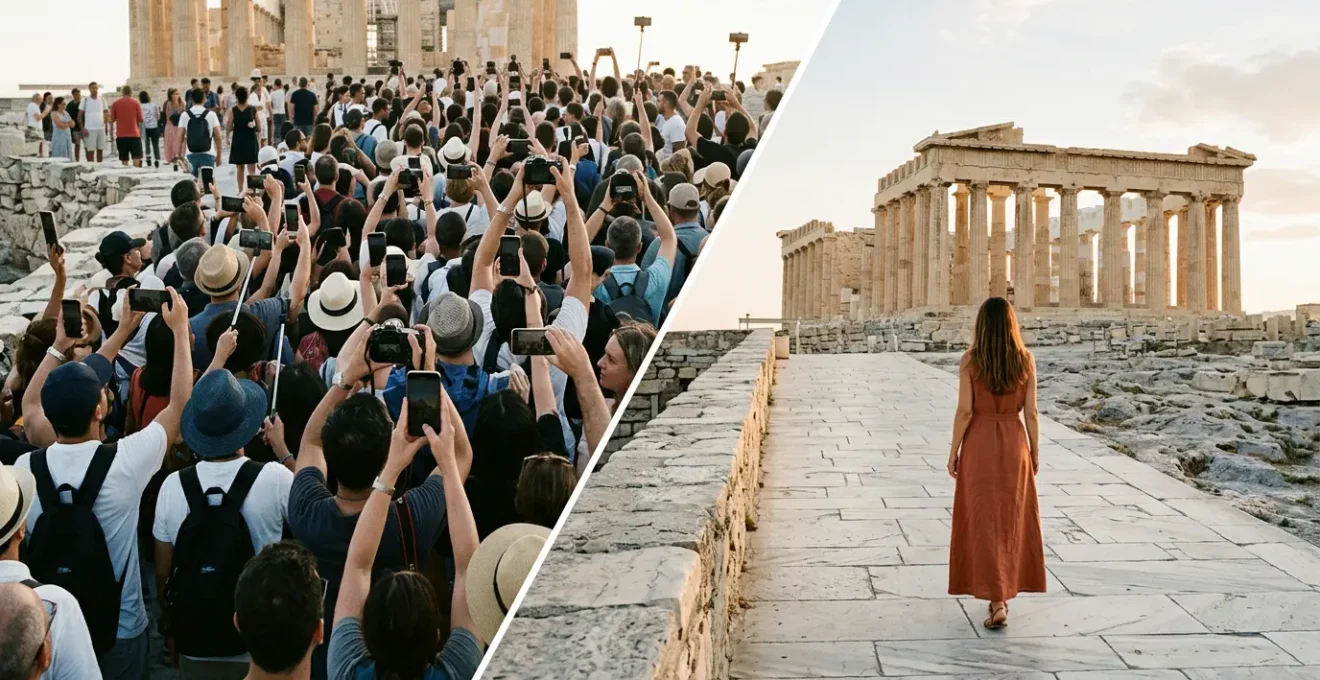
The perfect shot isn’t about avoiding crowds; it’s about mastering the hidden social, legal, and technical systems that govern popular locations.
- Famous photo spots are often private residential areas where photography is now banned due to over-tourism.
- The “perfect” colors you see online are the result of specific editing techniques, not the location’s natural state.
Recommendation: Shift your focus from replicating a single image to creatively navigating the context of each location, using technical skills and digital research to produce unique and ethical content.
You’ve seen the shot a thousand times. The perfectly symmetrical building, the impossibly vibrant basketball court, the solitary figure against a stunning urban backdrop. You book the flight, navigate the city, and arrive at the famous photo spot, only to find it swarming with people, covered in “No Photography” signs, and looking disappointingly dull compared to the images that brought you here. This is the content creator’s paradox: the more popular a location becomes on Instagram, the harder it is to capture the very image that made it famous.
The standard advice—go early, be patient, use Photoshop—misses the point. These are reactive tactics, not a sustainable strategy. They don’t address the core of the issue: these locations are not static film sets. They are dynamic environments with residents, regulations, and a history that is being actively shaped by the attention you and thousands of others bring. The frustration you feel is a sign that the old approach of simply showing up is broken.
But what if the key wasn’t to fight the reality, but to understand it? This guide proposes a new mindset. Instead of just being a photographer, you need to become a digital mentor, a strategist who masters the context. We’ll move beyond the generic tips and delve into the real systems at play. We will analyze why residents enforce photo bans, deconstruct the editing hype, uncover disappearing cityscapes, and explore the serious legal risks of chasing a shot. This is your playbook for turning disappointment into creative opportunity and navigating the complex world of “Instagram vs. Reality.”
This article provides a strategic framework, using Hong Kong’s iconic spots as a case study, to help you master any famous location worldwide. The following sections break down the key challenges and offer practical, actionable solutions.
Summary: Instagram vs Reality: How to Manage Expectations at Famous Photo Spots?
- Why Is the ‘Monster Building’ Photography Ban Strictly Enforced by Residents?
- How to Edit Choi Hung Estate Photos to Match the Internet Hype?
- Where to Find Remaining Neon Signs Before They Are Removed?
- How to Get a Clean Shot of the Blue Wall Without Traffic Ruining It?
- The Rooftop Risk: Why Trespassing for a Selfie Can Lead to Deportation?
- How to Find Secret Photo Spots That Guidebooks Don’t Mention?
- How to Map Your Own Route to See the Best Hollywood Road Murals?
- The Rooftop Risk: Why Trespassing for a Selfie Can Lead to Deportation?
Why Is the ‘Monster Building’ Photography Ban Strictly Enforced by Residents?
The “Monster Building” (Yick Cheong Building) is a prime example of a location loved to death. What creators see as a stunning architectural backdrop is, in fact, a private residential complex. The relentless influx of photographers has led to significant friction with the people who live there. It’s not just a matter of inconvenience; it’s about privacy and respect for one’s home. Posters explicitly state that entering the courtyard is trespassing, and residents, tired of the constant disruption, now actively enforce the photography ban. Understanding this requires a shift in perspective from “getting the shot” to ethical framing.
The sheer scale of the community puts the issue into perspective. This is not a handful of apartments; it’s a dense urban environment where, according to recent data, more than 43,000 residents live in the Monster Building complex and its interconnected structures. For them, the courtyards are their backyards, not a public studio. In 2018, residents began putting up signs asking for respect, but as the crowds grew, the owners installed metal barriers in 2020 to physically prevent photoshoots. This wasn’t a sudden decision, but an escalation born of frustration.
As a creator, ignoring these signs is not just rude; it’s an assertion that your content is more important than their right to peace and privacy. The enforcement isn’t about being difficult; it’s about reclaiming a sense of home. The responsible approach is to respect the ban entirely. This means no sneaking in for a “quick shot.” Instead, use this as an opportunity to get creative from public areas, like shooting the building’s immense scale from the surrounding streets on King’s Road.
How to Edit Choi Hung Estate Photos to Match the Internet Hype?
The iconic rainbow-colored basketball court of Choi Hung Estate is another flashpoint for the “Instagram vs. Reality” debate. Many visitors arrive to find the colors muted, especially on an overcast day, and the court occupied by local residents playing sports or practicing tai chi. The vibrant, pastel-perfect images flooding social media are not a lie, but they are a product of specific, and often intense, post-processing. Understanding this editing spectrum is key to managing your expectations and developing your own creative style.
The location’s fame was amplified after being featured in a K-pop music video and promoted by the Hong Kong tourist office, turning a residential playground into a global photo destination. The resulting images often push saturation and luminance far beyond reality to create a dreamlike aesthetic. This isn’t necessarily deceptive, but it sets an unrealistic expectation for those who arrive unprepared. Your job is not to perfectly replicate an edited reality, but to make a conscious choice about where your work falls on the editing spectrum.
As the visual comparison shows, the same photo can range from natural to hyper-realistic. To achieve the “Instagram look,” creators often use mobile apps to manipulate specific color channels. Here’s a typical workflow:
- Target Specific Colors: In an app like Lightroom Mobile, open the HSL (Hue, Saturation, Luminance) panel. This allows you to adjust individual colors without affecting the entire image.
- Boost Key Tones: Increase the saturation of oranges and blues by +30 to +40 to make the signature building colors pop.
- Brighten Carefully: Adjust the luminance of reds and yellows by +15 to +20. This brightens the colors without the harshness of oversaturation.
- Protect Skin Tones: Use selective masking tools to apply these strong adjustments only to the buildings and court, ensuring that any people in your shot have natural skin tones.
Alternatively, on a dull day, leaning into a high-contrast black-and-white edit can emphasize the powerful architectural lines, creating a unique image that stands out from the sea of color.
Where to Find Remaining Neon Signs Before They Are Removed?
Hong Kong’s neon-drenched streetscapes, immortalized in films like Blade Runner, are disappearing at an alarming rate. Stricter building regulations and the rise of cheaper LED technology mean this iconic part of the city’s visual identity is fading. For creators, this is a race against time. The challenge is no longer just finding a good sign to photograph, but finding one that still exists. According to a report from NBC News, it’s estimated that less than 500 traditional neon signs remain from an estimated high of over 100,000. This requires a new skill: digital archaeology.
You can no longer rely on outdated guidebooks. You must become a digital detective, using online tools to track signs in near real-time. This involves piecing together clues from various digital archives and communities to locate the last vestiges of this craft. As Cardin Chan, General Manager of the conservation group Tetra Neon Exchange, explained to Hong Kong Free Press, these are more than just lights:
Traditionally, shop owners wanted their businesses to be passed on through the generations. They invested a lot in getting a sign commissioned because, to them, a sign carries the soul of a business.
– Cardin Chan, Tetra Neon Exchange General Manager
Finding these remaining “souls” requires a proactive methodology. Instead of wandering aimlessly, you need a plan to hunt them down. High-quality information can often be found through dedicated archives like those provided by the Google Arts & Culture project on Hong Kong’s neon signs.
Your Action Plan: Digital Archaeology for Neon Signs
- Consult Digital Archives: Start by searching the M+ Museum’s online collections for documented sign locations and historical photos to build a foundational map.
- Monitor Social Hashtags: Use Instagram’s #streetsignshk hashtag and filter by ‘Recent’ to see what’s new, what’s been removed, and where active photographers are shooting.
- Explore Photography Communities: Check Flickr groups and local urban exploration (urbex) forums dedicated to Hong Kong photography, using keywords like ‘neon’, ‘night’, and ‘signage’.
- Focus on High-Density Areas: Physically visit Nathan Road in Mong Kok and Jordan, which still have the highest concentration of remaining signs.
- Target Specific Businesses: Focus your efforts on older, traditional businesses like pawn shops, bakeries, and mahjong parlors, as they are the most likely to have retained their original neon.
How to Get a Clean Shot of the Blue Wall Without Traffic Ruining It?
The various “blue wall” photo spots scattered around Hong Kong present a common creator challenge: how to capture a clean, minimalist architectural shot when the foreground is constantly cluttered with pedestrians and vehicle traffic. Waiting for a gap in the chaos is a game of chance, and often a losing one. The strategic solution lies not in patience, but in technique. By taking control of your camera’s settings—or using specialized apps—you can creatively erase moving objects from your frame, turning a chaotic scene into a serene image.
The key is long exposure photography. By leaving your camera’s shutter open for a few seconds, any object that moves through the frame becomes a transparent blur or disappears entirely, while the static wall remains perfectly sharp. This technique, once the domain of expensive DSLR cameras with neutral density (ND) filters, is now accessible on smartphones through apps like Slow Shutter Cam. You can set a multi-second exposure that effectively makes passing cars and people vanish from your final shot. This is a powerful tool for imposing your creative will on an uncontrollable environment.
Combining this with smart composition further improves your odds. Shooting from a low angle and pointing the camera upwards can eliminate the street level altogether, focusing solely on the architecture. Using foreground elements like planters or street signs can also help to naturally block out unwanted parts of the scene. The right timing also plays a crucial role, not just for lighting but for crowd and traffic levels.
To help plan your shoots across multiple locations, understanding the interplay of time, crowds, and technique is essential. This data provides a strategic starting point for some of Hong Kong’s most popular spots. For instance, an early morning shoot at the Blue Wall will give you low traffic to work with, making your long exposure efforts even more effective. As a comparative analysis by Daily Travel Pill on popular Hong Kong photo spots highlights, each location has its own rhythm.
| Location | Best Time | Crowd Level | Key Technique |
|---|---|---|---|
| Monster Building | 7-8 AM | Low | Wide angle from street level |
| Choi Hung Estate | 9 AM | Medium | Avoid earlier – tai chi groups present |
| Blue Wall spots | Early morning | Low traffic | Long exposure for motion blur |
| Neon signs | Blue hour (dusk) | High foot traffic | Stabilization crucial, Pro mode for manual exposure |
The Rooftop Risk: Why Trespassing for a Selfie Can Lead to Deportation?
The allure of an exclusive, high-altitude city shot has given rise to “rooftopping,” a dangerous and illegal trend where individuals trespass onto private rooftops to take photos. As a content creator, the pressure to get a unique angle can be immense, but the consequences of this particular risk far outweigh any potential reward. In a city like Hong Kong, with its strict rule of law, trespassing is not taken lightly. It’s a criminal offense that can lead to fines, arrest, and for non-residents, the very real possibility of visa cancellation and deportation.
This isn’t a hypothetical warning. Property owners, particularly in buildings that have become social media famous, are increasingly working with law enforcement to prosecute trespassers. The mindset that it’s “just for a photo” offers no legal protection. You are knowingly entering a private, often dangerous, area without permission. Beyond the legal jeopardy, there is the physical danger. These rooftops are not designed for public access; they lack safety barriers and are often home to unsecured equipment, posing a significant risk of a fatal fall.
The responsible and, frankly, smarter choice is to seek out legal alternatives. Cities like Hong Kong offer numerous publicly accessible vantage points that provide spectacular, sweeping views of the skyline without any of the risk. Observation decks, rooftop bars, and even certain public hiking trails offer stunning perspectives in a safe and legal environment. Choosing these options isn’t a compromise; it’s a mark of a professional creator who values their safety, their legal standing, and respects property laws. A great shot is never worth a criminal record or your life.
By focusing your creative energy on these legitimate spots, you can capture breathtaking content without putting yourself in harm’s way. The image of enjoying the view from a secure, designated area is ultimately more powerful and sustainable for your brand than a risky selfie from a place you were never meant to be.
How to Find Secret Photo Spots That Guidebooks Don’t Mention?
While guidebooks point everyone to the same crowded locations, the most unique and rewarding photo spots are often hidden in plain sight, waiting to be discovered. Finding them requires you to trade the passive role of a tourist for the active one of a digital detective. This means using online tools not just for navigation, but for forensic analysis of other people’s images to reverse-engineer their locations. This process of “digital location scouting” allows you to build a custom map of spots that are off the beaten path, ensuring your content is original.
The core technique is to analyze photos you admire for subtle background clues. Look past the main subject and examine the details: a unique piece of architecture, a reflection in a window, a partial store sign, or the specific angle of a shadow. Each of these is a data point. Your next step is to take these clues to Google Street View and Google Earth’s 3D view. By “walking” the streets digitally and examining buildings from different angles, you can often pinpoint the exact location and even identify the vantage point from which the photo was taken.
This method transforms your relationship with a city. You’re no longer just following a pre-set itinerary; you are engaging in a visual treasure hunt. Here is a step-by-step process for becoming a digital location scout:
- Analyze Visual Clues: Scour Instagram and Flickr for interesting photos. Screenshot them and zoom in on background details. Is there a distinctive building tile pattern, a unique street lamp, or a specific tree?
- Cross-Reference with Street View: Take your identified clues and search for them on Google Maps in the general area. Use Street View to virtually explore and match your clues to a physical location.
- Identify Vantage Points with 3D View: Once you have the location, switch to Google Earth’s 3D mode. This will help you identify if the photo was taken from a nearby bridge, a public park on a hill, or the upper floor of a public building like a library or mall.
- Check Heatmaps for Popular Routes: Use tools like the Strava Global Heatmap to see popular running or cycling paths. These often lead to scenic viewpoints that are well-known to locals but absent from tourist guides.
- Leverage Hiking Apps: Apps like AllTrails are invaluable for finding hiking paths that lead to elevated city views, offering a completely different perspective than street-level shots.
This proactive approach puts you in control, enabling you to build a portfolio of images that reflect your unique vision, not just the same shots everyone else is taking.
How to Map Your Own Route to See the Best Hollywood Road Murals?
Hollywood Road and the surrounding SoHo area are famous for their dynamic street art scene. However, this art is ephemeral; new murals appear while old ones are painted over. Relying on a static blog post or guidebook is a recipe for disappointment. To truly capture the best and most current murals, you need to create your own, up-to-the-minute walking tour. This empowers you to build an efficient route based on real-time information, turning your art hunt from a game of chance into a strategic mission.
The most powerful tool for this is Google My Maps, a free service that lets you build custom maps with pins, notes, and directions. The process begins with sourcing your locations. Instead of a generic Google search, go straight to the source: Instagram. By searching hashtags like #hkmurals or #hollywoodroad and filtering by “Recent,” you can see what’s being photographed right now. This gives you a real-time feed of the current state of the streets.
As you find murals you want to see, add them as pins on your custom Google My Map. In the description for each pin, add the artist’s name (if known) and even a screenshot of the mural for easy identification on the ground. Once you have all your desired locations pinned, you can use the “Add directions” feature to automatically generate the most efficient walking route between them. This simple process transforms a chaotic search into a structured and personalized art walk. Here’s how to do it:
- Create a New Map: Go to Google My Maps and start a new map titled “My HK Art Walk.”
- Source Murals from Instagram: Search relevant hashtags and add the location of each mural you like as a pin on your map.
- Add Context to Pins: In the pin’s description, add the artist’s handle and any notes about the artwork. This turns your map into a personal art guide.
- Generate the Optimal Route: Once all pins are placed, click to add directions. My Maps will connect the dots and create a walkable path.
- Enable Offline Access: Before you head out, make sure to enable offline access for your custom map in the Google Maps app to navigate without using mobile data.
- Create Themed Routes: For a more advanced approach, you can even create different layers on your map for themed routes, such as “Political Murals,” “Abstract Art,” or “Works by Female Artists.”
This method gives you complete control and ensures you spend your time appreciating art, not searching for it.
Key takeaways
- The most famous photo spots are often private spaces; respecting resident bans and privacy is non-negotiable.
- The “perfect” look of viral photos is a result of specific editing choices, not reality. Master editing to define your own style.
- Finding unique shots requires “digital archaeology”—using online tools to discover locations and track ephemeral art before it disappears.
The Rooftop Risk: Why Trespassing for a Selfie Can Lead to Deportation?
The previous discussion on rooftopping focused on the stark legal and physical consequences. But to truly move past this behavior, it’s crucial to understand the psychological drivers behind it. Why do creators feel compelled to take such risks? The answer often lies in the immense social media pressure to produce novel content. In a digital landscape saturated with images, there’s a perceived need to capture an angle that “nobody else thought to get.” This desire for originality, when unchecked, can override common sense and ethical considerations.
This phenomenon is not unique to Hong Kong. A case study of tourist behavior in Santorini, Greece, highlights the same pattern. Faced with crowds at the famous blue-domed churches, travelers were observed “daintily stepping across roofs and over balconies” in search of a clean shot. They were trespassing on private homes, driven by the same impulse to achieve a seemingly perfect and solitary image. This behavior stems from viewing a location as a mere backdrop, disconnecting the place from the people who inhabit it. It’s a fundamental misunderstanding of the creator’s role.
Breaking this cycle requires a conscious mental shift. Your value as a creator is not defined by your willingness to break rules for a photo. It’s defined by your creativity, your unique perspective, and your ability to tell a compelling story—even from the same crowded viewpoint as everyone else. The challenge is to find beauty and originality within the given constraints, not by ignoring them. This is the true test of skill. Can you create a stunning image from the designated, legal viewpoint? Can you tell a story about the crowds themselves? Can you focus on a small, overlooked detail that everyone else is missing?
Ultimately, becoming a more resilient and respected content creator is about shifting your goal from replication to innovation. Instead of chasing the exact same photo as everyone else, use your skills to tell a new story. Start today by planning your next trip not around a list of shots to copy, but around a series of contexts to explore and creatively interpret.