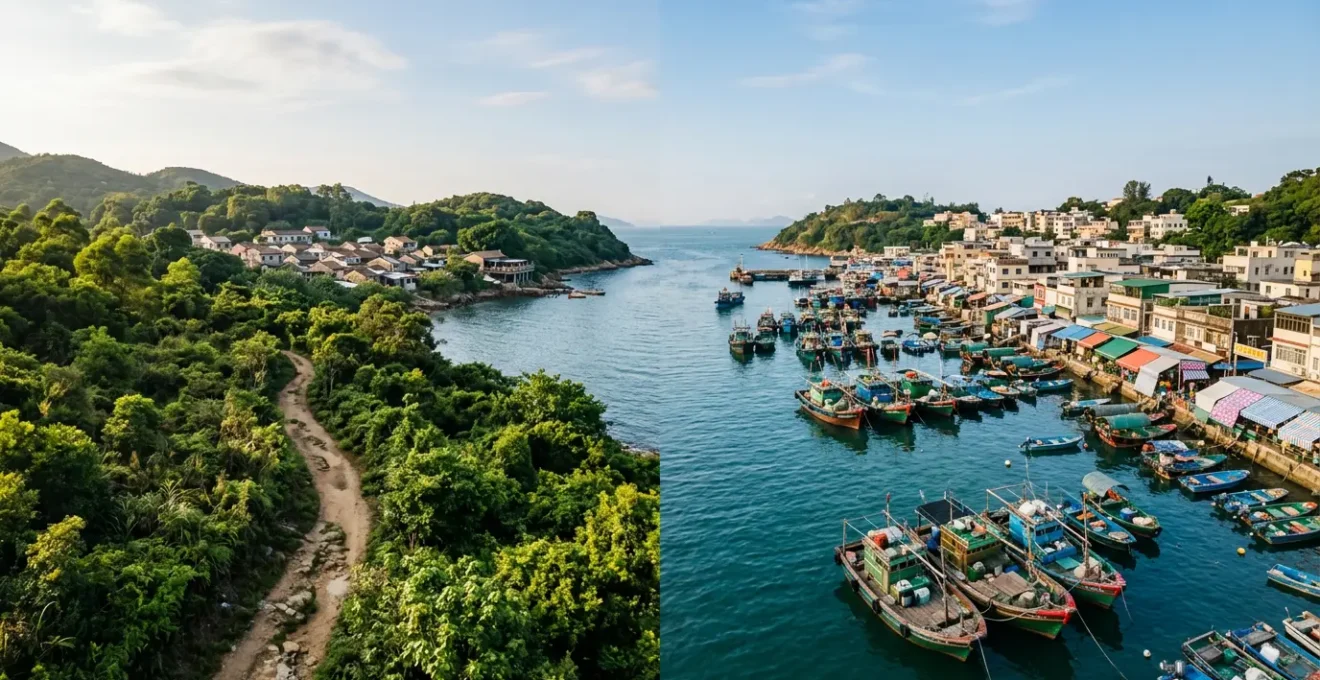
Choosing between Lamma and Cheung Chau is less about logistics and more of a personality test for the modern traveler.
- Lamma Island offers a radical, almost unsettling, digital detox with its profound quiet and bohemian, slow-paced life. It’s for the introspective traveler.
- Cheung Chau provides a vibrant, human-scale version of city energy, packed with tradition, bustling promenades, and endless activity. It’s for the social explorer.
Recommendation: If you seek to disconnect and challenge your city-dweller rhythm, choose Lamma. If you want to exchange urban chaos for charming, lively island culture, Cheung Chau is your destination.
The debate between Lamma Island and Cheung Chau is a classic for any traveler looking to escape the mesmerizing chaos of Hong Kong’s main island. On the surface, the choice seems simple. Guidebooks will tell you Lamma is the bohemian, expat-heavy haven, while Cheung Chau is the traditional, bustling fishing village. They’ll point out that one is for hiking and the other for cycling. This is all true, but it misses the point entirely.
The real decision isn’t about activities; it’s about the kind of sensory experience you’re craving. It’s a question of acoustics, pace, and the very definition of “escape.” Do you want to trade the sound of traffic for the sound of cicadas and your own thoughts, or for the cheerful ringing of bicycle bells and the chatter of a lively community? The mistake is thinking these two car-free islands offer the same kind of peace. They don’t.
This guide reframes the choice. We’re moving beyond the “what to do” and diving into “how it feels.” We’ll explore the unique sensory signatures of each island, from their soundscapes to their social rhythms, to help you diagnose which vibe is the perfect antidote to your city fatigue. This is about choosing your ideal state of mind, not just your day-trip destination.
To help you make the definitive choice, this article breaks down the essential differences in vibe, exploration, food, and culture. We will delve into the details that define the true character of each island, allowing you to select the experience that best suits your personal travel philosophy.
Contents: Deciding Your Island Persona
- Bohemian Lamma vs Traditional Cheung Chau: What Defines Their Vibe?
- How to Explore the Car-Free Islands: Bike Rental or Hiking?
- How to Spot Tourist Trap Seafood Restaurants on the Islands?
- The Public Holiday Error: Why You Should Avoid Outlying Islands on Buddha’s Birthday?
- Why a Car-Free Environment Transforms Your Family Experience?
- Why the Silence of Lamma Island Can Be Unsettling for City Dwellers?
- Shrimp Paste and Salted Fish: What to Buy in a Fishing Village?
- The Fragility Risk: How to Pack Handmade Ceramics for the Flight?
Bohemian Lamma vs Traditional Cheung Chau: What Defines Their Vibe?
Let’s get one thing straight: the “vibe” of an island is more than just its aesthetic. It’s a complex recipe of sound, language, and population density. The standard labels of “bohemian” for Lamma and “traditional” for Cheung Chau are just the start. The real difference is felt in the space between people. Recent demographic data reveals a stark demographic contrast, with a staggering 22,000 residents on Cheung Chau versus a mere 6,000 on Lamma. This isn’t just a number; it’s the foundation of each island’s energy.
Cheung Chau’s density creates a constant, low-level hum of human activity. It’s not the stressful noise of the city but the comforting sound of a community in motion: the whir of bicycles, the calls of vendors, and the ubiquitous chatter of Cantonese. It’s a fishing village that has scaled, but not lost, its core identity. Lamma, particularly outside the main village of Yung Shue Wan, offers something far more radical: an auditory detox. The dominant sounds are natural—the buzz of insects, the rustle of leaves, the lapping of waves. For many, this is paradise. For others, it’s a silence that can feel surprisingly loud.
This core difference in sensory input is what truly defines the choice. One island wraps you in a lively community, the other leaves you alone with nature. This table gives a quick overview of the resulting atmosphere.
| Aspect | Lamma Island | Cheung Chau |
|---|---|---|
| Primary Vibe | Bohemian, laid-back, artistic | Traditional Chinese fishing village |
| Expat Population | High concentration in Yung Shue Wan | Small proportion of total residents |
| Main Language | English widely spoken | Primarily Cantonese |
| Pace of Life | Very slow, unpredictable shop hours | Bustling but unhurried |
The illustration below captures the essence of Lamma’s unique soundscape, where the sounds of nature, like the ever-present cicadas, replace the urban hum and become the island’s soundtrack.
Ultimately, the “vibe” is a reflection of this population difference. Cheung Chau feels like a miniature, walkable Hong Kong with the stress dialled down. Lamma feels like another country altogether, where the slow pace and quiet are non-negotiable features of the experience.
How to Explore the Car-Free Islands: Bike Rental or Hiking?
The choice between hiking on Lamma and cycling on Cheung Chau is more than a simple preference; it dictates the very rhythm of your day. This isn’t just about how you get from A to B, but about the kind of “pace dissonance” you want to experience. Are you looking to surrender to a mandated slowness, or do you want the freedom to set your own, more active pace?
On Cheung Chau, renting a bike is practically the first thing you do stepping off the ferry. The island’s flat, paved promenade is perfect for it. Cycling here isn’t just for transport; it’s the primary mode of social and commercial life. It allows for a fluid exploration, letting you zip between temples, the main beach, and the street food stalls with a sense of liberated efficiency. You are in control of your tempo, covering significant ground without feeling rushed.
Lamma Island, in stark contrast, largely rejects wheeled transport. Its narrow, winding, and often unpaved paths make cycling impractical and, in many places, impossible. The island essentially forces you to walk. The premier experience is the Lamma Island Family Trail, a well-marked 5km route connecting the two main villages of Yung Shue Wan and Sok Kwu Wan. Taking around 90 minutes, this scenic hike forces a meditative pace. You have no choice but to slow down, absorb the stunning sea views, and move with the landscape. It’s a commitment to a singular path and a singular speed, a true departure from the multi-tasking mindset of city life.
This fundamental difference in mobility defines the type of freedom each island offers. Cheung Chau gives you the freedom of choice and speed on its coastal paths. Lamma gives you the freedom from choice, pushing you into a contemplative journey on foot. Consider whether you want to direct your day or let the trail direct you.
How to Spot Tourist Trap Seafood Restaurants on the Islands?
Both islands are famed for their waterfront seafood restaurants, but the idyllic image of a fresh catch can quickly sour if you fall into a tourist trap. The key to an authentic meal isn’t just finding a restaurant; it’s about applying an “authenticity litmus test.” This means looking past the flashy signs and aggressive touts to find the places where locals actually eat. The best meals are found not by chance, but by observation.
The first and most important check is the live tanks. Don’t be shy. Get up close and inspect them. You’re looking for crystal-clear, well-circulated water and, most importantly, active and alert fish and crustaceans. Cloudy water or listless animals are a major red flag. A restaurant proud of its product will have pristine tanks, a visual promise of freshness. Once you’ve chosen a place, a crucial rule is to avoid set menus targeted at tourists. The authentic way is to order “by-the-catty” (a traditional unit of weight). Insist on seeing the seafood weighed in front of you and confirm the price before it’s sent to the kitchen. This transparency is a hallmark of an honest establishment.
Finally, observe the clientele. A restaurant filled with tourists being spoken to in multiple languages by an aggressive host is a warning. The hidden gems are often the ones with a quieter entrance, filled with tables of locals speaking Cantonese and dressed casually. For a higher chance of success, consider the smaller, family-run establishments in Lamma’s Sok Kwu Wan, where some of the 300 resident fishing families still uphold traditional practices.
Action Plan: Your Seafood Tourist Trap Checklist
- Live Tank Inspection: Check for active, clear-eyed fish in clean, well-circulated water. Reject any place with cloudy tanks.
- Ordering Method: Avoid pre-set menus. Order ‘by-the-catty’ and ask to see the scale reading before they cook.
- Clientele Analysis: Look for tables filled with locals speaking Cantonese. A high tourist-to-local ratio is a warning sign.
- Touting Tactics: Be wary of aggressive, multilingual pitches. The best restaurants rely on their reputation, not high-pressure sales.
- Location Strategy: Venture to Sok Kwu Wan’s smaller restaurants, where traditional fishing practices are more prevalent.
The Public Holiday Error: Why You Should Avoid Outlying Islands on Buddha’s Birthday?
The dream of a peaceful island escape can shatter in an instant if you make one critical mistake: bad timing. Visiting Hong Kong’s outlying islands on a public holiday, especially during major events like the Cheung Chau Bun Festival (which coincides with Buddha’s Birthday in May), is a rookie error. You’re not escaping the city’s crowds; you’re heading directly into a super-concentrated version of them. With Hong Kong expecting over 45 million international visitors in 2024, the pressure on these small islands during peak times is immense.
The experience transforms from a relaxing getaway into a logistical nightmare. Ferries become packed to capacity with multi-hour waits, narrow island paths turn into human traffic jams, and every restaurant has a queue snaking out the door. The very peace you came to find is obliterated by the sheer volume of people with the exact same idea. This is the ultimate “pace dissonance,” where your expectation of tranquility clashes violently with the reality of chaotic overcrowding.
Of course, there is an exception: if you are visiting Cheung Chau specifically *for* the world-famous Bun Festival, then you go prepared for the crowds as part of the cultural experience. For every other occasion, strategic planning is essential. The best time to experience the true, unhurried vibe of either Lamma or Cheung Chau is on a weekday, particularly from Tuesday to Thursday. The islands are blissfully quiet, and you’ll feel like you have them almost to yourself. If you must go on a weekend, aim for the earliest ferry out and plan to return mid-afternoon to avoid the peak rush.
This table outlines the crowd levels and strategic approaches for visiting the islands, a crucial tool for protecting your peace and quiet.
| Holiday/Event | Typical Dates | Crowd Level | Strategy |
|---|---|---|---|
| Cheung Chau Bun Festival | May (Buddha’s Birthday) | Extreme | Visit FOR the crowds or avoid entirely |
| Chinese New Year | Jan-Feb | Very High | Take 9AM ferry out, 2-4PM return |
| Mid-Autumn Festival | Sept-Oct | High | Evening ferries most crowded |
| Weekdays (Tue-Thu) | Year-round | Minimal | Optimal for peaceful experience |
Why a Car-Free Environment Transforms Your Family Experience?
The term “car-free” might sound like a simple logistical detail, but on Lamma and Cheung Chau, it’s a feature that fundamentally redefines the family travel experience. The absence of private cars removes a layer of constant, low-grade anxiety that parents often don’t even realize they carry. This creates what some have called the “free-range kids” phenomenon, where children can experience a rare and exhilarating sense of independence.
This freedom, however, manifests differently on each island, creating two distinct types of family adventures. On Cheung Chau, with its wide, flat promenades, the freedom is urban and social. Kids can safely cycle ahead, explore storefronts, or run along the beach without the threat of traffic. It’s an ideal environment for families with strollers or young children on scooters, turning a simple walk into a dynamic and worry-free exploration of a lively village.
On Lamma Island’s 13 square kilometers, the experience is more rugged and natural. The freedom here is about letting kids run ahead on a dirt trail, explore a hidden cove, or lead the way through the quiet hills of the Family Trail. It’s less about social interaction and more about fostering a connection with nature. This environment transforms a family outing from a stressful exercise in crowd control into a shared adventure, where the journey itself becomes the main activity. The pace is naturally slower, dictated by little legs and curious minds, allowing for genuine moments of discovery that are impossible in a structured, vehicle-dominated world.
To make the most of this unique environment, a few practical tips are essential. Always pack light, as you’ll be carrying everything you bring. Plan ferry times carefully, as the last boats often depart before midnight, and remember that many smaller island vendors are cash-only. Most importantly, allow your children to set the pace—their unhurried exploration is precisely the magic these islands offer.
Why the Silence of Lamma Island Can Be Unsettling for City Dwellers?
For those accustomed to the constant soundtrack of a metropolis, true quiet can be a profoundly foreign experience. Lamma Island is marketed as the quieter of the two main outlying islands, a promise it absolutely delivers on. As travel writer Linda from Muy Linda Travels notes, it is a place of blissful quiet, but this quiet is not a neutral feature; it’s an active force that some visitors find unexpectedly challenging.
Lamma is less densely populated and the quieter of the two. Both islands are blissfully quiet with no traffic noise
– Linda from Muy Linda Travels, Lamma Island or Cheung Chau Travel Guide
The experience can be described as an “auditory detox.” When the external noise of traffic, sirens, and crowds is stripped away, you are left with only two things: the sounds of nature and the sound of your own thoughts. For many city dwellers, this abrupt shift can be jarring. The mind, conditioned to constant stimulation, can interpret the lack of familiar noise as emptiness or even isolation. This initial discomfort is a well-documented phenomenon for visitors, particularly in the more remote areas away from the main villages.
This is where the contrast with Cheung Chau becomes most stark. While also free of cars, Cheung Chau offers a familiar, human-scale soundscape. The gentle hum of bicycle chains, the friendly calls between neighbors, and the sizzle of street food stalls create a background noise that feels active and comforting. It’s a much gentler transition for a mind accustomed to urban life.
Choosing Lamma is therefore a commitment to confronting this silence. It’s an opportunity for deep relaxation and introspection, but it requires a willingness to sit with the quiet and let your internal rhythm adjust. If you are seeking a true disconnect and are prepared for this initial period of adjustment, Lamma is unparalleled. If you prefer your peace to be accompanied by the comforting sounds of a gentle community, Cheung Chau’s vibe will feel much more like home.
Shrimp Paste and Salted Fish: What to Buy in a Fishing Village?
Bringing home a souvenir from Cheung Chau is about capturing its sensory signature. Forget generic trinkets; the most authentic mementos are edible and aromatic. The island’s identity is deeply rooted in its maritime history, which dates back to the Ming and Qing dynasties when its proximity to the Pearl River Estuary made it a vital fishing hub. This long tradition has sustained industries like shipbuilding and, most importantly, the art of seafood processing. The pungent, unforgettable aromas of drying fish and fermenting shrimp are the very essence of the village.
The quintessential purchase is shrimp paste. But not all pastes are created equal. You must look for the authentic, locally-made product. Avoid the generic, mass-produced jars and seek out vendors selling a deep grayish-purple paste. The smell should be pungent and deeply savory, but not unpleasantly “off.” The best vendors understand that you’ll be traveling and will often offer to vacuum-seal your purchase for the flight home. It’s still wise to double-bag it in a Ziploc and wrap it in clothes to fully contain the powerful aroma.
Alongside shrimp paste, you’ll find an incredible variety of dried and salted fish, each a testament to traditional preservation methods that are increasingly rare in modern Hong Kong. These products are not just food items; they are a direct link to the island’s history as a working fishing community. For those less adventurous with their luggage, charming replicas of the famous “buns” from the Cheung Chau Bun Festival make for a lighter, less fragrant alternative. On Lamma, the souvenir scene leans more towards art prints and handmade crafts from its resident artist community, reflecting its different cultural focus.
Ultimately, buying shrimp paste on Cheung Chau is more than a transaction. It’s an act of participating in a living history and taking home the most authentic piece of the island’s soul.
Key Takeaways
- Your choice is a personality test: Lamma is for introspective detox, Cheung Chau is for vibrant cultural immersion.
- The “vibe” is physical: Lamma’s silence can be unsettling, while Cheung Chau’s bustle is a comforting, human-scale energy.
- Plan around crowds: Avoid public holidays (especially Buddha’s Birthday) unless you are visiting specifically for the festival events. Weekdays are ideal.
The Fragility Risk: How to Pack Handmade Ceramics for the Flight?
After immersing yourself in the unique vibe of Lamma or Cheung Chau, you might find a perfect, tangible memory: a piece of handmade pottery from a local artist or a charming ceramic spoon rest from a village shop. Getting this fragile treasure home intact requires more than just hope; it demands a strategic packing plan. The final step of your island journey is ensuring your memories don’t end up as shards in your suitcase.
First, never underestimate the power of a solid core. The “box-in-a-box” method is your best defense. If possible, get the original box from the vendor. Wrap your ceramic piece generously in soft material—your clothes work perfectly. A chunky sweater or a few t-shirts provide excellent cushioning. Place this bundle inside the vendor’s box. Then, find a spot in the very center of your suitcase and create a “nest” with more clothes, ensuring at least a few inches of padding on all sides. The goal is to suspend the box so it doesn’t touch any of the hard edges of your luggage.
If you don’t have a box, the “bundle” method is your next best option. Start by stuffing the inside of the ceramic piece (if it’s a mug or bowl) with socks to provide internal support and prevent collapse under pressure. Then, wrap the entire item in multiple layers of clothing, securing the bundle with a hair tie or rubber band so it doesn’t unravel. Again, place this clothing-wrapped ball in the center of your suitcase, buffered on all sides. This final, careful act ensures that the unique character of the island, captured in a piece of earth and glaze, makes the journey home with you.
Ultimately, the perfect island is out there. By looking beyond the surface-level activities and tuning into the deeper sensory experience you seek, you can move from a state of hesitation to a confident decision. Your ideal Hong Kong island escape is waiting.