Staying in Tsim Sha Tsui is a strategic trade-off: you swap larger room sizes for unparalleled “walkable value” and direct access to Hong Kong’s most iconic experiences.
- TST offers a direct, luggage-friendly airport connection via the A21 bus and puts you within a 15-minute walk of the Star Ferry, Avenue of Stars, and major museums.
- The noticeable price premium reflects saved daily commute time, not just a desirable location.
Recommendation: For first-time visitors who want to maximize sightseeing, TST is the optimal choice, provided you embrace its high-energy character and learn to navigate its minor challenges.
The first-time visitor to Hong Kong faces a classic dilemma: where to plant your flag? The internet sings praises of Tsim Sha Tsui (TST) as the city’s pulsating heart, a hub of unparalleled convenience. Yet, whispers of caution follow close behind, painting a picture of overwhelming crowds, relentless touts, and claustrophobic hotel rooms. Most advice presents it as a binary choice—embrace the chaos or seek refuge elsewhere. This approach, however, misses the point of TST entirely.
Viewing TST as merely “central” is an understatement. It’s a meticulously engineered nexus of hyper-efficiency, a place where geography, transport, and attractions converge to create a powerful travel engine. The question isn’t whether you can *endure* its intensity, but whether you can learn to *leverage* it. The perceived “overwhelm” is not a bug; it’s a feature of its extreme density. The key is understanding its operational logic—from its transport arteries to its social rhythm—to unlock a richer, more immersive first-time experience than any other district can offer.
This guide deconstructs the TST experience. We’ll move beyond the simple pros and cons to analyze its core systems. We will quantify its convenience, provide a playbook for its challenges, and reveal why its famous skyline view is more than just a pretty picture—it’s your compass in the urban jungle.
Summary : Decoding Tsim Sha Tsui: An Insider’s Guide for First-Time Visitors
- Why Is TST the Best Hub for Airport Bus A21 Connections?
- How to Deal With Tailors and Watch Sellers on Nathan Road?
- Hotel Breakfast vs Local Cha Chaan Teng: What to Choose in TST?
- Why Are Rooms in TST Smaller and More Expensive Than Wan Chai?
- The Commute Advantage: Walking to the Star Ferry in 5 Minutes
- Kowloon vs Hong Kong Island: Which Side Should You Choose?
- Why Is SOGO Culturally Significant and When to Avoid the Thankful Week?
- Why Staying on the Kowloon Side Gives the Best Island Skyline View?
Why Is TST the Best Hub for Airport Bus A21 Connections?
For a first-time visitor, the journey from airport to hotel is the first test of a city’s logistics. While the Airport Express train is fast, TST’s true advantage lies with the humble Cityflyer A21 bus. This isn’t about saving a few dollars; it’s about preserving your sanity. After a long-haul flight, the last thing you want is to navigate the MTR’s underground labyrinth with heavy luggage. The A21 offers a direct, single-seat journey from the airport terminal to the very spine of TST, Nathan Road. A travel blogger’s comparison found that this direct drop-off, avoiding station transfers, was more valuable than the 15-minute time saving offered by the train combo.
The service is built for efficiency, with an average journey time of 70 minutes and buses departing every 20 minutes. This reliable frequency means you’re never waiting long. The bus drops you at multiple points along Nathan Road, placing you within a short walk of most hotels. This “door-to-artery” service is a low-stress entry into the city’s beautiful chaos. By choosing the A21, you’re not just picking a mode of transport; you’re opting into a more humane and practical start to your Hong Kong adventure, a prime example of TST’s underlying hyper-efficiency.
For a seamless experience, grab a seat on the upper deck’s left side for breathtaking views of the Tsing Ma Bridge as you approach the city. Using an Octopus Card simplifies the fare, making the entire process frictionless.
How to Deal With Tailors and Watch Sellers on Nathan Road?
Walking down Nathan Road, especially between Jordan and TST MTR stations, is a rite of passage. You will be approached. “Copy watch, sir?” “Tailor-made suit, my friend?” For a first-timer, this can feel aggressive and intimidating. However, understanding the dynamic transforms it from a threat into a predictable, harmless part of the local color. This is not a high-pressure scam; it’s a low-stakes, high-volume numbers game played by the vendors.
The key is not to engage in confrontation or lengthy explanations. These sellers are experts at reading hesitation as interest. The most effective strategy is a form of sensory navigation. Avoid direct eye contact as you approach, give a single, slight shake of the head, and continue walking at your current pace. A polite but firm “no, thank you” (or “m̀hgòi,” the Cantonese equivalent) without breaking your stride is more than sufficient. There is no need for rudeness or fear; they will simply move on to the next person.
Think of it as the human equivalent of pop-up ads on a webpage. You don’t get angry at them; you simply close the window and continue what you were doing. By adopting this calm, disengaged approach, you cease to be a target. This small skill is your first lesson in navigating Hong Kong’s density, allowing you to appreciate the vibrant energy of Nathan Road without feeling harassed.
Hotel Breakfast vs Local Cha Chaan Teng: What to Choose in TST?
Your first meal of the day in TST presents a fundamental choice that defines your travel style: the predictable comfort of a hotel breakfast or the chaotic, delicious immersion of a local Cha Chaan Teng. One is a quiet sanctuary; the other is a dive into the city’s beating heart. The hotel breakfast offers a familiar Western or international buffet. It’s calm, easy, and requires no thought—a perfect option for a day when you need a slow, gentle start.
The Cha Chaan Teng, however, is where Hong Kong truly wakes up. These bustling, no-frills diners are institutions of efficiency. You’ll share a table with strangers, point at a menu you might not understand, and have your food arrive in minutes. It’s a symphony of clattering dishes, shouted orders, and the rich aroma of macaroni soup, pineapple buns (bo lo bau), and famously strong Hong Kong-style milk tea. It’s not a relaxing experience; it’s an invigorating one. Choosing the Cha Chaan Teng is choosing to participate in local life, to trade tranquility for authenticity.
For the first-time visitor, the ideal approach is to do both. Use the hotel breakfast for days with early starts or when you’re feeling tired. On other days, venture out to a neighborhood spot like Australia Dairy Company (be prepared to queue) or a smaller, nameless diner. This “two-speed breakfast” strategy allows you to balance comfort with cultural immersion, getting the best of both worlds that TST offers.
This simple choice between a croissant in a quiet hotel and a pineapple bun in a noisy diner is a microcosm of the entire TST experience: you can insulate yourself from the intensity or you can dive in headfirst.
Why Are Rooms in TST Smaller and More Expensive Than Wan Chai?
It’s one of the first things travelers notice when booking: a hotel room in TST often costs more and offers less space than a comparable one in another popular district like Wan Chai. This isn’t a rip-off; it’s a direct reflection of TST’s “walkable universe” premium. An analysis of the hospitality market confirms that TST hotels can command a 30-40% premium over similar properties across the harbor. This price difference isn’t for the room itself, but for what lies just outside your door.
The concept of value density is critical here. An analysis of the 500-meter radius around a typical TST hotel reveals an astonishing concentration of attractions. Within a 5-to-15-minute walk, you can access Harbour City’s 450 shops, five major museums, the Avenue of Stars, Kowloon Park, and the iconic Star Ferry terminal. This proximity is a tangible asset. It saves you an estimated 40 minutes of commute time daily compared to staying further out. Over a five-day trip, that’s over three hours of extra time for sightseeing, relaxing, or exploring.
You are not paying more for less space; you are paying for more time. The smaller room size is a direct consequence of the extreme value of land in this hyper-connected core. Hotels maximize their footprint by building vertically and compactly. So, when you book a room in TST, you are making a strategic investment. You are trading square footage for hours saved, a transaction that is almost always worthwhile for a time-crunched first-time visitor wanting to experience as much of Hong Kong as possible.
The Commute Advantage: Walking to the Star Ferry in 5 Minutes
The single greatest advantage of staying in TST is its immediate proximity to the Star Ferry. This isn’t just another mode of transport; it’s Hong Kong’s most scenic, historic, and soulful commute. Being able to walk from your hotel to the pier in five minutes fundamentally changes how you interact with the city. It transforms a ferry ride from a planned excursion into a spontaneous, everyday pleasure. You can cross Victoria Harbour for a morning meeting on Hong Kong Island, return for an afternoon break, and cross back again for dinner in SoHo, all with minimal effort and for a fare of just HK$2.60-3.60.
This “walkable universe” is TST’s superpower. A quick look at a 15-minute walking radius from the ferry pier reveals the sheer density of attractions at your fingertips:
- 0-5 minutes: Star Ferry Pier, the historic Clock Tower, and the start of the TST Promenade.
- 5-10 minutes: Avenue of Stars, the ultra-modern K11 MUSEA, and the Hong Kong Cultural Centre.
- 10-15 minutes: The vast Harbour City mall, the green oasis of Kowloon Park, and the Space Museum.
A smart strategy for any first-timer is to end your sightseeing day on Hong Kong Island at dusk, then take the Star Ferry back to TST. This allows you to catch the spectacular “Symphony of Lights” show at 8 p.m. from the water or the promenade, giving you a perfect, unobstructed viewing angle. This seamless integration of transport and sightseeing is what makes TST the ultimate convenience hub.
The ability to use the Star Ferry as your daily “scenic shuttle” is a luxury that no other district can offer with such ease, turning a simple commute into a memorable part of your trip.
Kowloon vs Hong Kong Island: Which Side Should You Choose?
The “Kowloon or Island” debate is central to planning any Hong Kong trip. There’s no single right answer, as the best choice depends entirely on your travel personality. Hong Kong Island, particularly areas like Central and Wan Chai, offers a more polished, Western-facing experience with its sophisticated bar scene, fine dining, and proximity to hiking trails like the Dragon’s Back. It feels more corporate and is the hub for the city’s expat community.
Kowloon, especially TST and its grittier northern neighbors like Mong Kok, offers a different flavor. It’s a deeper dive into the city’s Cantonese soul. The energy is more raw, the street life is 24/7, and the focus is on markets, local eateries, and that world-famous skyline view. As the experts at City Unscripted note in their guide to local experiences, the key difference is authenticity. While Central caters to visitors, much of Kowloon serves locals first.
This table helps break down the choice based on what you seek from your trip:
| Traveler Type | Best Choice | Key Attractions |
|---|---|---|
| View Chaser | Kowloon (TST) | Iconic HK Island skyline views, Avenue of Stars |
| Urban Explorer | Kowloon | Nathan Road markets, Mong Kok intensity |
| Expat-Vibe Seeker | HK Island | SoHo bars, Mid-Levels escalators |
| Nature Hiker | HK Island | Victoria Peak, Dragon’s Back trail access |
| Full Immersion | Kowloon | 24/7 street energy, late-night food stalls |
The fundamental difference between Mong Kok and Hong Kong Island’s tourist areas is authenticity. While Central and Tsim Sha Tsui cater primarily to visitors, Mong Kok serves locals first and accommodates tourists second.
– City Unscripted, Local Things to Do in TST Guide
For a first-time visitor, Kowloon (and specifically TST) often wins out. It places you face-to-face with the postcard image of Hong Kong, offering a more visceral and visually spectacular introduction to the city.
Why Is SOGO Culturally Significant and When to Avoid the Thankful Week?
On the surface, SOGO in TST is just another department store. But to a neighborhood profiler, it’s a living museum of Hong Kong’s retail culture. SOGO is a relic of the 1980s Japanese department store boom that fundamentally shaped modern consumerism in the city. It was one of the first to introduce the Japanese philosophy of ‘omotenashi’ (wholehearted service), elevating customer service expectations and setting a standard that still influences Hong Kong retail today.
Visiting SOGO is less about shopping and more about witnessing this cultural legacy in action. However, there is one period when you should actively avoid it unless you are a glutton for punishment: the “Thankful Week.” This bi-annual mega-sale, typically held in mid-May and mid-November, transforms the store into a frenzy of hyper-consumerism. Crowds are immense, queues are legendary, and the experience can be incredibly stressful for the uninitiated. For travelers, it’s a phenomenon best observed from a distance, or for a very short period to simply witness the spectacle.
If you find yourself in TST during this period, or simply want to navigate it like a pro, a clear strategy is essential.
Your Action Plan: Surviving SOGO Thankful Week
- Check Dates: Confirm the exact dates for mid-May and mid-November annually before your trip.
- Time Your Visit: Go on a weekday morning before 11 a.m. to avoid the crushing peak crowds.
- Plan an Escape: Use the basement food hall as both a culinary destination and a strategic refuge from the shopping floors.
- Embrace Observation: Treat it as a cultural event. Visit for just 30-60 minutes to witness Hong Kong’s shopping fervor firsthand.
- Shop Smart: If you must buy something, research items online beforehand and use any available express pickup counters to minimize time in the fray.
Understanding SOGO’s place in the city’s history and knowing when to engage with its most intense moments allows you to appreciate it as a cultural landmark rather than just a chaotic store.
Key Takeaways
- Embrace the A21 Bus: It offers a stress-free, direct connection from the airport to the heart of TST, proving more practical than the train for those with luggage.
- Understand the Value Proposition: TST’s smaller, pricier rooms are a trade-off for saving significant daily commute time, giving you more hours for sightseeing.
- Master Sensory Navigation: Learn to politely disengage from Nathan Road touts to turn an intimidating experience into a harmless local quirk.
Why Staying on the Kowloon Side Gives the Best Island Skyline View?
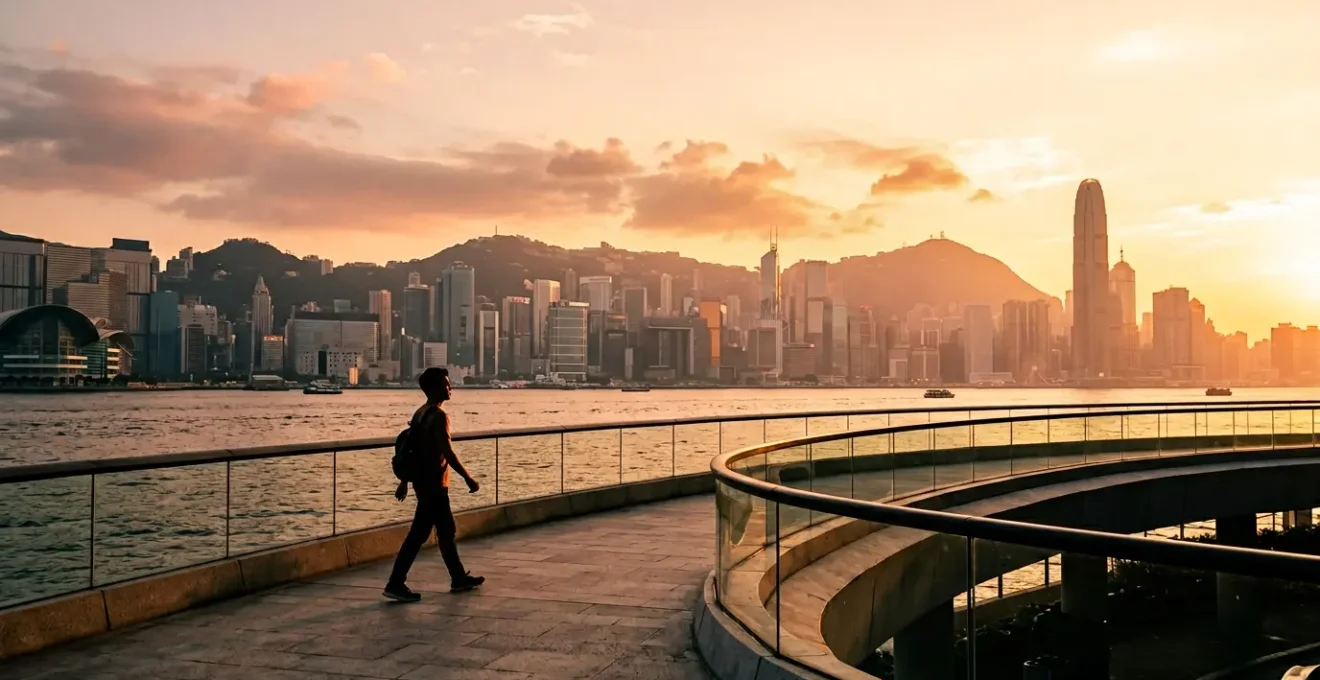
It’s a simple rule of photography and perspective: you can’t see the picture if you’re standing inside the frame. This is the ultimate argument for staying in TST. By basing yourself on the Kowloon peninsula, you are gifted a front-row seat to the main event: the spectacular, ever-changing skyline of Hong Kong Island. The TST waterfront provides 2.5 kilometers of unobstructed harbor views, a public space designed for the sole purpose of admiring the architectural marvel across the water.
This view is not a monolithic entity. As professional photographers know, the TST location offers three distinct tiers of viewing experience. The first is the ‘Public View’ from the Tsim Sha Tsui Promenade and Avenue of Stars. It’s free, democratic, and the perfect ground-level vantage point for the 8 p.m. Symphony of Lights. The second is the ‘Premium Room View,’ the exclusive, 24/7 panorama from a harbor-facing hotel room. Waking up and going to sleep with the skyline as your wallpaper is an experience that many feel is worth the upgrade cost.
Finally, there’s the ‘Elevated Social View’ from rooftop bars like Aqua or Eyebar. This combines cocktails with a sophisticated, raised perspective. The best time to go is during the “blue hour”—the 30 minutes just after sunset when the fading daylight perfectly balances the emerging city lights, creating a magical, cinematic glow. This view is the constant reward for choosing TST. It’s your compass, your backdrop, and your enduring memory of Hong Kong. It’s the reason why, for a first-timer, being on the Kowloon side is being on the right side.
Now that you understand the strategic advantages and operational logic of TST, the choice is no longer about enduring a tourist trap but about leveraging a powerful convenience hub. The next step is to embrace its energy and start planning your itinerary around this incredible home base.