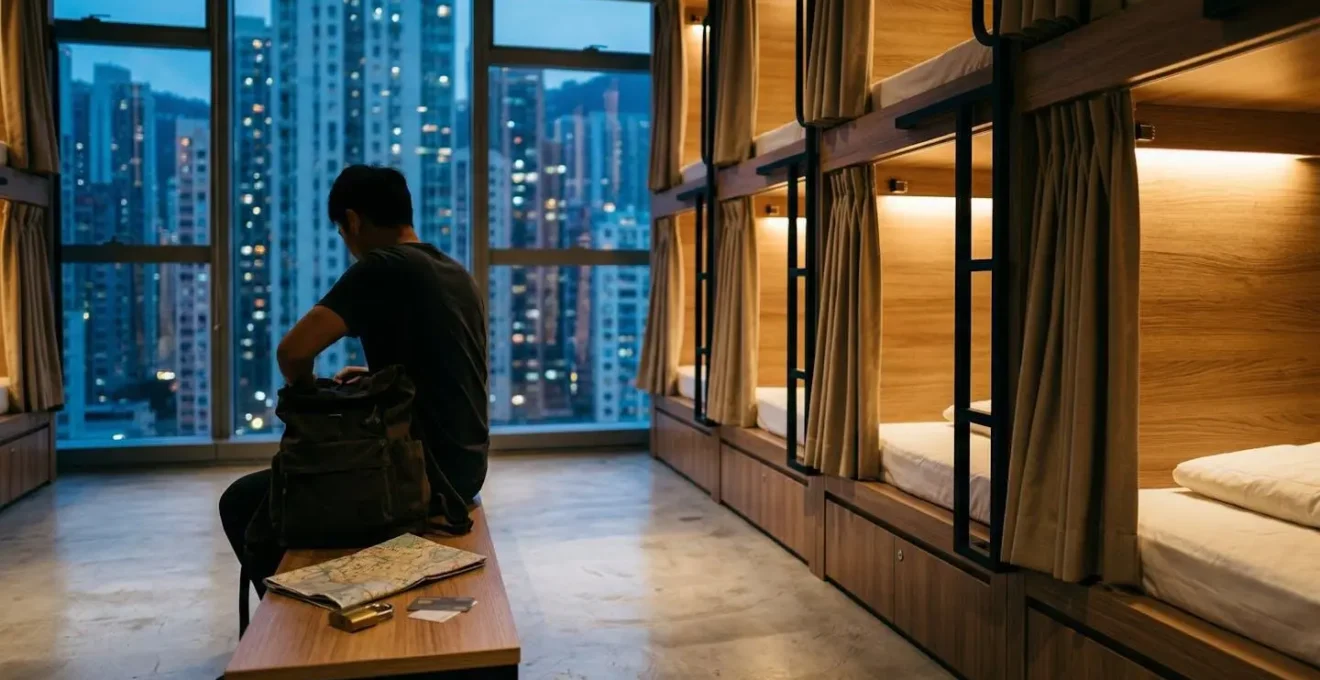
Forget generic hostel lists; finding a clean, safe bed in Hong Kong isn’t about luck, it’s about mastering a specific strategy to navigate the city’s unique pressures on space and hygiene.
- Prioritize pod-style beds for guaranteed privacy and quiet over traditional bunks.
- Trade a central location for stunning nature and lower costs at well-managed YHA hostels.
- Use ‘review forensics’ to spot red flags specific to Hong Kong’s humidity and space constraints.
Recommendation: Always cross-reference reviews on multiple platforms and only book hostels with a cleanliness score of 8.0 or higher.
You’ve seen the pictures, you’ve heard the stories. Hong Kong: a dazzling, vertical city where east meets west, where neon-lit streets pulse with energy. Then you check the accommodation prices, and your backpacker heart sinks. The sticker shock is real. The immediate, “obvious” solution is a hostel. But in a city notorious for its microscopic apartments and sky-high rents, a terrifying question emerges: what horrors await at the bottom of the price ladder? Are Hong Kong’s hostels even remotely clean? Are they safe? The usual advice feels flimsy here. “Read reviews” seems naive when you’re battling a city defined by extreme density and humidity.
Let’s be clear: the generic travel-blogger tips won’t cut it. To conquer Hong Kong on a budget, you need to think like a local, or better yet, like a seasoned travel veteran who’s been burned before. The key isn’t just finding a cheap bed; it’s understanding the fundamental trade-offs you’re making in the city’s unique “Space-Cost-Hygiene Triangle.” You can’t have all three on a budget, but you can learn to strategically prioritize. This isn’t a list of the “Top 10 Hostels.” This is the playbook. It’s about developing a strategy for review forensics, mastering the location-for-lifestyle trade, and equipping yourself with the tools to not just survive, but thrive in one of the world’s most exciting—and expensive—cities.
This guide will walk you through the critical decisions you need to make, from choosing your bed style to eating safely on the street. We will break down the strategies that separate a miserable trip from an unforgettable adventure, giving you the confidence to book a bed that’s both affordable and genuinely livable.
Summary: A Veteran’s Playbook for Finding Safe and Clean Budget Stays in Hong Kong
- Capsule Hotels vs Bunk Beds: Which Offers More Privacy?
- Why Are YHA Hostels Often Located Far From the City Center?
- Bring Your Own Padlock: Hostel Security Essentials
- Which Hostels Have the Best Social Vibes for Solo Travelers?
- Bed Bugs and Cleanliness: How to Check Reviews Before Booking?
- MTR Speed vs Tram Views: Which Mode Suits Your Journey Best?
- Hygiene Concerns vs Flavor: Is It Safe to Eat on the Street?
- How to Find Free Rooftop Views Without Paying Admission Fees?
Capsule Hotels vs Bunk Beds: Which Offers More Privacy?
The first decision you’ll face in Hong Kong’s budget accommodation scene is fundamental: an open bunk or an enclosed capsule? In a city where personal space is the ultimate luxury, this choice defines your stay. A traditional bunk bed is the cheapest option, but it leaves you exposed to the symphony of snores, rustling bags, and your neighbor’s 3 AM phone alarm. You are, quite literally, sleeping in a public space. While some bunks offer a flimsy privacy curtain, it does little to block out noise or light.
Enter the capsule, or pod-style bed. Pioneered in Japan and perfected for high-density cities like Hong Kong, these are a game-changer. For a slightly higher price, you get a fully or semi-enclosed pod, often with its own door or thick curtain, a dedicated light, power outlets, and a small shelf. It’s your tiny private room within a larger dorm. This isn’t just about privacy; it’s about control over your environment. An analysis of traveler preferences at The Mahjong hostel, an innovator in this space, found that 85% of solo travelers prefer these semi-enclosed spaces over traditional bunks, citing significantly better sleep quality. While capsules can sometimes feel stuffy in Hong Kong’s humidity, the benefits in noise reduction and personal space are almost always worth the extra few dollars.
To make the right choice, you need to weigh the variables. This comparison breaks down the core differences between the two dominant styles of budget sleeping in the city.
| Feature | Capsule Hotel | Bunk Bed |
|---|---|---|
| Price Range | $25-50/night | $15-30/night |
| Privacy Level | Enclosed pod with door/curtain | Open space with optional curtain |
| Noise Isolation | Moderate (walls muffle sound) | Low (open dormitory) |
| Personal Storage | Built-in shelf + locker | External locker only |
| Power Outlets | 2-3 inside pod | 1 shared outlet |
| Air Control | Personal fan/AC vent | Shared room AC |
For a budget veteran, the choice is clear: the small premium for a capsule is an investment in sanity and sleep, the two most valuable commodities on a long trip.
Why Are YHA Hostels Often Located Far From the City Center?
When you start your search, you’ll quickly notice a trend: the official YHA (Youth Hostel Association) hostels are often not in the throbbing hearts of Tsim Sha Tsui or Central. This isn’t a mistake; it’s a deliberate strategy and a crucial “Location-for-Lifestyle Trade” for savvy backpackers. YHA, being a global non-profit, often secures land in less commercially frantic, more scenic locations. Instead of being packed into a high-rise, they are frequently nestled in country parks or on hillsides, a world away from the urban chaos.
This is where you cash in. According to YHA Hong Kong’s own data, their hostels are typically 30-45 minutes from Central by MTR. What you lose in commute time, you gain in value and experience. A prime example is the YHA Jockey Club Mt. Davis. It’s a 40-minute journey from the city center, but for around $20 a night, you get 270-degree harbor views, BBQ pits, and sprawling outdoor terraces—amenities that would cost hundreds of dollars per night in a central hotel. You’re trading instant access to nightlife for morning coffee with a million-dollar view and easy access to hiking trails like the famous Dragon’s Back.
This trade-off is the secret. While other tourists are paying a premium to sleep amidst the noise and crowds, you can save upwards of $30 per night, breathe cleaner air, and experience a side of Hong Kong most visitors miss entirely. Many of these remote YHAs even run shuttle buses to the nearest MTR station, mitigating the inconvenience. It’s the ultimate budget veteran move: sacrificing a little convenience for a massive upgrade in environment and a significant cost saving.
Before you book that cramped, overpriced bunk in the city center, ask yourself what kind of trip you really want. The answer might be a short bus ride away.
Bring Your Own Padlock: Hostel Security Essentials
Hong Kong is, by global standards, an incredibly safe city. Violent crime is rare, and you can generally walk around at all hours without issue. This sense of public safety is even highlighted by travel experts. In their latest report, the Hostel Geeks Travel Guide notes:
Hong Kong is extremely safe. The city’s hostels have CCTV surveillance systems and safe deposit boxes to ensure belongings are secure
– Hostel Geeks Travel Guide, Hong Kong Hostel Safety Report 2025
However, a budget veteran knows that city-level safety and hostel-level security are two different things. The biggest threat in a hostel isn’t a mugger; it’s opportunistic theft. A dorm room is a shared space with a constant flow of strangers. Your primary defense is simple and non-negotiable: a good padlock. While many hostels sell or rent them, they are often flimsy and overpriced. Bringing your own is a rookie move that pays dividends. But not just any lock will do; you need one that fits the majority of lockers in the city.
Beyond physical security, digital security is paramount. Hostel Wi-Fi networks are notoriously insecure, making them a playground for data thieves. Using a VPN is not optional; it’s essential, especially when accessing banking or booking sites. The notorious Chungking Mansions, while a hub for cheap accommodation, also highlights another issue: unreliable infrastructure. Reports of broken ATMs are common, reinforcing the age-old advice to always have an emergency cash stash in a money belt, separate from your main wallet. Your security is your own responsibility, and a few proactive steps can prevent a trip-ruining disaster.
Your Hong Kong Hostel Security Checklist
- Bring a 40-50mm padlock with a 6mm shackle; this size fits over 95% of standard hostel lockers in Hong Kong.
- Install and use a VPN on all devices before connecting to hostel WiFi to protect your personal and financial data.
- Photograph your passport and other important documents, uploading them to a secure cloud service (like Google Drive or Dropbox) for emergency access.
- Keep a small amount of emergency cash in a money belt or hidden pocket, as ATMs in budget areas can be unreliable.
- When possible, choose a bottom bunk near the main exit for a quick escape, but away from the bathroom to avoid high foot traffic and potential theft.
- Register your trip with your home country’s embassy or consulate travel app for emergency alerts and assistance.
Don’t let the city’s overall safety lull you into a false sense of security. Lock your things, protect your data, and stay one step ahead.
Which Hostels Have the Best Social Vibes for Solo Travelers?
For a solo traveler, a hostel is more than a bed; it’s a social hub, an instant community. Yet, not all hostels are created equal. Some are little more than silent, transient dormitories, while others are engineered for interaction. In a city as dense and potentially isolating as Hong Kong, finding the latter can be the difference between a lonely trip and an adventure filled with new friends. The secret is looking for hostels designed with “social density” in mind—not just cramming people in, but creating spaces that encourage them to connect.
A masterclass in this is Urban Pack in Tsim Sha Tsui. Run by a pair of Canadians, they didn’t just rent out beds; they engineered a social experience. The hostel features multiple lounges, a rooftop terrace, a movie room, and two separate kitchenettes. These aren’t just amenities; they are designated collision points. By providing a variety of comfortable common areas, they exponentially increase the chances of spontaneous conversations. They then layer on structured activities: walking tours, hiking trips, and the infamous pub crawls. The result is a powerful social formula. Data from reviews shows an incredible 78% of solo travelers reported making friends within their first 24 hours, compared to a baseline of 45% at standard hostels.
You can learn to spot these social dynamos through “review forensics.” Don’t just look at the rating; search the text of reviews for specific keywords. The term “common room” appearing more than ten times is a strong indicator of an active social space. Look for mentions of “organized activities” or “pub crawl” to gauge the party level. A full “kitchen” attracts long-term, social digital nomads, whereas a “kitchenette” suggests a more transient, less connected crowd. Even the availability of female-only dorms can be a proxy for a hostel that is thoughtful about creating a safe and comfortable environment for solo female travelers, which often correlates with a better overall social vibe.
Don’t leave your social life to chance. Choose a hostel that invests in it, and you’ll be rewarded with travel companions and memories that last a lifetime.
Bed Bugs and Cleanliness: How to Check Reviews Before Booking?
This is the core fear, the question that keeps budget travelers up at night: cleanliness. In a subtropical, humid, and absurdly dense city like Hong Kong, the battle against dirt, mold, and—dare we say it—bed bugs is relentless. A hostel that might be considered clean in a dry European climate can quickly descend into a biohazard zone here. This is where “Review Forensics” becomes your most critical skill. You must become a detective, reading between the lines of reviews to uncover the truth.
First, ignore almost everything more than three months old. Hong Kong’s humidity means a hostel’s cleanliness is a moving target. A glowing review from last year is useless if the cleaning staff has changed or a mold problem has taken root. Filter all booking sites to show only the most recent reviews. Next, use the search function within the reviews. Don’t just read; hunt for specific keywords: ‘clean’, ‘dirty’, ‘bugs’, ‘mold’, ‘smell’. One mention of “bugs” is a deal-breaker. Multiple mentions of “smell” or “damp” in a humid city are a major red flag for mold. Conversely, repeated, specific praise like “bathrooms were spotless” or “sheets smelled fresh” is a great sign.
Be skeptical. Ignore short, generic five-star reviews (“Great place!”). They are often fake. A real, positive review has details. A real, negative review has a story. Furthermore, cross-reference ratings across multiple platforms. A hostel might have a 9.0 on one site but a 7.5 on another. The truth is usually in the average. For Hong Kong specifically, a crucial benchmark has been identified through data analysis: based on an analysis of over 3,000 traveler reviews, only hostels that consistently maintain an 8.0/10 or higher on their cleanliness score manage to stay ahead of the city’s challenging climate. Anything less is a gamble.
Your health and peace of mind are on the line. Don’t be lazy. Do the detective work, trust the data, and book a hostel that proves it takes cleanliness seriously.
MTR Speed vs Tram Views: Which Mode Suits Your Journey Best?
Once you’ve secured your bed, your next budget battle is transportation. Hong Kong has one of the world’s best public transport systems, but choosing the right mode for each journey is key to stretching your dollar. The MTR (subway) is the backbone of the city: it’s fast, efficient, and air-conditioned—a blessing in the summer heat. It’s the undisputed champion for long-distance travel or getting anywhere during rush hour. However, it’s also the most expensive option and it’s entirely underground, meaning you see nothing of the city.
For sightseeing on a shoestring, nothing beats the Hong Kong Tram, or “ding-ding.” For a ridiculously cheap flat fare, you can ride the entire length of Hong Kong Island. It’s slow, it’s not air-conditioned, and it’s often crowded, but it offers a front-row seat to the city’s street life. The best trick is to snag a seat at the front of the upper deck for unparalleled views. It’s not just transport; it’s a mobile sightseeing tour for pennies. The ultimate budget hack, however, is the Star Ferry. Crossing Victoria Harbour from Kowloon to Central via MTR is faster by a few minutes, but costs significantly more. The ferry offers the single most iconic view of the Hong Kong skyline for less than 50 US cents.
To make the best choice, you need to weigh cost against time and experience. The following table breaks down the main options for a budget traveler.
| Transport | Cost (HKD) | Speed | Best For |
|---|---|---|---|
| MTR | $4-25 | Fastest (2-5 min between stations) | Long distances, rush hour |
| Tram | $3 flat fare | Slow (30-45 min HK Island) | Sightseeing, short hops |
| Ferry | $2.20-3.70 | Medium (8-15 min crossing) | Harbor crossing, views |
| Red Minibus | $3-10 | Fast but chaotic | Late night, local experience |
A true veteran knows when to pay for the MTR’s speed and when to save a few dollars for the Tram’s unbeatable views. The right choice depends entirely on your mission for the day.
Hygiene Concerns vs Flavor: Is It Safe to Eat on the Street?
One of the greatest joys of traveling in Asia is the street food, and Hong Kong is no exception. From curry fish balls and egg waffles (gai daan jai) to stinky tofu and roasted chestnuts, the streets are a culinary adventure. But for the uninitiated, it’s also a minefield of potential hygiene disasters. Is it safe? The answer is a resounding “yes,” provided you know the rules. Eating on the street isn’t just a cultural experience; it’s the single most effective budget strategy you can employ. An analysis of backpacker budgets confirms that street food meals cost $3-4, while a basic meal in a restaurant will set you back $20-25. Avoiding street food isn’t just missing out on flavor; it’s burning a hole in your wallet.
The key is learning to spot the safe stalls. The number one rule: follow the queue. A long line of locals (not tourists) is the best certification a stall can have. It signals not only delicious food but also high turnover, which means the ingredients are constantly being replenished and are therefore fresh. Next, observe their process. Look for stalls that have two people: one handling the food and one handling the money. This separation is a critical hygiene indicator. If you’re still nervous, start with low-risk items. Anything cooked to a high temperature right in front of you—like steamed buns, roasted meats, or freshly made waffles—is generally very safe. Avoid pre-cut fruit or anything that looks like it’s been sitting out for a while.
Many stalls will also display a green or blue certificate from the Food and Environmental Hygiene Department. While not a guarantee, it shows the operator is at least meeting basic standards. By following these simple rules, you can feast your way through the city for a fraction of the cost of eating in restaurants, all while experiencing the authentic, vibrant flavors of Hong Kong. As travel writer Orlagh Claire puts it, “The best food in Hong Kong is often the cheapest – skip fancy restaurants and stick to street food, markets, and casual eateries.”
Trust the locals, follow the queues, and embrace the controlled chaos of Hong Kong’s street food scene. Your taste buds and your wallet will thank you.
Key takeaways
- In Hong Kong, always prioritize a capsule bed over a bunk for guaranteed privacy and better sleep.
- Embrace the “Location-for-Lifestyle Trade”: remote YHA hostels offer huge savings and access to nature in exchange for a short commute.
- Your security is your own responsibility: bring a 40-50mm padlock, use a VPN on public WiFi, and maintain a healthy dose of situational awareness.
How to Find Free Rooftop Views Without Paying Admission Fees?
Hong Kong’s skyline is its crown jewel, a breathtaking spectacle of neon-drenched skyscrapers set against majestic green mountains. And of course, there are plenty of businesses eager to charge you a premium to see it. Observation decks like Sky100 charge hefty admission fees, and rooftop bars will demand you buy a wildly overpriced cocktail for the privilege of a view. But a budget veteran knows the truth: the best things in life—and in Hong Kong—are often free. You just need to know where to look.
Your first stop should be the IFC Mall in Central. While tourists flock to paid decks, savvy travelers head to the public rooftop garden of this luxury mall. It’s completely free to access, offers stunning close-up views of the harbor, and even has chic public seating. For an even higher vantage point, the Hong Kong Monetary Authority exhibition on the 55th floor of IFC Tower 2 is also free and offers panoramic views that rival any paid attraction. Public libraries are another fantastic resource; the Central Library in Causeway Bay has floor-to-ceiling windows on its upper floors facing the harbor. You get a world-class view, free WiFi, and blessed silence.
For those willing to expend a little physical energy, the rewards are even greater. The hike up to Lion Rock is challenging but rewards you with a 360-degree panorama of the entire city. For a less strenuous option, the Tsim Sha Tsui Promenade on the Kowloon side offers the classic, ground-level view of the Hong Kong Island skyline, and it’s the best place to watch the free Symphony of Lights show every night at 8 pm. These free spots aren’t just about saving money; they offer a more authentic, less crowded experience of the city’s magnificent beauty.
By applying these budget strategies, you transform from a mere tourist into a savvy traveler who gets to enjoy the million-dollar views for free, proving that the best Hong Kong experience isn’t about how much you spend, but how smart you travel.