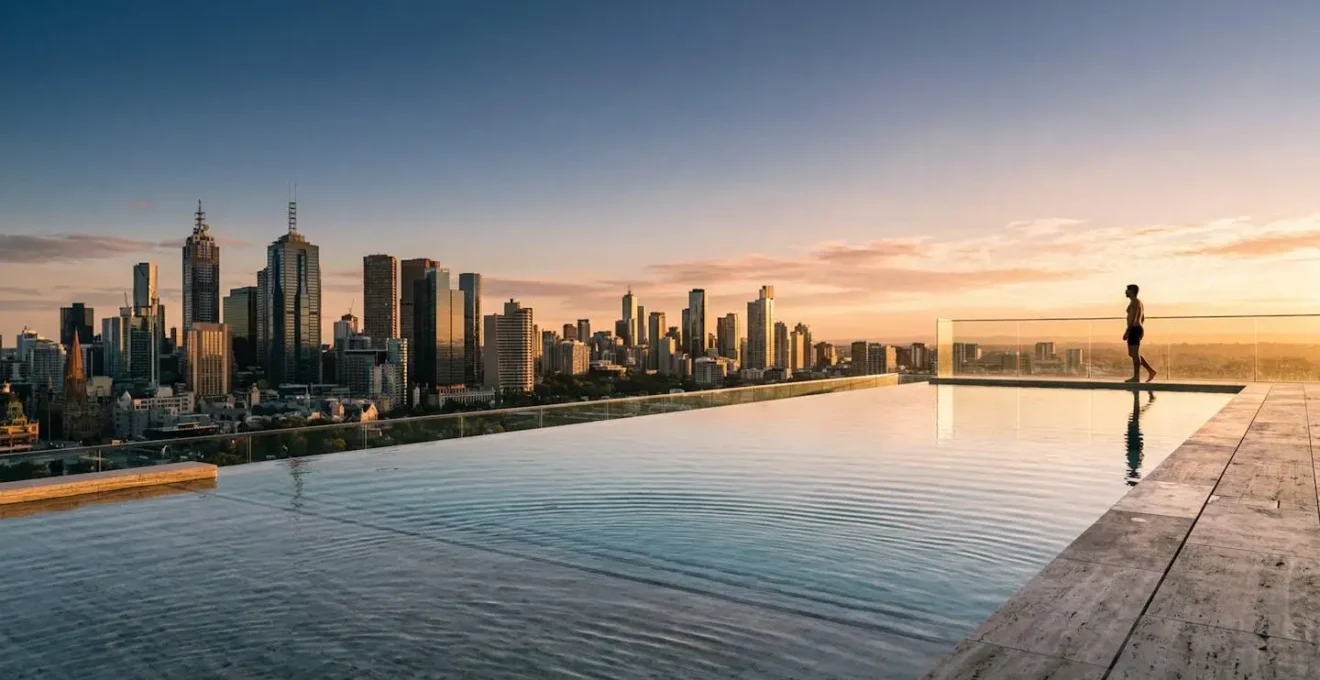
Mastering the iconic infinity pool photo is less about the location and more about mastering the details of access, timing, and technique.
- Securing entry often requires strategies beyond booking a room, such as spa packages or off-peak day passes.
- The perfect shot depends on technical skill: using golden/blue hours, eliminating glass reflections, and finding unique water-level angles.
Recommendation: Plan your pool visit as a photographic mission with distinct stages for scouting, shooting, and wellness.
The image is iconic: a swimmer poised at the edge of a glittering infinity pool, the water seamlessly merging with a breathtaking city skyline. For the luxury traveler and discerning influencer, this isn’t just a photo; it’s the ultimate trophy. But capturing this moment is far more complex than simply showing up. Most guides will list the usual locations and offer generic advice like “go at sunset.” This approach yields predictable, often crowded, results that blend into a sea of similar social media posts.
The real challenge lies in transcending the cliché. What if the secret to an extraordinary photo wasn’t just about the view, but about a deliberate and strategic approach? This guide moves beyond the obvious, treating the infinity pool experience as an art form. It’s a connoisseur’s manual for mastering the unseen details: the subtle differences in a pool’s vibe, the clever hacks for exclusive access, the technical photography skills that separate a good shot from a great one, and the art of pairing the swim with a holistic wellness experience. We’ll deconstruct the entire process, transforming a simple swim into a masterpiece of travel photography and personal luxury.
Summary: A Strategic Guide to Skyline Pool Photography and Access
- Ritz-Carlton vs W Hong Kong: Which Pool Has the Better Vibe?
- Are Outdoor Infinity Pools Heated for Winter Swimming?
- How to Access Luxury Pools Without Booking a Room?
- How to Get a Solo Photo in a Crowded Hotel Pool?
- The Vertigo Risk: Is It Scary to Swim Right at the Edge?
- The Glass Reflection Error That Ruins Night Photos From Indoors
- Day or Night: When to Capture the Skyline for Maximum Impact?
- Which 5-Star Hotel Has the Best Traditional Chinese Medicine Spa?
Ritz-Carlton vs W Hong Kong: Which Pool Has the Better Vibe?
Choosing an infinity pool in a city like Hong Kong is not just about the view; it’s about curating an experience. The “vibe” is a critical, yet often overlooked, element in the architecture of your perfect photo. The city’s two most famous rooftop pools, at The Ritz-Carlton and the W Hong Kong, offer dramatically different atmospheres, catering to distinct tastes. Your choice between them should be a deliberate one, aligned with the narrative you wish to create.
The Ritz-Carlton, home to the world’s highest swimming pool on the 118th floor, offers an experience of serene, almost celestial, detachment. The ambiance is one of quiet sophistication and classic luxury. It’s a sanctuary above the clouds, ideal for capturing images that convey tranquility, introspection, and opulent calm. The lighting is more subdued, the crowd is typically older and more reserved, and the overall feeling is one of exclusive escape. This is the setting for a pensive, elegant shot, not a vibrant party scene.
In contrast, the W Hong Kong’s 76th-floor WET® Deck is the epitome of trendy, high-energy glamour. The vibe is social, driven by DJ sets, colorful cocktails, and a younger, fashion-forward crowd. This is the place for dynamic, vibrant photos that capture a sense of celebration and modern chic. The design is bold, the music is present, and the atmosphere encourages interaction. If your goal is to portray a narrative of excitement, social connection, and cutting-edge style, the W is the superior canvas. The decision, therefore, is not about which is “better,” but which one authentically serves your personal brand.
Are Outdoor Infinity Pools Heated for Winter Swimming?
The allure of an infinity pool against a crisp winter sky—steam rising from the water as snow dusts the cityscape—is a powerful image. But is it a feasible one? The answer, for the true connoisseur, is a resounding yes, provided you choose your location wisely. The world’s top-tier luxury hotels understand that their pools are year-round assets, and many invest heavily in sophisticated heating systems to ensure a comfortable swim no matter the season. The key is knowing which properties guarantee this amenity.
Many premier hotels maintain their pools at a pleasant temperature throughout the year. The Four Seasons Philadelphia, for instance, confirms that its 57th-floor infinity pool is heated year-round, allowing for a comfortable swim even during the icy winters of the Northeast. This isn’t an anomaly; it’s a standard feature among elite properties that cater to a discerning clientele. These systems are powerful enough to maintain a welcoming temperature against cold air, turning a potential obstacle into a unique photographic opportunity.
For those planning a skyline swim in cooler months, several destinations are renowned for their heated, year-round pools:
- Singapore (Marina Bay Sands): While the main pool is subject to ambient temperature, the outdoor jacuzzis remain heated, offering a warm perch with the same iconic view. The pool itself is open daily from 6 a.m. to midnight.
- Dubai (Address Beach Resort): Home to the world’s tallest infinity pool, it is comfortably heated to provide a perfect swimming environment during the cooler winter months.
- New York City (TWA Hotel): A prime example of winter commitment, this heated “pool-cuzzi” is open 365 days a year, famously operating even as planes take off from a snow-covered JFK.
The ability to swim in winter is not a matter of luck, but of strategic hotel selection. It opens up a new aesthetic for your portfolio: the dramatic contrast of warm, steaming water against a cold, sharp city backdrop.
How to Access Luxury Pools Without Booking a Room?
The most coveted infinity pools are often guarded by an impenetrable wall of exclusivity: the hotel room key. For many top-tier locations, this is a non-negotiable policy. The iconic Marina Bay Sands in Singapore, for example, is famously strict, with its website confirming there are zero non-guest access options for its pool. This gatekeeping preserves the experience for paying guests and enhances the pool’s allure. However, for the strategic traveler, this is not an insurmountable barrier but a challenge to be navigated with intelligence and creativity.
Instead of seeing access as a binary choice (guest or no guest), the connoisseur views it as a hierarchy of hacks. Many luxury hotels offer alternative pathways to their aquatic paradises, often as a way to monetize their amenities and attract a high-spending local clientele. These methods require research and investment but are often more cost-effective than a full night’s stay.
Here is the established hierarchy of access strategies, from most direct to most indirect:
- The Day Pass: A growing number of hotels offer day passes specifically for pool access. These can range from $50 to over $200 but provide guaranteed entry for a set period.
- The Cabana Rental: This is a premium version of the day pass. For instance, the Address Beach Resort in Dubai allows non-guests to book a private cabana on its record-breaking 77th floor, which includes full pool access.
- The Spa Package: This is often the most elegant solution. Book a qualifying spa treatment at the hotel, and pool access is frequently included as a complimentary amenity. You get a massage and the photo.
- The Restaurant Minimum Spend: Some rooftop restaurants adjacent to pools offer dining packages that may include access. This is more of an indirect approach, providing views and atmosphere, but not always a swim.
- The Off-Peak Strategy: All these options are more readily available and often cheaper during a destination’s shoulder season. Less demand means more flexibility from the hotel.
Mastering this “access hierarchy” is a fundamental skill for the serious pool photographer, transforming a “members-only” sign from a stop sign into a welcome challenge.
How to Get a Solo Photo in a Crowded Hotel Pool?
The greatest challenge of infinity pool photography isn’t the lighting or the angle; it’s the other people. The world’s most famous pools are magnets for crowds, making a clean, solitary shot seem impossible. However, achieving that “private pool” illusion is a matter of technique, not luck. It involves a combination of strategic timing and clever composition to create negative space where none exists.
First, timing is paramount. The single most effective strategy is to be the first person at the pool when it opens. This often means a pre-dawn wake-up call, but it grants you a precious, often brief, window of near-solitude before the crowds descend. The early morning light is also soft and forgiving, adding to the quality of the shot. Conversely, staying until the very last minute before closing can sometimes yield similar results as the crowds thin out.
When crowds are unavoidable, the art of composition takes over. The key is to think in terms of creating forced perspectives. Professional photographers recommend finding overlooked corners or unique angles away from the main “photo spot.” The most powerful technique is adopting a water-level perspective. By bringing your camera down to the surface of the water, you use the pool’s edge to block out other swimmers in the background. This creates a powerful foreground element and an intimate, immersive feel, effectively erasing the crowd. This approach transforms a busy environment into a seemingly private oasis.
As this image demonstrates, a low angle not only hides unwanted background elements but also creates a dramatic interplay between the water’s surface, the light, and the skyline. Combining this with a telephoto lens can further compress the background, isolating you against the cityscape and making the final image feel both grand and intensely personal.
The Vertigo Risk: Is It Scary to Swim Right at the Edge?
The very design of an infinity pool is meant to create a thrilling illusion: that you are swimming at the precipice of the world, with nothing between you and the city below. For some, this is exhilarating; for others, it’s a source of genuine vertigo and anxiety. The question is valid: just how scary is it, and more importantly, is it safe? For the well-informed traveler, understanding the engineering behind the magic is the key to replacing fear with awe.
The “disappearing edge” is a masterclass in visual trickery. It is not an open drop. As the official FAQ from Marina Bay Sands explains, the system is elegantly simple:
When you swim to the edge of the pool, you’ll reach a wall. The pool’s ‘disappearing edge’ is a visual trick.
– Marina Bay Sands, Official Hotel FAQ
The water flows over this primary wall into a lower catch basin, which is inaccessible to swimmers and sits behind another substantial, solid barrier. According to engineering details from Marina Bay Sands, a fall is physically impossible. You are always protected by at least one, and usually two, robust physical walls. The fear comes from what your eyes see, not what is physically present.
However, the psychological effect of height varies. To help manage expectations, one can think of pools on a “Vertigo Scale”:
| Level | Description & Examples |
|---|---|
| 1 (Low Anxiety) | Ground-level pools with ocean views (e.g., Maldives resorts). |
| 2 (Moderate) | 10-20 floor rooftop pools with city views. Height is noticeable but not overwhelming. |
| 3 (Elevated) | Marina Bay Sands at 57 floors. The 150m length can help diffuse the sense of height. |
| 4 (High) | Address Beach Dubai at 77 floors (293m). The sheer altitude is the dominant sensation. |
| 5 (Extreme) | Cantilevered or glass-bottom pools (e.g., The Joule Dallas), where you see directly down. |
By understanding both the flawless safety engineering and your own comfort level on this scale, you can choose a pool that delivers the thrill you seek without unnecessary anxiety.
The Glass Reflection Error That Ruins Night Photos From Indoors
Sometimes, the best view of a skyline isn’t from the pool deck itself but from an indoor lounge or your own room, especially on a cold or windy night. This presents a formidable photographic enemy: the glass reflection. Nothing ruins a stunning night shot of a sparkling city more than the ghostly reflection of your own camera, a stray room light, or your own silhouette. Overcoming this is a non-negotiable technical skill for any serious skyline photographer.
The mistake most people make is simply holding their camera up to the window and hoping for the best. This is a recipe for failure. The solution requires two key professional techniques: polarization and light sealing. First, a circular polarizer filter (CPL) is an essential piece of kit. By rotating this filter, you can dramatically reduce or even eliminate the glare and reflections coming off the glass surface, making the window virtually invisible to your lens. This single tool is often the difference between an amateur and a professional-looking shot.
The second, and equally crucial, technique is the “lens-to-glass” method with light sealing. This involves physically pressing the front of your camera lens directly against the window pane. This simple act already blocks a significant amount of stray light from reflecting between the lens and the glass. To perfect it, you then use a dark piece of clothing—like a jacket or a hoodie—to create a makeshift lens hood. You drape the fabric over your camera and hands, forming a light-proof seal against the window. This blocks all residual ambient light from the room from reaching the lens and creating reflections.
This setup, while looking a bit strange, is the gold standard for shooting through glass. It ensures that your sensor is capturing only the magnificent view outside, free from any distracting internal light pollution. Mastering this technique unlocks the ability to capture pristine skyline shots from the comfort of an indoor viewpoint.
Day or Night: When to Capture the Skyline for Maximum Impact?
The question of the “best” time to photograph a skyline from an infinity pool seems simple, but the common answers of “day” or “night” are inadequate for a connoisseur. The true magic lies not in a static time but in the transitional periods of light that last only for a few precious minutes. For photographers in the know, there are only two correct answers: the Golden Hour and the Blue Hour. These periods offer a quality of light and color that cannot be replicated at any other time of day.
The Golden Hour occurs in the short window just after sunrise and before sunset. During this time, the sun is low on the horizon, casting a warm, soft, and directional light. This light is incredibly flattering for portraits in the pool and wraps the city’s architecture in a beautiful golden glow. It creates long, dramatic shadows and reduces harsh contrast, making it ideal for capturing both yourself and the cityscape in perfect harmony.
The Blue Hour happens in the twilight period just before sunrise and after sunset. The sun is below the horizon, but its residual light fills the sky with a deep, serene blue. This is the moment when the city’s artificial lights begin to turn on, creating a perfect balance between the ambient light of the sky and the sparkling lights of the buildings. This contrast between the cool blue of the sky and the warm yellow of the city lights is visually stunning and produces images with incredible depth and mood.
A professional doesn’t choose one over the other; they plan their “experience architecture” to capture both. This involves a strategic photo session sequence:
- Stage 1 – Daylight Scouting (1 hour before sunset): Arrive early to scout the best angles and set up your gear without rush.
- Stage 2 – Golden Hour (45 mins before sunset): Focus on capturing portraits and shots with warm, direct light.
- Stage 3 – Sunset (The 15-minute window): Capture the dramatic colors of the sun dipping below the horizon.
- Stage 4 – Blue Hour (30 mins after sunset): The prime time for balancing the ambient sky with the city lights.
- Stage 5 – Full Night: Once the sky is black, focus on capturing the pure sparkle of the city and any light shows.
Viewing your pool time not as a single event but as a multi-stage photographic mission is the key to walking away with a diverse and impactful portfolio of images.
Key Takeaways
- Access is strategic: Look for day passes, spa packages, or cabana rentals to enter exclusive pools without a room key.
- Timing is non-negotiable: Plan your entire shoot around the Golden and Blue Hours for the most dramatic and balanced light.
- Technique trumps location: Master water-level angles to erase crowds and the lens-to-glass method to eliminate reflections for flawless shots.
Which 5-Star Hotel Has the Best Traditional Chinese Medicine Spa?
For the true luxury connoisseur, an infinity pool is not the final destination; it’s a component of a larger wellness narrative. The ultimate experience involves a “sensory pairing”—combining the physical exhilaration of a skyline swim with the deep, restorative benefits of an authentic spa treatment. In this realm, a generic massage falls short. The pinnacle is a hotel that offers a world-class pool alongside a genuinely expert Traditional Chinese Medicine (TCM) spa.
This pairing elevates the trip from a simple vacation to a holistic retreat. The swim becomes the active, yang part of the day, while the TCM treatment provides the grounding, yin balance. Properties like Marina Bay Sands are beginning to master this, offering exclusive Night Spa experiences that blend rejuvenating treatments with the spectacular ambiance of their rooftop pool after hours. This creates the ultimate urban sanctuary. However, identifying a truly authentic TCM spa requires looking beyond marketing brochures and a generic “Asian-inspired” menu.
An authentic TCM spa is defined by its expertise and adherence to genuine principles, not just its decor. The discerning traveler should look for specific markers of quality before booking a treatment that is meant to complement their poolside experience.
Your Checklist for TCM Spa Authenticity
- Licensed Practitioners: Verify that the spa employs practitioners with recognized certifications in Traditional Chinese Medicine, not just standard massage therapists.
- Custom Prescriptions: A genuine TCM experience often involves a consultation that leads to tailored herbal remedies or treatments based on your individual constitution (Qi, blood, yin/yang balance).
- Advanced Techniques: Look for a service menu that goes beyond basic massage to include specialized techniques like Tui Na (therapeutic massage), acupuncture, or cupping.
- Meridian Focus: The spa’s philosophy and treatment descriptions should be rooted in the core TCM concept of balancing the body’s energy meridians.
- Integrated Wellness: The best programs will explicitly suggest how to integrate their treatments with other hotel amenities, like a post-swim session to aid muscle recovery and circulation.
By using this checklist, you ensure that your spa experience is as authentic and high-quality as the infinity pool itself, creating a truly memorable and restorative journey.
Elevate your next trip from a simple stay to a complete wellness journey by integrating these expert strategies. By planning your access, mastering the light, and pairing your swim with restorative therapies, you transform a fleeting moment into an art form and an unforgettable memory.