In summary:
- The Fire Dragon Dance is not a parade; it’s a purifying ritual best experienced by immersing yourself in its smoke-filled, spiritual atmosphere.
- Secure the best vantage point on Wun Sha Street, but the true event begins hours earlier with the sacred “eye-dotting” ceremony at Lin Fa Kung Temple.
- Protect yourself from the intense incense smoke and sparks not to avoid them, but to safely embrace them as part of the blessing.
- The dance is one of many living traditions; exploring the Heritage Centre and nearby rituals like ‘villain hitting’ completes the cultural experience.
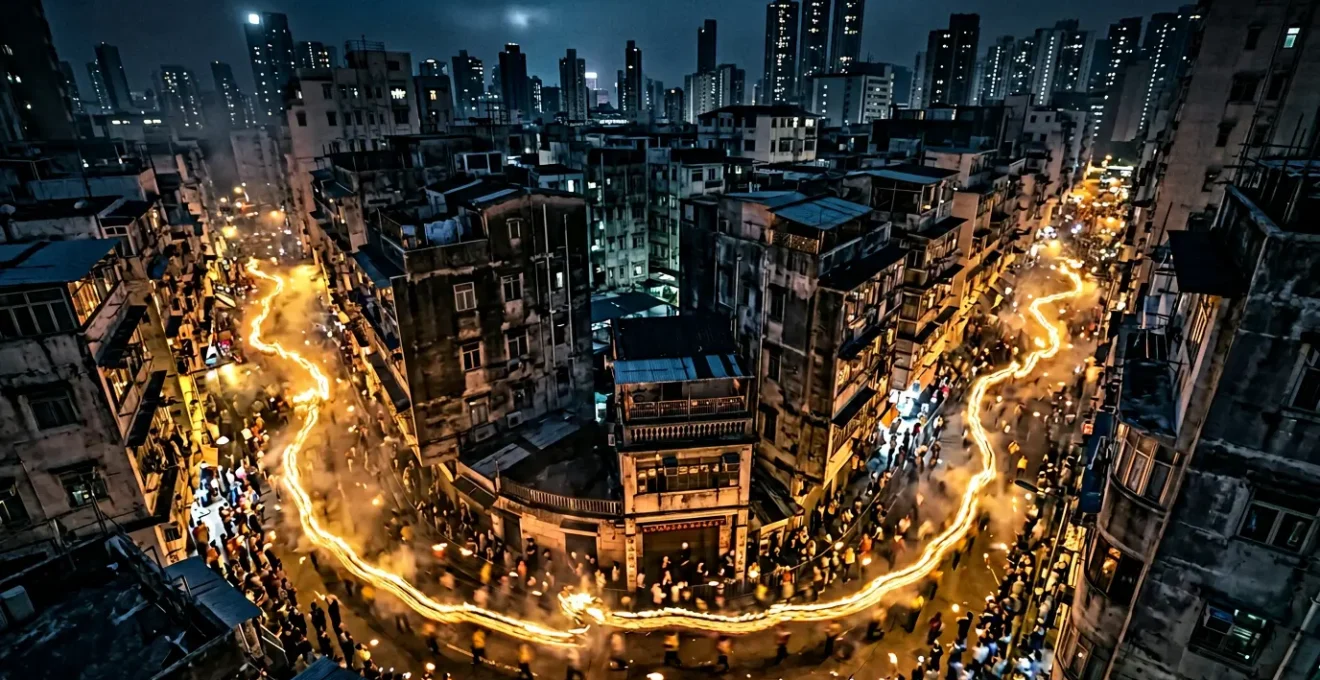
During Hong Kong’s Mid-Autumn Festival, while most of the city gazes peacefully at the full moon with lanterns and mooncakes, the narrow streets of the Tai Hang neighborhood erupt in a chaotic symphony of fire, smoke, and drumming. This is the Tai Hang Fire Dragon Dance, a spectacle that transcends mere performance. Many guides will tell you where to stand for the best photograph, focusing on logistics and crowd control. They treat the dragon as an object, a 67-meter-long float made of hemp and straw.
But that’s missing the point entirely. To truly witness the dance is to understand that the dragon is not an object; it is a temporary vessel for a powerful spiritual entity. This guide is for the festival chaser, the traveler who wants to get under the skin of a tradition. We won’t just tell you where to stand; we’ll tell you how to feel the heat, how to breathe in the history, and how to understand the soul of this incredible act of community resilience. The goal isn’t to watch the dragon pass by, but to become part of its purifying, incense-fueled journey through the heart of the city.
This article breaks down how to transform your experience from that of a simple spectator to an informed participant. We’ll explore the spiritual origins of the ritual, the strategy for finding the most immersive spot, the real timeline of the event, and the wider cultural context that gives the dance its profound meaning.
Summary: Tai Hang Fire Dragon Dance: Your Insider’s Guide to a Mid-Autumn Spectacle
- Why Did Villagers Create a Dragon of Fire in the 19th Century?
- How to Secure a Front Row Spot in the Narrow Streets of Tai Hang?
- When Exactly Does the Dance Start Relative to the Full Moon?
- The Smoke Risk: How to Protect Your Eyes During the Performance?
- What Does It Mean if You Get an Incense Stick from the Dragon?
- When to Visit Museums to Catch Special Historical Exhibitions?
- What Is the ‘Villain Hitting’ Ritual Under Canal Road Flyover?
- What Are the Pop-Up Bamboo Theatres Built for Festivals?
Why Did Villagers Create a Dragon of Fire in the 19th Century?
The Fire Dragon Dance was not born from a desire for celebration, but from an act of desperation and spiritual warfare. To understand the energy you feel on the streets of Tai Hang, you have to go back to 1880. The area was then a small Hakka village, a community whose presence is still felt today, with a study suggesting that the significant Hakka community in Hong Kong today numbers over 2 million.
That year, disaster struck in waves. First a typhoon, then a devastating plague. According to local history, villagers believed the calamities were caused by a giant python—the son of the Dragon King—seeking revenge. In the face of overwhelming catastrophe, a village elder had a vision: to save themselves, the community had to forge a dragon of fire and dance it through the village for three days and three nights. The fire, smoke, and thunder of firecrackers would purify the streets and banish the evil spirits causing the sickness.
They built a dragon from straw and covered it in thousands of lit incense sticks. They danced. And, as the story goes, the plague subsided. What you witness today is not a reenactment; it is the continuation of that very same ritual. It is a powerful, living testament to community resilience and the unshakeable belief that collective action can ward off the darkest of threats. The smoke isn’t just for show; it’s the same purifying agent first used over 140 years ago.
How to Secure a Front Row Spot in the Narrow Streets of Tai Hang?
Forget the idea of a comfortable seat or a clear, unobstructed view. The magic of the Tai Hang Fire Dragon Dance lies in its intimacy and chaos. The streets are narrow, the crowds are dense, and the dragon moves with a life of its own. Securing a “front-row spot” is less about seeing everything and more about positioning yourself for the most intense sensory immersion. This free public event demands a bit of strategy.
The prime real estate for viewing is Wun Sha Street. This is where the opening ceremony takes place and where you’ll find special stage performances. It offers the best overall vantage point. To get a spot here, you need to arrive early—plan to be in position by 7:15 PM at the latest, a full hour before the official 8:15 PM start. You’ll know things are beginning when you see lantern bearers and youth groups begin their warm-up performances around 7:30 PM, their energy building anticipation in the packed alleyways.
If you prefer to be more mobile, you can follow the dragon’s ritual choreography. The procession moves in a clockwise loop through the neighborhood, navigating streets like Warren, Brown, Ormsby, and King Street. A pro tip for the dedicated festival chaser: don’t leave during the breaks. There is a lengthy pause of over 30 minutes between performance rounds when the thousands of burnt-out incense sticks are replaced. This is a fantastic opportunity to witness the ‘behind-the-scenes’ ritual and feel the collective effort required to keep the dragon alive.
When Exactly Does the Dance Start Relative to the Full Moon?
While the public schedule states the dance starts at 8:15 PM on the three nights leading up to the day after the Mid-Autumn full moon, the true beginning of the ritual happens hours earlier, away from the main crowds. For the festival chaser, knowing this timeline is the key to understanding that the dragon is a spiritual entity, not just a puppet. The process begins at the historic Lin Fa Kung Temple (Palace of the Lotus Flower), the spiritual heart of the event.
The most crucial moment is the “eye-dotting” ceremony. As described by the Hong Kong Tourism Board, this is when the dragon is ceremonially “awakened.” Elders and community leaders light giant incense sticks and dot the dragon’s eyes, symbolically imbuing the straw-and-hemp frame with a living spirit. The dragon transforms from a craft object into a sacred vessel. This ceremony and the associated Hakka rituals begin around 6:00 PM inside the temple grounds.
The public parade itself, while a spectacular event scheduled over three nights—for instance, the 2025 Tai Hang Fire Dragon Dance will take place from October 5-7—is the culmination of these sacred preparations. When the dragon finally emerges onto the streets at 8:15 PM, wreathed in smoke and carried by hundreds of volunteers, it is not just the start of a parade. It is the public manifestation of a spirit that was born in the temple hours before. Knowing this changes your perspective: you are no longer just watching a procession, but witnessing the journey of a newly awakened deity.
The Smoke Risk: How to Protect Your Eyes During the Performance?
The question isn’t how to *avoid* the smoke; it’s how to safely *embrace* it. The smoke is the entire point. The original ritual was designed to purify the village with the fragrant, sacred smoke of incense. The 67-meter dragon is not just decorated with incense; it is brought to life by it. To give you a sense of scale, the dragon is adorned with over 12,000 incense sticks during the event. This creates an incredibly thick, aromatic, and eye-stinging atmosphere, punctuated by sparks that fly everywhere “like fairy dust.” This is not a hazard to be avoided, but a blessing to be experienced.
That said, being prepared is crucial for a positive immersion. The smoke can be overwhelming, especially for children or those with respiratory issues like asthma. The key is to manage your exposure so you can stay in the heart of the action without being forced to retreat. Think of it as gearing up for a spiritual expedition.
Being prepared allows you to focus on the raw, elemental power of the dance rather than discomfort. Marshals are present to ensure safety, but you are an active participant in a controlled but wild environment. Your goal is to find the sweet spot between overwhelming sensory assault and authentic ritual immersion.
Your Action Plan for Full Immersion
- Assess your position: If you have children or asthma, position yourself on the periphery of the main crowd or wear a high-quality N95 mask to filter the thickest smoke.
- Protect your eyes: For photographers or anyone wanting to get close, simple sunglasses won’t do. Wear clear protective glasses to shield your eyes from falling ash and the occasional stray spark.
- Embrace the sparks: Understand that sparks landing on you are considered part of the blessing. Wear natural fibers like cotton, as synthetic materials can be more susceptible to melting from embers.
- Listen to officials: Crowd marshals are there to maintain a safe flow. Follow their directions, especially when the dragon’s head or tail makes a wide turn.
- Stay hydrated: The heat from the dragon and the density of the crowd can be dehydrating. Bring a bottle of water to stay comfortable throughout the long performance.
What Does It Mean if You Get an Incense Stick from the Dragon?
As the dance concludes each night, a unique and highly anticipated ritual takes place. The smoldering incense sticks that formed the dragon’s fiery body are removed and distributed to the onlookers. For a first-time visitor, this might seem like a simple souvenir. But for those who understand the tradition, receiving one of these sticks is the ultimate culmination of the experience. It is not a memento; it is a direct transference of blessing and good fortune.
These are not just any incense sticks. They are the very instruments of purification that have absorbed the energy of the dance, the spirit of the dragon, and the collective hope of the community. To be handed one is to receive a tangible piece of the ritual’s power. Locals believe that taking a stick home and placing it on their family altar or in their home brings protection, luck, and prosperity for the coming year.
The Hong Kong Tourism Board, an authority on local culture, highlights the profound significance of this act:
Tradition has it that the incense sticks from the dragon are distributed to the audience, symbolising blessings and good fortune.
– Hong Kong Tourism Board, 5 Fun Facts about the Tai Hang Fire Dragon Dance
If you find yourself in the crowd as the dance winds down, don’t be shy. Position yourself respectfully near the performers. Getting an incense stick is the final step in transitioning from a spectator to a participant. You are no longer just watching a tradition; you are carrying its blessing away with you, connecting your own story to a ritual that has been bestowing its magic for over a century.
When to Visit Museums to Catch Special Historical Exhibitions?
The Fire Dragon Dance may be an ephemeral event, but its spirit has a permanent home. For those whose visit doesn’t align with the Mid-Autumn Festival or who want to deepen their understanding, the Tai Hang Fire Dragon Heritage Centre is an essential destination. Housed in a Grade 3 Historic Building at 12 School Street, this centre offers a year-round connection to the tradition.
The best time to visit any museum for special exhibitions is typically during the festival season itself, from September to October, when cultural institutions across Hong Kong often align their programming with events like Mid-Autumn. However, the Heritage Centre is specifically designed to be the guardian of this 140-year-old tradition. Inside, you’ll find engaging exhibits on the dragon’s intricate craftsmanship, historical photos that bring the village of the 1880s to life, and even a Hakka-inspired restaurant to taste the culture.
To make the most of your cultural exploration, a modern approach can enhance the historical experience. The “City in Time” mobile app is a fantastic tool that uses augmented reality to overlay historical scenes onto modern-day locations. Before your visit, make sure to download it and look for AR markers scattered throughout the Tai Hang neighborhood. These can unlock 360° panoramic illustrations and bring the history right in front of you. The Heritage Centre itself often features a 360° video of “The Awakening” ceremony, allowing you to witness the eye-dotting ritual up close at any time of year.
Key Takeaways
- The Fire Dragon Dance is a ritual of purification and community resilience, not just a parade.
- Experiencing the event means embracing the smoke, heat, and chaos as part of the blessing.
- The dragon’s spiritual “awakening” at Lin Fa Kung Temple is the true start of the ritual, hours before the public procession.
What Is the ‘Villain Hitting’ Ritual Under Canal Road Flyover?
Just a short distance from the organized chaos of Tai Hang, another of Hong Kong’s most potent public rituals takes place in the shadows of a Causeway Bay overpass. This is “da siu yan,” or villain hitting. For the festival chaser who appreciates the raw, unfiltered spirituality of a place, witnessing this is just as essential as seeing the Fire Dragon. Both are forms of communal catharsis and spiritual protection played out on the city streets.
Under the Canal Road Flyover, you will find elderly women, the professional “villain hitters,” presiding over small, makeshift altars. For a small fee (around 50 HKD), they will perform a ritual to curse your enemies and dispel bad luck. The process is visceral and theatrical. You write down the name of your “villain”—be it a specific person, a difficult boss, or even abstract concepts like ‘illness’ or ‘bad luck’—on a piece of paper. The hitter then places this on a brick and proceeds to furiously beat it with an old shoe or slipper, chanting curses and incantations.
The air fills with the rhythmic, slapping sound of shoe against paper, a strangely satisfying act of vengeance-by-proxy. After the paper effigy is thoroughly thrashed, it is often fed to a paper tiger, which is then set alight to seal the curse. The ritual concludes with blessings to welcome good fortune. While it may seem aggressive, villain hitting is seen as a vital way to restore balance and release pent-up frustration—a form of psychological cleansing that is deeply ingrained in Cantonese folk culture.
What Are the Pop-Up Bamboo Theatres Built for Festivals?
While the Fire Dragon is a moving spectacle, another form of “living heritage” takes a more stationary, yet equally breathtaking, form: the pop-up bamboo theatres. These magnificent structures are another cornerstone of Hong Kong’s festival culture, appearing almost overnight for events like the Cheung Chau Bun Festival or the Hungry Ghost Festival. They are masterclasses in traditional craftsmanship, built by hand without a single nail.
Skilled artisans use thousands of bamboo poles and plastic ties to construct vast, stable theatres capable of seating hundreds of people for performances of Cantonese opera. Seeing one rise from an empty public park or square is to witness a kind of architectural magic. These theatres are entirely ephemeral; once the festival is over, they are dismantled just as quickly as they were built, leaving no trace behind. This temporary nature is part of their beauty, creating a sacred, fleeting space for cultural celebration.
The existence of these theatres, alongside rituals like the Fire Dragon Dance, speaks to a core aspect of Hong Kong’s culture: its heritage is not confined to museums. It is a living, breathing force that actively occupies and transforms public space. As the Hong Kong Tourism Board notes, this is a culture to be cherished.
The Tai Hang Fire Dragon Dance has been inscribed onto the third national list of intangible cultural heritage and is really a treasure
– Hong Kong Tourism Board, Official Tai Hang Fire Dragon Dance Guide
From a fiery dragon dancing through narrow alleys to vast theatres constructed from bamboo, Hong Kong’s traditions are vibrant and alive. They are not relics of the past but ongoing conversations between the city’s history and its dynamic present. To experience them is to experience the true soul of Hong Kong.
To truly appreciate these traditions, the next step is to immerse yourself in the city’s living culture. Move beyond the guidebooks, wander the backstreets, and open yourself up to the sights, sounds, and rituals that make Hong Kong an unforgettable destination for any festival chaser.