In summary:
- Man Mo Temple is a living place of worship; respectful participation is valued over passive observation.
- Key rituals include sponsoring incense coils for long-term wishes and using “kau chim” fortune sticks for specific questions.
- The heavy incense smoke can be managed by visiting early, wearing a proper mask, and staying in low-smoke zones.
- Respectful behavior involves specific actions like entering with the left foot, not stepping on thresholds, and knowing where (and when) not to take photos.
- Understanding the temple’s role as a place of “transactional faith” is key to appreciating the local spiritual culture.
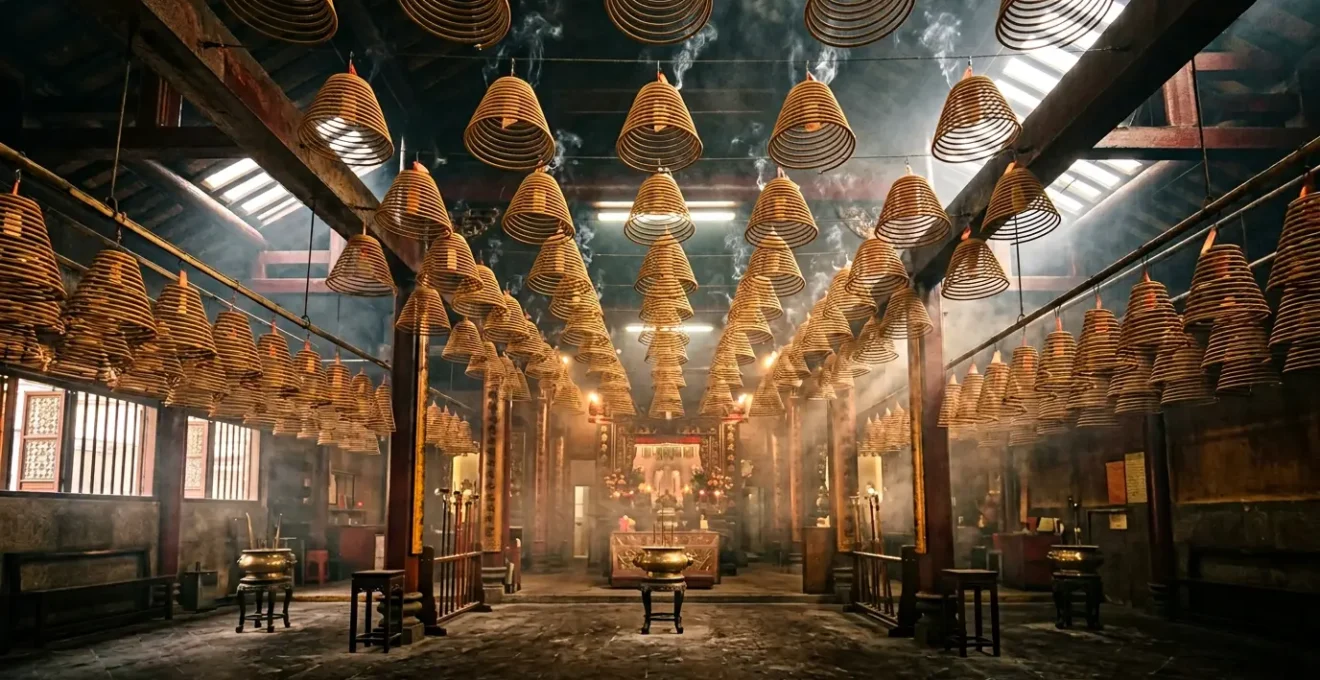
Stepping into Man Mo Temple is like parting a curtain of smoke to enter another era. The air is thick with the scent of sandalwood and the silent prayers of generations. For many visitors, the immediate reaction is one of awe, quickly followed by uncertainty. How does one navigate this sacred space? It’s easy to read that you should “be respectful,” but what does that truly mean in a Taoist temple buzzing with activity? Many guides will point out the famous giant incense coils and tell you it’s dedicated to the gods of Literature and War, but they rarely explain the intricate mechanics of the rituals you are witnessing.
This guide is different. It is built on the understanding that Man Mo Temple is not a museum, but a living, breathing spiritual center. The key to a profound visit is not just seeing, but understanding how to interact. We will move beyond the surface-level facts to explore the “how” and “why” behind the temple’s most important practices. What is the process for sponsoring an incense coil? How do you correctly use the fortune sticks to ask a question about your future? And where can you stand to capture the beauty of the temple on camera without disrespecting a worshipper’s private moment with the divine?
By focusing on this ritual etiquette, you transform from a simple tourist into a mindful guest. This approach allows you to appreciate the temple’s profound history and spiritual significance on a much deeper level. Entry is free, and a visit can last between 30 to 60 minutes, depending on your level of participation.
This article provides a complete guide to respectfully engaging with the temple’s traditions. Below is a summary of the key practices and cultural contexts we will explore to help you prepare for a meaningful visit.
Summary: A Visitor’s Handbook to Man Mo Temple’s Sacred Practices
- Why Are a Scholar and a Warrior Worshipped Together here?
- How to Sponsor a Giant Incense Coil for Good Luck?
- The Smoke Irritation Risk: How to Visit if You Have Asthma?
- What Do the Chim Fortune Sticks Reveal About Your Future?
- Where to Stand to Take Photos Without Disturbing Prayers?
- How to Behave in a Taoist Temple Without Offending Locals?
- St John’s Cathedral vs Wong Tai Sin: What Do They Say About Faith?
- How to Map Your Own Route to See the Best Hollywood Road Murals?
Why Are a Scholar and a Warrior Worshipped Together here?
The soul of Man Mo Temple resides in its central figures: Man Cheong, the God of Literature, and Mo Tai (or Kwan Yu), the God of War. This pairing is not accidental; it represents a core philosophy of harmonious duality. Man symbolizes the civil and intellectual pursuits—the power of the pen—while Mo embodies martial valor and integrity—the power of the sword. Together, they represent the balanced qualities needed for success and justice, a principle that has deeply resonated throughout Hong Kong’s history.
You can identify them by their distinct appearances: Man Cheong is typically dressed in a green robe and holds a writing brush, representing his dominion over scholarly success and bureaucracy. Mo Tai, by contrast, is a formidable figure in a red robe, carrying a long sword, symbolizing righteousness and protection. Their partnership reflects the belief that both intellect and strength are essential for a stable and prosperous society.
This temple’s significance goes beyond spiritual worship. It once played a crucial civic role, especially during the British colonial era. As a neutral and deeply respected local institution, it served as a place of arbitration where disputes within the Chinese community were settled. The power of an oath taken here was profound and even recognized by the colonial government. This historical context reveals the temple not just as a place of worship, but as a pillar of community justice and identity.
During British colonial times, the temple served as a court of arbitration for local disputes when trust was thin between Chinese and colonialists, with oaths taken at the temple (often accompanied by ritual rooster beheadings) accepted by the colonial government.
– The Historical Role of Man and Mo in Hong Kong’s Colonial Era
This historical weight is what gives the atmosphere its palpable gravity, turning a simple visit into a brush with the forces that shaped modern Hong Kong.
How to Sponsor a Giant Incense Coil for Good Luck?
One of the most iconic sights within Man Mo Temple is the canopy of large, cone-shaped incense coils hanging from the ceiling. These are not merely decorative; they are long-burning prayers. Sponsoring a coil is a powerful way to make a long-term wish for good fortune, health, or success. As the incense burns continuously for several weeks, the fragrant smoke carries the devotee’s prayers and name up to the heavens. It is a slow, persistent form of communication with the divine.
The process is straightforward and open to all visitors who wish to participate. Temple staff are accustomed to guiding newcomers through the steps, turning it into an accessible and meaningful experience rather than an intimidating ritual. The coils vary in size and price, allowing for different levels of offering. The attached red paper is where the magic happens—it’s the personal message attached to your prayer, ensuring your specific wish is what ascends.
This visual spectacle of smoke and prayer creates the temple’s unique atmosphere. Each coil represents an individual’s hope, and together they form a collective tapestry of devotion that fills the space. Participating in this tradition is a direct way to engage with the temple’s living spirituality.
Your action plan: Sponsoring a Prayer Coil
- Enter the temple during operating hours (8am-6pm) and locate the main hall.
- Approach the temple staff to purchase an incense coil; choose a size that feels appropriate for your offering.
- Carefully write your name, the date, and your specific wish on the provided red paper slip.
- Hand your coil and wish to the staff, who will then hang it in a designated spot among the others.
- Understand that your coil will burn for up to three weeks, carrying your wish heavenward. It is crucial not to touch or interfere with any other hanging coils.
By doing so, you leave a small part of your own story intertwined with the centuries of worship that define this sacred place.
The Smoke Irritation Risk: How to Visit if You Have Asthma?
The very element that gives Man Mo Temple its mystical atmosphere—the dense, fragrant incense smoke—can also be a significant challenge for visitors with asthma, allergies, or other respiratory sensitivities. The sheer volume of burning coils and incense sticks, especially in the enclosed main hall, creates a high concentration of particulates in the air. This does not mean you have to skip the experience, but it does require a strategic approach to your visit.
The key is sensory navigation: knowing how to minimize your exposure while still experiencing the temple’s essence. Timing is your greatest ally. Arriving early in the morning, shortly after the 8 am opening, means you’ll encounter fewer crowds and a lower accumulation of smoke from the day’s offerings. Weekdays are generally quieter than weekends. Furthermore, wearing a high-quality mask like an N95 or KF94 can make a substantial difference, as they are designed to filter out the fine particulates that are most likely to cause irritation.
‘Very smoky atmosphere, especially with the heat of the summer’ – This feedback from recent visitors highlights the importance of preparation for those with respiratory sensitivities.
Instead of lingering in the main chamber, focus your time in better-ventilated areas. The entrance courtyard offers a great vantage point, and the side halls, like the Lit Shing Kung hall, are often less smoky. This allows you to appreciate the architecture and ambiance without overwhelming your lungs. A quick, focused walk through the main hall may be all you need to see the famous coils before retreating to a more comfortable space.
A little preparation ensures that the temple’s powerful atmosphere inspires you rather than causing discomfort.
What Do the Chim Fortune Sticks Reveal About Your Future?
Beyond incense offerings, the most interactive ritual at Man Mo Temple is “kau chim” (or “kau cim”), the practice of seeking guidance through bamboo fortune sticks. This is not a vague prediction but a form of direct communication with the deities to answer a specific question. This practice is a cornerstone of the temple’s “transactional faith,” where a sincere question, properly asked, receives a direct answer.
The process is a ritual in itself, requiring focus and respect. You begin by purifying the cylinder of numbered sticks and formulating a clear, decisive question in your mind. While kneeling before the altar, you shake the cylinder until a single stick falls out. To ensure the deity has truly answered, you must validate the choice using “jiaobei” (moon blocks). A successful validation—one block face up, one face down—confirms the stick is your answer. Each numbered stick corresponds to a poetic oracle, which can then be interpreted by a temple volunteer or through provided texts.
A City’s Fortune: The Government’s Kau Chim Tradition
The cultural significance of kau chim is so profound that it’s practiced at a state level. Each year, a representative from the Hong Kong Government performs the ritual at Che Kung Temple to draw a fortune for the entire city. The resulting poetic message is then interpreted by a Feng Shui master, offering a public forecast of Hong Kong’s luck for the year ahead. This tradition elevates the practice from a personal quest for guidance to a vital cultural touchstone for the whole community.
The fortunes are categorized from good to bad, but even a “bad” fortune is seen as valuable advice—a warning of obstacles to be mindful of. The ritual mechanics are precise:
- Purify and Pray: Cleanse the cylinder and sticks at an incense burner and hold them while you silently or softly ask your single, specific question.
- Shake and Select: Gently shake the container until one, and only one, stick falls out.
- Validate the Answer: Toss the jiaobei blocks to confirm the divine selection. If it fails, the process must be repeated.
- Interpret the Oracle: Match the number on your stick to the corresponding written fortune to receive your guidance.
It transforms a simple game of chance into a meaningful act of seeking clarity and direction from the temple’s resident deities.
Where to Stand to Take Photos Without Disturbing Prayers?
Man Mo Temple’s atmospheric interior, with shafts of light cutting through incense smoke, is a photographer’s dream. However, the line between capturing a beautiful moment and disrupting a sacred one is very thin. The core principle of spatial etiquette is to remember you are in an active place of worship. Your primary role is a respectful guest; your role as a photographer is secondary.
The key is to identify zones where you can shoot without being intrusive. The main entrance is an excellent spot, allowing you to capture the temple’s scale and smoky ambiance from a distance. The sides of the main chamber also offer compelling angles without placing you directly in a worshipper’s line of sight to the altar. For detailed shots, the quieter side halls are perfect for focusing on architectural elements like intricate carvings and lanterns without disturbing anyone. Using a tripod or steadying your camera against a surface is wise, as the low light and smoke can make sharp photos challenging.
The most important rule is situational awareness. The clearest “camera down” signal is when someone is actively praying at the main altar, kneeling, or shaking fortune sticks. Lower your camera immediately. This simple act of deference shows immense respect and is deeply appreciated. With tourism on the rise—Hong Kong recorded approximately four million visitor arrivals in October 2024—this awareness is more critical than ever to preserve the temple’s serene atmosphere.
Your best shots will come from patience and observation. Wait for moments when the prayer areas are clear. Focus on details: the texture of the incense coils, the play of light on a carved panel, the offerings left on an altar. These images often tell a more powerful story than a wide shot filled with unsuspecting people.
This mindful approach ensures that your memories of the temple are captured with the same respect you show during your visit.
How to Behave in a Taoist Temple Without Offending Locals?
While photography has its own rules, general conduct in a Taoist temple like Man Mo involves a series of small but significant gestures that signal respect. These actions are part of the unspoken language of the sacred space. For a visitor, adopting them is a way of showing you understand and honor the traditions, even if you don’t share the faith. Many of these customs are rooted in symbolic beliefs about purity and flow.
One of the first rules concerns the entrance. It is customary to enter with your left foot first, as this side is symbolically considered cleaner in Taoist tradition. Just as important is what you don’t step on: the raised wooden threshold at the entrance. This piece is considered the “shoulders” or spiritual protector of the temple, and stepping over it, never on it, is a fundamental sign of respect. Once inside, try to move in a clockwise direction, following the traditional flow of energy and pilgrimage around the space.
Communication should be non-verbal or hushed. A silent nod towards the main deities upon entering is a simple, universal gesture of acknowledgement. Voices should be kept low, as you are in a home for the gods, not a public square. When it comes to offerings, the principle is to give before you ask. If you plan to ask for a fortune, making a small offering of incense first is believed to curry favor with the deities. Finally, dress modestly; covering shoulders and knees is a simple way to show respect for the sacred nature of the site.
These small acts, when combined, create a powerful statement. They tell the local worshippers and the temple guardians that you are not just a tourist, but a mindful visitor who has taken the time to learn the ways of their sacred space.
Your actions will speak louder than any words, ensuring a peaceful and positive experience for everyone.
St John’s Cathedral vs Wong Tai Sin: What Do They Say About Faith?
To truly understand the spiritual personality of Man Mo Temple, it helps to place it within Hong Kong’s diverse landscape of faith. The city is home to a wide spectrum of religious practices, and comparing Man Mo to other major sites like the Anglican St. John’s Cathedral and the popular Taoist Wong Tai Sin Temple reveals fascinating differences in how divinity is approached. This comparison illuminates the unique character of Man Mo’s contemplative, community-focused worship.
St. John’s Cathedral, with its soaring Gothic architecture, directs the gaze and soul upwards towards a single, omnipotent God. Prayer is often silent, introspective, and centers on submission to divine will. In sharp contrast, Wong Tai Sin Temple is famous for its highly active and transactional style of faith. Worshippers come with specific requests and engage in rituals like kau chim with the expectation of a direct, almost contractual response, famously operating on the principle of “what you request is what you get.” The atmosphere during festivals like Chinese New Year is electric, with thousands rushing to make offerings for good luck.
Man Mo Temple occupies a middle ground. While it shares the Taoist practice of making specific requests through incense and fortune sticks, its atmosphere is more subdued and contemplative than Wong Tai Sin. The emphasis on the dual gods of literature and war, and its historical role in justice, gives it a civic and philosophical weight. The prayer here feels less like a rapid transaction and more like a long-term petition, as embodied by the slow-burning incense coils.
The following table, based on common observations, helps illustrate these distinct spiritual atmospheres. As an analysis from a comparative religion perspective suggests, each architectural and ritual choice fosters a different kind of relationship with the divine.
| Aspect | St John’s Cathedral | Wong Tai Sin Temple | Man Mo Temple |
|---|---|---|---|
| Prayer Style | Silent, introspective worship | Active, transactional offerings | Contemplative but communal |
| Architecture Impact | Vertical Gothic drawing eyes upward to singular God | Horizontal courtyards for multiple deities | Intimate halls with hanging coils creating layers |
| Peak Times | Sunday services, Christmas | Chinese New Year – thousands rush at midnight | Morning prayers, exam seasons |
| Divine Requests | Submission to God’s will | Specific bargains via kau chim | Long-term wishes via incense coils |
You begin to see not just a single temple, but one facet of the city’s complex and vibrant soul.
Key takeaways
- Understand the Rituals: Don’t just observe; learn the simple steps for participating in incense offerings and fortune telling.
- Navigate with Awareness: Be mindful of the dense smoke by visiting early and know the designated zones for respectful photography.
- Embrace the Etiquette: Small actions like stepping over thresholds, keeping quiet, and dressing modestly show profound respect.
How to Map Your Own Route to See the Best Hollywood Road Murals?
Having respectfully engaged with the sacred traditions within Man Mo Temple, the final step is to place it within its vibrant, modern-day context. The temple is not an isolated monument; it is anchored in the heart of Sheung Wan, on a street that pulses with history and creativity. Hollywood Road is an open-air gallery, and creating your own walking tour to explore its famous street art is the perfect way to conclude your visit, blending the ancient spirituality of the temple with the contemporary energy of the city.
The journey doesn’t require a rigid itinerary. The joy is in the discovery. Start by simply walking downhill from Man Mo Temple. The area is a canvas for local and international artists, with murals tucked away in alleyways and splashed across entire building facades. Look for the famous townhouse mural by Alex Croft on Graham Street, a popular photo spot, but don’t let it be your only stop. The real magic lies in wandering off the main path and finding lesser-known works. This exploration reflects the dynamic nature of Hong Kong itself, a city where heritage and hyper-modern art coexist on the same block.
This cultural vibrancy is fueled by the city’s continuous growth and appeal. According to recent data, Hong Kong recorded around 45 million visits in 2024, up 31 percent year-on-year, making areas like Hollywood Road a bustling intersection of tourists and locals. This constant flow of people ensures the street art scene is always evolving, with new pieces appearing regularly.
This final step completes your journey, showing you how the serene, ancient world of Man Mo Temple is woven into the very fabric of a bustling, modern metropolis. To fully appreciate this dynamic, consider starting your exploration with a fresh perspective on the temple’s foundational principles.