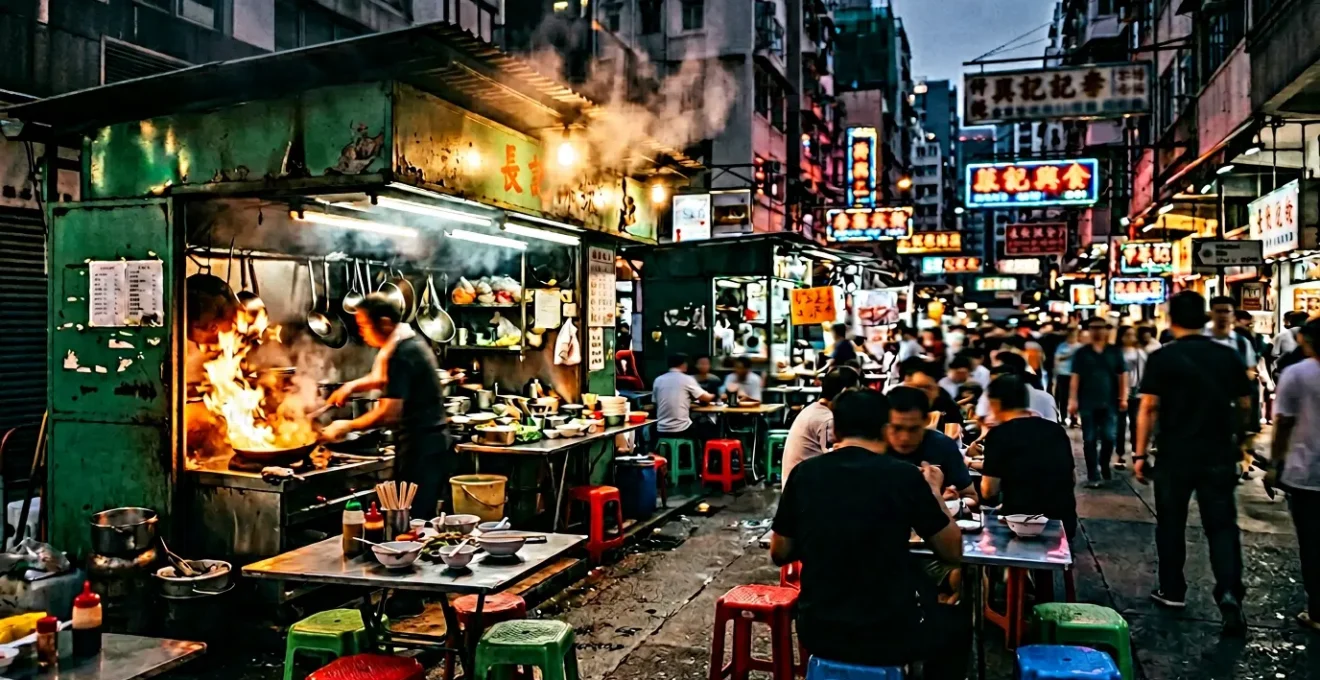
The soul of Hong Kong isn’t in its skyscrapers, but in the fiery woks of its dai pai dongs; the experience is less about the menu and more about mastering a piece of living, culinary theatre.
- Authenticity comes from ‘wok hei’—a smoky essence created by extreme heat that you can see, smell, and taste.
- Hygiene fears are largely unfounded; high-heat cooking and local practices like the ‘tea wash’ ensure safety.
Recommendation: Skip the generic food tours and use this guide to find a real stall in Sham Shui Po, order a shared beer, and embrace the delicious chaos.
The image is iconic, burned into the collective memory by countless action films and travel documentaries: steam billowing from a roaring wok, the clatter of a metal spatula, plastic stools crowded onto a bustling Hong Kong street, and plates of food that look impossibly delicious. This is the dai pai dong, the city’s open-air food stall. Many guides will tell you it’s a “must-do,” a place for “authentic” food. They’ll list a few famous dishes and send you on your way. But this approach barely scratches the surface, treating a complex cultural institution like a fast-food joint.
The truth is, visiting a dai pai dong is not just about eating; it’s about participating in a performance. It’s about understanding the unspoken social rules, deciphering the sensory cues, and appreciating an art form that is rapidly vanishing. But what if the key to the ultimate dai pai dong experience wasn’t just finding the right stall, but knowing how to read the ‘culinary theatre’ unfolding before you? What if the real flavour is found not just in the food, but in the social choreography of a shared table and the roaring fire of the wok?
This guide moves beyond the menu. We will explore why these institutions are disappearing, how to identify the signature ‘wok hei’ that defines their cooking, and where to find the last true strongholds of this heritage. We’ll decode the rituals, from ordering beer to the late-night supper known as ‘siu yeh,’ transforming you from a tourist into an active participant in Hong Kong’s most authentic dining experience.
To help you navigate this immersive world, this article breaks down the essential elements of the dai pai dong experience. Below is a summary of the key topics we will cover, from the cultural significance of these stalls to the practical tips you need to dine like a seasoned local.
Summary: Your Guide to Hong Kong’s Legendary Street Food
- Why Are Authentic Dai Pai Dongs Disappearing from the Streets?
- How to Identify Dishes with ‘Wok Hei’ (Breath of the Wok)?
- Hygiene Concerns vs Flavor: Is It Safe to Eat on the Street?
- What Are the Best Dai Pai Dongs Remaining in Sham Shui Po?
- How to Pair Blue Girl Beer with Spicy Crab?
- When to Go for ‘Siu Yeh’ (Late Night Supper) Like a Local?
- Where to Find the Last Strongholds of Authentic Heritage Food?
- The MSG Risk: Is It Really Bad for You or Just a Myth?
Why Are Authentic Dai Pai Dongs Disappearing from the Streets?
The gritty, authentic dai pai dong is a critically endangered species. Their decline isn’t a recent trend but a long, slow erosion driven by government policy, urban development, and generational shifts. Since the 1970s, the government has stopped issuing new licenses, making existing ones non-transferable upon the holder’s death. This policy alone has created a finite and shrinking population. According to official figures, there were only 17 dai pai dong remaining as of July 2024, a stark drop from 25 just a decade earlier in 2014. Each closure feels like a wound to the city’s soul.
The Case of Man Yuen Noodles
The story of Man Yuen Noodles in Central serves as a poignant example. In 2005, the stall faced imminent closure after its licensee passed away. Despite a public outcry and calls for its preservation from locals and politicians who cherished it as a cultural landmark, the stall was forced to close its doors permanently. This event highlighted the rigid licensing laws that prioritize regulation over heritage, slowly strangling these beloved institutions out of existence.
Beyond bureaucracy, there’s a human element to their disappearance. The work is grueling—long hours spent over a scorching wok in the humid Hong Kong air. As one dai pai dong operator explained, it’s a life few want for their children. “The previous generations work so hard to support their kids to have a better education, and they don’t want their kids to do such hard work. It’s hot, it’s outdoors, the work is repetitive,” he noted. This generational gap means that as the original licensees retire or pass on, there is no one left to take over the family business, and another piece of culinary history fades away.
How to Identify Dishes with ‘Wok Hei’ (Breath of the Wok)?
If dai pai dongs have a soul, it’s called wok hei. Literally translated as “breath of the wok,” it’s a complex, smoky flavour that is impossible to replicate in a normal kitchen. It’s the delicious result of intense, searing heat caramelizing sugars and oils, imbuing simple ingredients with a sublime essence. This is the hallmark of a true dai pai dong chef, a mark of skill that separates the masters from the amateurs. For a traveler, learning to identify wok hei is like learning to taste the difference between table wine and a grand cru; it unlocks a deeper level of appreciation.
This elusive quality isn’t just a taste; it’s a multi-sensory experience. You can spot it before the plate even hits your table. The key is to engage all your senses in a kind of culinary detective work. This visual below captures the very moment of creation, where steam and char meet.
As you can see, the perfect charring is not about burning the food but about flash-cooking it at an incredible temperature. To become a true connoisseur, train yourself to look for these specific signals:
- Smell: A distinct smoky, almost metallic aroma that is fragrant, not acrid. It should smell like a controlled fire, not a mistake.
- Sight: A glossy sheen on noodles and rice, with slight, deliberate charring on the edges of vegetables or meat. The food should look vibrant, not stewed.
- Sound: Listen for the constant, roaring jet engine of the stove and the percussive clang of the metal wok and spatula—this is the soundtrack of wok hei being born.
- Taste: The flavour is the ultimate test. It’s a deep, smoky undertone that elevates every other ingredient without overpowering them. It’s the difference between a simple stir-fry and a transcendent culinary moment.
Hygiene Concerns vs Flavor: Is It Safe to Eat on the Street?
For many travelers, the raw, open-air setting of a dai pai dong can trigger a flicker of apprehension. Plastic stools on a pavement, a kitchen exposed to the elements—it’s natural to wonder about hygiene. Yet, to let these concerns stop you would be to miss the point entirely. The truth is, the very nature of dai pai dong cooking provides its own powerful, built-in safety measures. The secret lies in the two pillars of their operation: extreme heat and high turnover.
The wok, heated to temperatures often exceeding 200°C (400°F), acts as a sterilizer. Food is flash-cooked in seconds, killing bacteria instantly. This isn’t slow cooking; it’s a controlled pyrotechnic process. Furthermore, the constant stream of customers means ingredients don’t sit around. Produce is bought fresh daily and used up quickly. Paradoxically, this open-air environment was seen as a safe haven during health crises. It’s a fascinating historical footnote that their revenues increased considerably in 2003 during the SARS epidemic, as locals actively avoided enclosed, air-conditioned restaurants, viewing them as potential hotbeds for the virus.
The spirit of the Dai Pai Dong is now often found indoors.
– Hong Kong Tourism Board, Discover Hong Kong
Locals also have their own time-honoured practice: the ‘tea wash’. When you sit down, you’ll be given a bowl and a pot of hot tea. Before eating, diners rinse their chopsticks, bowls, and spoons in the tea. While its practical sterilizing effect is debated, it’s a deeply ingrained cultural ritual—a small act of purification and respect for the meal to come. It’s part of the social choreography and a sign that you understand the local customs. So, is it safe? For the licensed, busy stalls, the answer is a resounding yes. The real risk isn’t getting sick, but missing out on the experience.
What Are the Best Dai Pai Dongs Remaining in Sham Shui Po?
While dai pai dongs are scattered across Hong Kong, the district of Sham Shui Po in Kowloon remains one of their most important spiritual homes. This working-class neighborhood, with its bustling markets and unpretentious vibe, provides the perfect backdrop for these street-side culinary theatres. If you want to find a concentration of authentic, high-quality stalls, this is the place to start your pilgrimage. It’s here that you can find legendary establishments that have been firing up woks for over half a century.
Navigating the options can be overwhelming for a first-timer. Each stall has its own personality, its own fiercely guarded family recipes, and its own set of loyal patrons. Some are famous for their classic Cantonese stir-fries, others for their seafood or claypot rice. Choosing the right one depends on what you’re looking for, whether it’s a classic introduction or a more adventurous dive into local flavours. A Foodie World magazine notes that one of the most famous, Oi Man Sang, “has breathed fire into the wok since 1956, stationed in an open-air space with the kitchen on street level,” perfectly capturing its historical significance.
To help you choose, here is a breakdown of some of the most celebrated dai pai dongs in Sham Shui Po, each offering a unique window into this culinary tradition.
| Dai Pai Dong | Specialty | Signature Dish | Best For |
|---|---|---|---|
| Oi Man Sang | Classic Cantonese | Black pepper beef with potato | First-timers seeking authentic experience |
| Keung Kee | Seafood & Claypot | Clams with black bean sauce | Quieter dining, quality wok hei |
| Dai Lee | Family recipes | Pepper chicken pot with offal | Adventurous eaters, 50-year heritage |
This table gives you a starting point, but the real joy comes from exploring. Don’t be afraid to wander, look for the busiest stalls with the loudest woks, and point at what looks good on your neighbor’s table. In Sham Shui Po, every meal is an adventure.
How to Pair Blue Girl Beer with Spicy Crab?
Ordering food at a dai pai dong is only half the equation. The other half is the drink, and in this world, beer is king. Specifically, large, shareable 640ml bottles of crisp pilsner. Forget craft IPAs or fancy wine pairings; the drink of choice is often Blue Girl Beer, a German-style pilsner that has become a ubiquitous part of the Hong Kong dining scene. Its high carbonation and clean, refreshing taste are the perfect foils for the rich, oily, and intensely flavourful food that comes flying out of the wok.
The act of drinking is as much a social ritual as it is a way to quench your thirst. It’s about community and camaraderie. Beer is rarely ordered in individual servings. Instead, large bottles are placed in the center of the table, and everyone pours for each other into small, tumbler-like glasses. This sets the stage for frequent toasts of “Yum Sing!” (Cheers!), a gesture of shared joy and friendship. This communal atmosphere is the very essence of the dai pai dong experience.
Pairing this beer with a classic dish like Typhoon Shelter Spicy Crab is a match made in heaven. The crispness of the pilsner cuts through the richness of the fried garlic and chili, cleansing the palate and preparing you for the next bite. It’s a functional and delicious symbiosis. But there are other options too, each serving a different purpose in this culinary ecosystem.
Your Action Plan: Ordering Drinks Like a Local
- Choose high-carbonation pilsners like Blue Girl to cut through oil and richness.
- Order 640ml bottles to share communally rather than individual servings.
- Pour into small glasses for frequent ‘Yum Sing’ toasting rituals.
- Consider alternative pairings: Tsingtao for lighter dishes, San Miguel for heartier fare.
- Explore non-alcoholic options: Fresh sugarcane juice or Vitasoy provide a cooling contrast to spicy food.
When to Go for ‘Siu Yeh’ (Late Night Supper) Like a Local?
While dai pai dongs serve food throughout the day, they truly come alive after dark. The culture of siu yeh, or late-night supper, is a cornerstone of Hong Kong life and the prime time to witness a dai pai dong in its full glory. This isn’t just a late dinner; it’s a city-wide social decompression ritual. In a high-pressure metropolis that never sleeps, siu yeh is the moment when Hong Kong collectively lets its hair down, and dai pai dongs are its most important stage.
The atmosphere shifts dramatically at night. The daytime crowds of shoppers and workers are replaced by a different energy. The menus often change too, with a greater emphasis on seafood and more elaborate dishes. A simple noodle stall might transform into a bustling seafood restaurant under the stars. The cost reflects this shift, with a single nighttime dish typically costing between 40-70 Hong Kong dollars. The crowd itself evolves throughout the night, creating a fascinating social timetable. From 9-11pm, you’ll find office workers unwinding after a long day. From 11pm-2am, the post-entertainment crowd arrives. And from 2am onwards, it’s the service industry staff—chefs, bartenders, and waiters—finally getting their own chance to eat and relax.
There’s something about the atmosphere of eating out on the street that’s special – the late-night ‘siu yeh’ represents more than just food; it’s when Hong Kong lets its hair down, creating vital spaces for decompression and bonding in this high-pressure city.
– Local resident, Adventure.com
To go for siu yeh is to tap directly into the city’s pulse. It’s to understand that in Hong Kong, food is intrinsically linked to community and release. It’s a loud, boisterous, and joyous affair. This is where friendships are forged over shared plates of salt and pepper squid and bottles of beer. For a traveler, timing your visit to coincide with the siu yeh hours isn’t just a scheduling choice; it’s the difference between observing a culture and participating in it.
Where to Find the Last Strongholds of Authentic Heritage Food?
The sad reality is that the classic, street-side dai pai dong is a vanishing piece of heritage. With licenses fading away and streets being gentrified, their numbers continue to dwindle. The Food and Environmental Hygiene Department confirmed a drop to just 17 street-side cooked food stalls by the end of 2023, down from 22 in 2021. So, where does a traveler go to find the spirit of this tradition when the physical stalls are disappearing? The answer lies in their modern successors: cooked food centres.
These government-run indoor markets are the new strongholds of heritage food. In an effort to preserve the culinary traditions while meeting modern hygiene standards, many legendary dai pai dong chefs and their successors have moved into these centres. While they may lack the gritty, open-air romance of their predecessors, the “culinary theatre” is still very much alive. The kitchens are often open, the woks still roar with the same intensity, and the family recipes have been passed down intact.
The Evolution to Cooked Food Centres
The cooked food market on Haiphong Road in Tsim Sha Tsui is a prime example of this evolution. When it reopened in 2020 after a major renovation, it consciously retained the old dai pai dong design aesthetic, complete with an iron roof and nostalgic red lampshades. However, the venue is now brighter, more spacious, and better ventilated. It represents a compromise—a way to keep the wok hei firing while adapting to the realities of a modern city. These centres are where the legacy of the dai pai dong continues, ensuring the flavours are preserved for a new generation.
While a few iconic street-side stalls still exist in areas like Sham Shui Po and Central (like the ones on Stanley Street), a savvy traveler should also explore the cooked food centres in neighborhoods like Quarry Bay, Mong Kok, and Wan Chai. They may look different, but close your eyes and listen to the sizzle of the wok, and you’ll find the same spirit is still there. These are the living museums of Hong Kong’s street food culture.
Key Takeaways
- The true dai pai dong is a disappearing art form due to strict licensing and generational shifts, making each visit a precious experience.
- ‘Wok hei’ is the essential, smoky flavour you must learn to identify by sight, sound, and smell to appreciate authentic cooking.
- The social rituals, like sharing large beers and participating in the ‘siu yeh’ (late-night supper), are as important as the food itself.
The MSG Risk: Is It Really Bad for You or Just a Myth?
The final barrier for many Western travelers is a three-letter acronym: MSG. For decades, monosodium glutamate has been the subject of fear and misinformation, often unfairly linked to the myth of “Chinese Restaurant Syndrome.” Let’s be clear: the idea that MSG is inherently bad for you is a pervasive myth, one rooted more in cultural bias than in scientific fact. To truly eat like a local, you need to shed this outdated prejudice.
Scientifically, MSG is simply the sodium salt of glutamic acid, an amino acid found naturally in countless foods we eat every day. It’s what provides the savory, “fifth taste” known as umami. Your body doesn’t distinguish between the glutamate in a tomato and the glutamate in a pinch of MSG powder. In fact, many beloved Western foods are packed with natural glutamate; a study shows that Tomatoes contain 140mg/100g of natural glutamate, while Parmesan cheese boasts a massive 1200mg/100g. The fear of it in Cantonese cooking while happily eating pasta with tomato sauce is, frankly, illogical.
The “syndrome” itself originated from anecdotal claims in the 1960s in the US and has since been widely debunked by numerous scientific studies. The symptoms attributed to it have not been consistently reproduced in double-blind, placebo-controlled trials. While a tiny fraction of people may have a sensitivity to MSG, it’s no more common than sensitivities to other food ingredients. At a dai pai dong, MSG is used as a flavour enhancer, just as salt and pepper are used in a Western kitchen—a tool to make delicious food even more delicious. While you can request no MSG by saying “m’goi, m̀h sái meih jīng,” many pre-made sauces will contain it anyway. Embracing it is part of the experience.
So, the next step is simple. Leave your preconceptions and the tourist guidebook behind. Find a crowded stall, point to something that looks delicious, grab a plastic stool, and dive into the chaotic, exhilarating, and profoundly flavourful heart of Hong Kong.
Frequently Asked Questions about Dai Pai Dong Dining
How does the high-heat cooking ensure food safety?
Wok temperatures exceed 200°C, effectively sterilizing food instantly. The constant high-turnover ensures ingredients are fresh and not sitting around.
What is the ‘tea wash’ ritual?
Diners often rinse their utensils with hot tea before eating – both a practical sterilization method and cultural ritual showing respect for the meal.
How can I identify a licensed dai pai dong?
Look for the green license certificate issued by the Food and Environmental Hygiene Department that all legal establishments must display prominently.
What is MSG scientifically?
MSG is the sodium salt of glutamic acid, one of the most abundant amino acids in nature, providing the ‘fifth taste’ umami, naturally occurring in tomatoes, parmesan cheese, and mushrooms.
Where did ‘Chinese Restaurant Syndrome’ come from?
The MSG scare originated from unscientific claims in the US during the 1960s, now recognized as a myth rooted in cultural bias rather than legitimate health concerns.
How can I request no MSG in Cantonese?
Say ‘m’goi, m̀h sái meih jīng’ (please, no MSG), though many pre-made sauces will still contain it naturally.