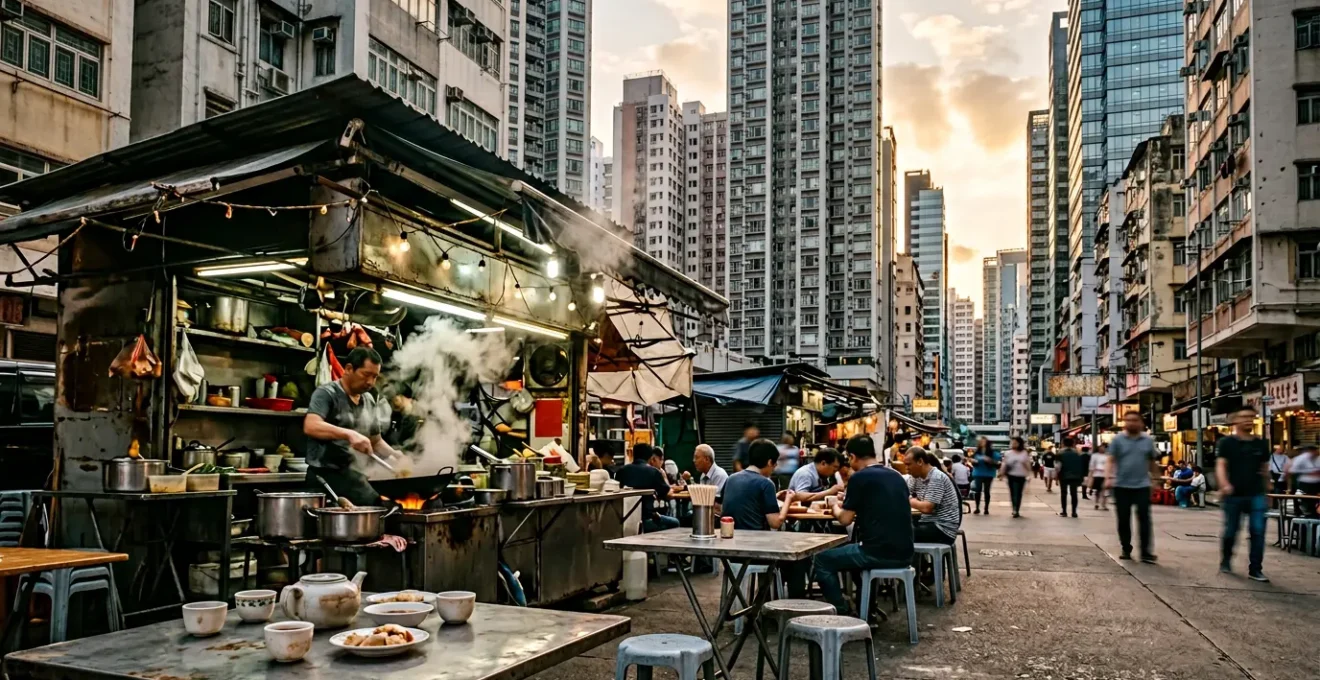
Contrary to the focus on fine dining, Hong Kong’s true culinary heritage is a living archive of social history, resilience, and community rituals that Michelin stars often overlook.
- The city’s most iconic beverage, silk-stocking milk tea, is recognized as Intangible Cultural Heritage for its unique technique and role in daily life.
- Authentic food experiences are under threat from soaring rents and policies phasing out street vendors, making their preservation a critical issue.
Recommendation: To truly understand Hong Kong’s food, look past the ratings and focus on the stories, rituals, and endangered crafts that give each dish its meaning.
Hong Kong glitters with more Michelin stars per capita than almost anywhere on earth. For many, its culinary identity is defined by exquisitely crafted dim sum in five-star hotels and innovative chefs reimagining Cantonese classics. But to focus solely on these accolades is to read only the final chapter of a long and complex story. It’s to admire the polished surface while ignoring the deep, intricate roots that truly nourish the city’s soul. The real gastronomic heritage of Hong Kong is not plated on fine china; it’s brewed in humble cha chaan tengs, shouted over the din of a dai pai dong, and passed down through generations of hands that value craft over celebrity.
The city’s food culture is a dynamic, living testament to its history of migration, adaptation, and sheer grit. It’s a fusion of East and West born not in a chef’s lab, but from the practical needs of a bustling port city. This article steps away from the star ratings to act as a culinary anthropologist. We will explore the embodied knowledge in a cup of milk tea, the social significance of disappearing street stalls, and the unspoken etiquette of a yum cha gathering. We will uncover why the most profound flavors of Hong Kong are often found in its most unassuming corners, and why protecting these traditions is about preserving the city’s very identity.
This guide delves into the cultural fabric that makes Hong Kong’s food scene unique. We’ll explore the stories behind the city’s most cherished rituals, the threats they face, and how you can experience them with the appreciation they deserve.
Summary: Uncovering the Stories Behind Hong Kong’s Food Culture
- Why is Hong Kong Style Milk Tea on the Intangible Cultural Heritage List?
- What Makes the ‘Silk Stocking’ Tea Technique So Unique?
- How to Order in a Local Tea Restaurant Like a Pro?
- The Risk of Losing Traditional Recipes to High Rents
- Where to Find the Last Strongholds of Authentic Heritage Food?
- Why Are Authentic Dai Pai Dongs Disappearing from the Streets?
- Why Is Hand-Carved Mahjong a Dying Art and Where to Buy It?
- Yum Cha Etiquette: How to Eat Dim Sum Like a Local Without Embarrassment?
Why is Hong Kong Style Milk Tea on the Intangible Cultural Heritage List?
Long before coffee shops populated every corner, Hong Kong ran on milk tea. This is not just a beverage; it’s the city’s lifeblood, with industry data suggesting that an incredible 2.5 million cups are consumed daily. Its status as an official piece of Intangible Cultural Heritage (ICH) has little to do with its ingredients and everything to do with its cultural significance. The drink, known locally as *nai cha*, is a symbol of Hong Kong’s unique identity, a perfect blend of British colonial history and local Cantonese ingenuity.
The British tradition of afternoon tea with milk and sugar was adapted using stronger, more affordable black tea blends and evaporated milk, creating a bolder, creamier profile that suited local palates. This evolution turned a colonial import into a distinctly Hong Kong creation. The ICH designation recognizes this story of cultural adaptation. As the Hong Kong Intangible Cultural Heritage Office notes, it represents a core piece of the city’s social fabric.
The tea-making technique does not only epitomise the fusion and development of Hong Kong’s East-meets-West food culture, but also gives a glimpse of how locals live and eat.
– Hong Kong Intangible Cultural Heritage Office, Official ICH designation documentation
This recognition solidifies milk tea not merely as a popular drink, but as an embodied cultural practice. It’s the centerpiece of the *cha chaan teng* (tea restaurant), the democratic social hubs where people from all walks of life connect. Its heritage status protects the story of a city that took a foreign custom and made it unequivocally its own.
What Makes the ‘Silk Stocking’ Tea Technique So Unique?
The secret to Hong Kong milk tea’s iconic smooth, full-bodied texture lies in a unique brewing method known as “silk-stocking” or *si mat nai cha*. The name is a colourful descriptor for the fine-meshed cloth sack used to filter the tea, which becomes stained a deep brown over time, resembling a silk stocking. This is not just filtration; it’s a meticulously choreographed ritual of pulling, pouring, and brewing that elevates the drink from a simple infusion to a work of craftsmanship. The technique, famously claimed to be perfected in 1952 by Lum Muk-ho of the Lan Fong Yuen tea stall, is the heart of what makes this tea special.
This process is about achieving a perfect balance between strength (*heung*), smoothness (*waat*), and thickness (*hau*). The uniqueness comes from the dynamic action of “pulling” the tea—pouring the hot liquid between two pots from a height. This aerates the tea, cooling it slightly to prevent bitterness while developing a velvety texture that coffee or standard brewed tea cannot replicate. The process is a display of physical skill and deep-seated knowledge.
The entire technique is a precise science passed down through generations of tea masters. It involves far more than just steeping leaves, as seen in the traditional five-step process:
- Blend specific ratios of Ceylon and other black tea leaves for optimal strength.
- Boil and infuse tea at precise temperatures for maximum flavor extraction.
- Force-pour tea through the cloth filter multiple times for aeration and smoothness.
- Brew tea with controlled timing to balance strength without bitterness.
- Add evaporated milk with a specific pouring technique for that final silk-like texture.
This manual, labour-intensive method is what separates authentic Hong Kong milk tea from mass-produced versions. It is a form of embodied knowledge, a craft where the final product is inseparable from the maker’s skill.
How to Order in a Local Tea Restaurant Like a Pro?
Stepping into a bustling *cha chaan teng* during peak hours can be an intimidating experience. The clatter of ceramic, the rapid-fire Cantonese, and the brisk efficiency of the staff create a whirlwind of activity. The key to navigating this environment like a local is understanding its unique linguistic shorthand. Born from the need for speed and efficiency, a special code of Canto-slang evolved for placing orders, and knowing a few key terms will earn you a nod of respect.
This isn’t just about ordering food; it’s about participating in a social ritual. Using terms like *Cha jau* (milk tea with condensed milk instead of sugar) or *Ga dai* (extra rice or noodles) shows you understand the culture of customization and the working-class roots of these establishments, which prioritize hearty, affordable meals. It’s a language that reflects the “scrappy and so adaptable” nature of Hong Kong people. To help you decode this system, here is a guide to some essential ordering codes.
| Code/Term | Meaning | Cultural Context |
|---|---|---|
| C0T | Lemon Tea | Efficient shorthand developed for speed during rush hours |
| Cha jau (茶走) | Milk tea with condensed milk instead of sugar | Shows insider knowledge of customization options |
| Ga dai (加底) | Extra rice/noodles | Working class tradition of hearty portions |
| Fai gee | Spaghetti | Cantonese phonetic adaptation of foreign dishes |
| Hung dau bing siu tim | Red bean ice with less sugar | Health-conscious modern adaptation |
Mastering these terms is more than a party trick. It’s an acknowledgment of the unwritten rules and social codes that govern these vital community spaces. It transforms you from a mere customer into an informed participant, showing appreciation for a system honed by decades of fast-paced service.
The Risk of Losing Traditional Recipes to High Rents
While some traditions are celebrated, many others are facing a silent extinction. The single greatest threat to Hong Kong’s culinary heritage is not changing tastes, but the city’s notoriously exorbitant commercial rents. This economic pressure creates an environment where only large, high-margin chain stores can survive, squeezing out the small, family-run eateries that are the custodians of traditional recipes. These institutions sell food for daily life—dishes that are affordable and comforting, not expensive and trendy. Their business model is simply incompatible with the demands of modern landlords.
The statistics are stark. According to official data, over 2,000 restaurants shut down between May 2024 and April 2025, a number that outpaced the 1,700 new openings. This trend signals a dangerous hollowing out of the city’s independent food scene. As Silvana Leung of Hong Kong Foodie tours explains, the economics are brutal and are fundamentally reshaping the city’s culinary landscape.
The Squeeze on Everyday Eateries
Leung notes: “These restaurants just cannot afford to pay the rent because what they are selling is just something people eat on a day-to-day basis—not something that is very expensive. Shopping malls charge people high rent, and that is why only chain stores can survive. We are losing a lot of individual restaurants, but seeing more chain stores around.”
This isn’t just a loss of businesses; it’s a profound cultural erosion. With each shuttered door, a unique family recipe, a specific way of making wonton noodles, or a secret blend for beef brisket broth can be lost forever. The city risks trading its diverse, flavourful soul for a homogenous landscape of global brands and repetitive chain restaurants, losing the very character that makes its food scene so special.
Where to Find the Last Strongholds of Authentic Heritage Food?
Despite the challenges, authentic heritage food has not vanished. It has instead retreated into specific pockets of the city, surviving through a combination of resilience, community support, and clever strategy. For the culinary explorer willing to look beyond the main thoroughfares, these strongholds offer a taste of Hong Kong’s true character. They generally fall into three categories, each representing a different strategy for survival in a tough environment.
Finding these places requires a different approach to travel—one that values authenticity over convenience and story over style. It means venturing into older districts, seeking out the places with lines of locals, and appreciating an atmosphere built on decades of service, not interior design trends. The reward is an experience that is deeply rooted in the city’s history. These establishments are more than just restaurants; they are living museums of Hong Kong’s culinary soul.
- The Time Capsules: These are old shops, often protected from rent hikes because the family owns the property. They operate almost exactly as they did decades ago. A prime example is Kung Lee Sugar Cane Drink on Hollywood Road, a fixture since 1948.
- The Neighborhood Legends: Thriving in less-central, traditionally working-class districts like Sham Shui Po or Shau Kei Wan, these places are supported by a loyal local clientele. Hop Yik Tai’s beloved rice rolls in Sham Shui Po are a testament to this model.
- The New Guardians: This category includes modern ventures that consciously aim to preserve heritage. Mammy Pancake, for instance, took the humble street-side egg waffle (*gai daan zai*) and elevated it to Michelin-recommended status, ensuring its survival through a scalable business model.
Your Action Plan: How to Spot a True Heritage Gem
- Look beyond location: Prioritize shops with deep neighborhood roots over those in high-traffic tourist traps. Are they serving a community?
- Observe the clientele: Is the place filled with locals and regulars of all ages, rather than just tourists? This is a key sign of authenticity.
- Assess the specialization: Does the menu focus on mastering a few dishes over generations? Specialization is often a hallmark of true craftsmanship.
- Note the ambiance: Is the focus on function, speed, and community over polished, modern aesthetics? The wear and tear is part of the story.
- Listen for the language: Is the buzz of local Cantonese the primary soundtrack? This indicates you’re in a place that serves the local community first.
Seeking out these strongholds is an act of cultural appreciation, supporting the businesses that are the true keepers of Hong Kong’s gastronomic flame.
Why Are Authentic Dai Pai Dongs Disappearing from the Streets?
The *dai pai dong*—the open-air street food stall—is perhaps the most romanticized symbol of Hong Kong’s culinary past. It represents a vibrant, democratic street-level food culture, famous for its *wok hei* (the “breath of the wok”) and bustling, no-frills atmosphere. Yet, these iconic institutions are a critically endangered species. Their decline is not a simple matter of changing tastes or hygiene concerns, but the direct result of a specific and intentional government policy designed to phase them out.
The core issue lies with their operating licenses. For decades, the government has pursued a policy of attrition by making these licenses non-transferable. When a license holder retires or passes away, the license cannot be passed on to a family member or sold. It simply expires. This was intended to gradually “clean up” the streets and move food service indoors, but its long-term effect has been the slow-motion erasure of a vital part of the city’s social and culinary fabric.
This policy has reduced the number of dai pai dongs from hundreds in their post-war heyday to just a handful today, mostly concentrated in Central and Sham Shui Po. The loss is more than just culinary. As one academic study on the topic explains, it was a deliberate policy choice.
The specific historical government policy of non-transferable licenses, issued to phase out Dai Pai Dongs naturally through attrition, is the primary factual driver of their decline.
– Hong Kong culinary heritage researchers, Academic study on Hong Kong food heritage
Dai pai dongs were crucial third places—social spaces outside of home and work where communities gathered. Their disappearance represents a significant shift in the city’s public life, pushing social interaction into privatized, indoor spaces like shopping malls and formal restaurants. The decline of the dai pai dong is a story of how administrative policy can profoundly impact cultural heritage.
Why Is Hand-Carved Mahjong a Dying Art and Where to Buy It?
The click-clack of mahjong tiles is an iconic Hong Kong soundscape, the backdrop to countless family gatherings and social events. Yet, the craft of creating these tiles by hand is on the verge of extinction. This decline is intricately linked to the very social and economic shifts that threaten the city’s food heritage. The art of hand-carving mahjong is not dying because of a lack of appreciation, but because the social context that supported it is vanishing.
The connection to food spaces is direct. The disappearance of communal gathering spots like dai pai dongs and the trend towards smaller, “shoebox” apartments have reduced the venues for large, boisterous mahjong games. With fewer places to play, the demand for high-quality, hand-carved sets has plummeted in favor of cheaper, mass-produced plastic ones. This change in the social fabric has had a devastating effect on the craftsmen.
The Fading Craft of Mahjong Carving
The erosion of this craft is a story of disrupted tradition. The modern Hong Kong labour market, with its emphasis on efficiency and high-paying sectors, has broken the traditional apprenticeship system. Very few young people are willing to invest the years required to master the intricate hand-carving techniques. This is a craft that values precision and artistry over economic output, making it a poor fit for the city’s fast-paced economy.
For those looking to purchase one of these last remaining treasures, the options are few. A handful of masters, like Cheung Shun-king, still operate small shops, often hidden in older neighborhoods. Buying a set from them is more than a transaction; it’s an act of patronage for a dying art. It is a tangible piece of Hong Kong’s history, representing a time when craftsmanship and community were deeply intertwined.
Key Takeaways
- Hong Kong’s food heritage is a form of “living history” best seen in everyday items like milk tea, which is recognized as Intangible Cultural Heritage.
- The biggest threat to authentic food traditions is not changing tastes but economic pressure from high rents, which favors chains over family-run shops.
- To truly experience this heritage, one must participate in its social rituals, from learning ordering codes to understanding the etiquette of yum cha.
Yum Cha Etiquette: How to Eat Dim Sum Like a Local Without Embarrassment?
Yum cha, the tradition of drinking tea and eating dim sum, is the quintessential Hong Kong social ritual. It’s a loud, lively, and communal affair that can be confusing for the uninitiated. While the food is central, the experience is governed by a set of unwritten rules and etiquette. Understanding these customs is key to moving from a tourist to an appreciative guest, showing respect for a tradition that is about family, connection, and community.
From the moment you sit down, the rituals begin. The first is often the washing of utensils (*ngau bui*). While it has historical roots in hygiene, today it is more of a social function, a shared activity that signals the start of the meal. Another key piece of etiquette is thanking your server or companion for pouring tea by tapping two fingers (the index and middle) on the table. This simple gesture is said to originate from an imperial legend, a discreet bow of thanks. Navigating yum cha is about being observant and participating in these small but meaningful interactions.
To enhance your experience, pairing the right tea with your chosen dim sum can elevate the meal. Different teas are believed to complement different types of food, cutting through grease or enhancing delicate flavours. This adds another layer of appreciation to the ritual.
| Dim Sum Type | Recommended Tea | Pairing Reason |
|---|---|---|
| Steamed dumplings (Har Gow, Siu Mai) | Jasmine or Dragon Well | Light teas that don’t overpower delicate flavors |
| Fried items (Spring rolls, Wu Gok) | Pu-erh or Iron Buddha | Strong teas that cut through oil and grease |
| Sweet desserts (Egg tarts, Ma Lai Go) | Oolong or Tie Guan Yin | Balanced teas that complement sweetness |
| Rice dishes (Lo Mai Gai) | Bo Lei (Pu-erh) | Dark tea aids digestion of heavy starches |
Embracing these customs enriches the meal, turning it from a simple dining experience into a genuine cultural immersion. It is the final piece of the puzzle in understanding that in Hong Kong, food is never just about what’s on the plate—it’s about how it brings people together.
Now, equipped with this cultural understanding, your next visit to a dim sum restaurant can be more than just a meal; it can be a genuine connection to the heart of Hong Kong. Go forth and explore these living traditions with curiosity and respect.
Frequently Asked Questions About Yum Cha Etiquette
Why do people tap fingers on the table when tea is poured?
This gesture represents bowing to thank the tea pourer, originating from an imperial legend where subjects couldn’t bow openly to a disguised emperor, using finger tapping as a discreet sign of respect.
What is ‘ngau bui’ and why do people wash utensils with tea?
This ritual of rinsing utensils with hot tea has historical origins in hygiene practices but now serves more as a social function and tradition, showing you know the proper customs.
How has the shift from push-cart to order-sheet service changed etiquette?
The old push-cart system required aggressive claiming of dishes, while modern order sheets have created more orderly service but lost some of the chaotic energy that was part of the traditional experience.