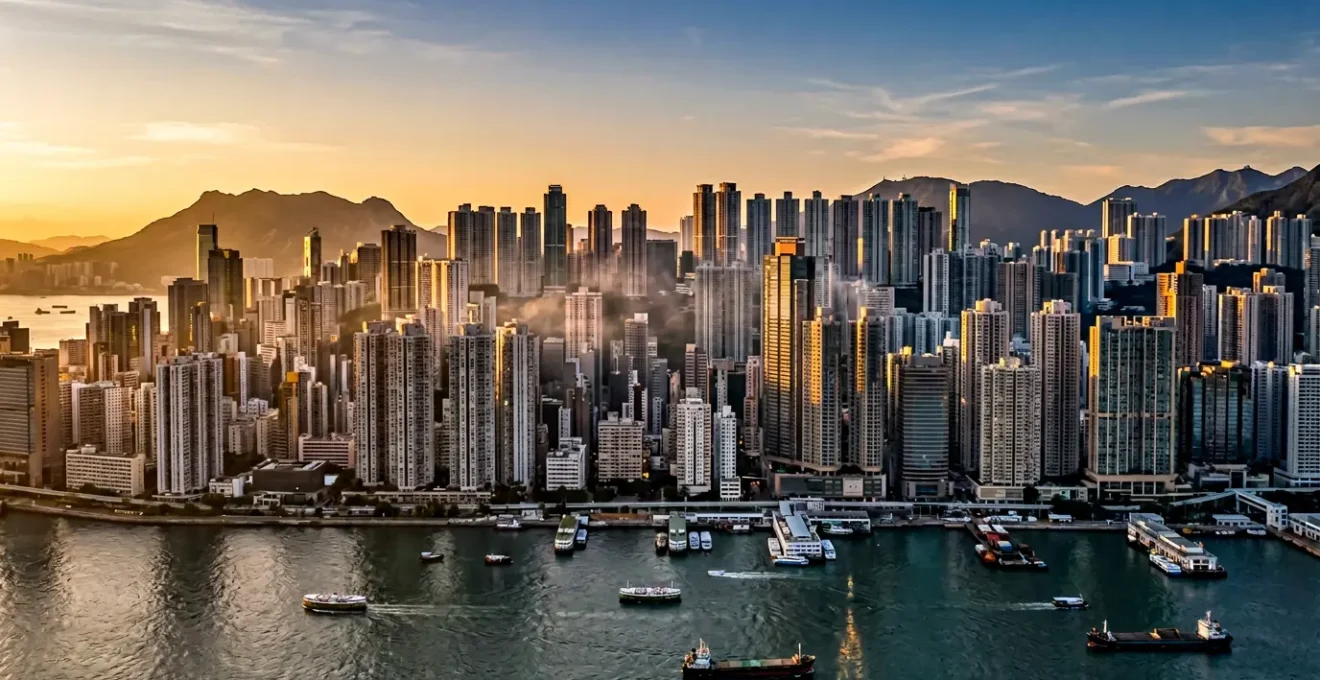
The common image of Hong Kong is one of overwhelming crowds and towering skyscrapers. But to view it merely as a dense city is to miss the point. Life here is not just an adaptation to limited ground; it’s a mastery of a three-dimensional urban operating system. This verticality has forged a unique sociology, reprogramming the very concepts of neighborhood, commerce, and daily routine into a complex and fascinating choreography of human interaction.
The first impression of Hong Kong is often a sensory overload of height and density. The city’s skyline, a dense forest of steel and glass, pierces the clouds, while at street level, a torrent of humanity flows through canyons of concrete. For the curious traveler or potential expat, the immediate questions revolve around survival: How do people live in such small apartments? How do they cope with the crowds? These concerns, while valid, only scratch the surface of a much more profound reality. The common answers—that Hong Kong is crowded and built on efficiency—are platitudes that obscure the city’s true genius.
The real story of Hong Kong is not about the lack of horizontal space, but the ingenious creation of vertical space. This is not just an architectural phenomenon; it is a sociological one. To truly understand this place, we must look beyond the spectacle of density and analyze the underlying systems that make it function. What if the key to understanding Hong Kong wasn’t in its streets, but in its elevators? What if the concept of a neighborhood wasn’t a collection of blocks, but a stack of floors connected by escalators?
This analysis will deconstruct the vertical city. We will explore the historical and engineering forces that compelled Hong Kong to grow upwards. We will navigate the labyrinthine vertical malls and public transit systems, decoding the unspoken rules of this elevated world. By examining how residents handle the psychological pressure of density and how a hidden economy thrives floors above the ground, we will uncover how living in Hong Kong fundamentally changes one’s perspective on what it means to occupy, and belong to, a space.
To fully grasp the intricate layers of this urban marvel, this article delves into the specific mechanisms that define life in Hong Kong’s vertical landscape. The following sections provide a structured exploration of this unique environment, from its foundational principles to the daily hacks that residents use to navigate it.
Summary: Decoding the Vertical City’s Operating System
- Why Hong Kong Was Forced to Build Upwards Instead of Outwards?
- How to Navigate Vertical Malls Without Getting Lost in Elevators?
- The Claustrophobia Risk: How to Handle the Density if You Are Sensitive?
- What Makes the Central-Mid-Levels Escalator System Unique in the World?
- When to Avoid High-Rise Elevators to Save 20 Minutes of Queuing?
- Why Building Soaring Skyscrapers in Hong Kong Is an Engineering Miracle?
- Why Is the ‘Monster Building’ Photography Ban Strictly Enforced by Residents?
- How to Find Hidden Boutiques in Commercial High-Rises?
Why Hong Kong Was Forced to Build Upwards Instead of Outwards?
Hong Kong’s verticality is not a choice, but a powerful response to the twin pressures of geography and history. The story begins after World War II, when a massive influx of hundreds of thousands of refugees from mainland China catalyzed an industrial boom. This sudden population explosion occurred within a severely constrained area. The usable land of Kowloon and northern Hong Kong Island spans a mere 88 square kilometres, hemmed in by steep mountains and the sea. With nowhere to expand outwards, the only direction to go was up.
This necessity birthed a new kind of architecture. The city didn’t just build tall residential towers; it created what urbanists call “composite buildings.” As sociologist Eunice Seng notes, “Composite equals domestic uses plus – it could be anything.” This meant single structures could house factories, apartments, restaurants, and schools, creating self-contained vertical villages. This model of mixed-use, high-density living became the blueprint for the city’s development.
The result is a city that holds the world record for verticality. With 315 buildings taller than 150 metres, Hong Kong has more skyscrapers than any other city on Earth. This ascent was not merely an architectural trend but a fundamental solution to a demographic and geographic crisis, setting the stage for a society that would learn to live, work, and socialize in three dimensions. The skyscraper wasn’t just a building; it was the essential unit of a new urban fabric.
How to Navigate Vertical Malls Without Getting Lost in Elevators?
In Hong Kong, the shopping mall is not the suburban box you might know; it is a vertical streetscape, a complex ecosystem of commerce and transit that can be utterly bewildering to the uninitiated. Malls like Langham Place or Times Square are not just collections of stores, but multi-story labyrinths designed for a constant flow of people. To navigate them is to learn a new form of urban literacy, a kind of vertical wayfinding.
The key challenge is the sheer complexity of circulation. A single complex can have dozens of elevators and escalators, each with a different purpose. There are express lifts to dining floors, local lifts that stop at every level, and “scenic” escalators that span multiple stories at once to guide foot traffic. Getting lost is not a possibility but a probability for novices. Mastering this environment requires a strategic approach, treating the mall directory not as a suggestion but as a critical map for a three-dimensional expedition.
This photograph perfectly captures the dizzying yet organized chaos of a Hong Kong vertical mall’s interior, showcasing the intersecting paths of escalators across a vast atrium.
The design encourages a specific “vertical choreography.” Shoppers are guided along predetermined paths, often upwards via long escalators towards food courts or cinemas at the top, then encouraged to descend level by level, passing the maximum number of storefronts. It’s a carefully engineered system designed to maximize both efficiency of movement and commercial exposure, turning a simple shopping trip into a vertical journey.
Your Action Plan: Mastering Vertical Mall Navigation
- Identify express elevators versus local-stop lifts. Study the building directory to understand which elevator bank serves which floors (e.g., dining, cinema, retail).
- Employ the “Top-Down” strategy. Take an express lift to the highest floor you intend to visit and make your way down via escalators, following the intended flow of traffic.
- Look for shortcuts. Restaurant-specific elevators or less-crowded service corridors (where permitted) can help you bypass the main throngs of shoppers.
- Follow thematic zones. Many malls group similar stores (e.g., electronics, luxury goods) or use color-coded lighting to help you orient yourself across different levels.
- Decode the directory. Generic names like “Global Trading Co.” on a directory often hide unique, specialized businesses. Note the floor and unit number to find these hidden gems.
The Claustrophobia Risk: How to Handle the Density if You Are Sensitive?
The sheer density of Hong Kong is a physical reality that can be psychologically overwhelming. With an average of nearly 70,000 people per square mile in its most populated districts, the city presses in from all sides. For those sensitive to crowds or confined spaces, the constant proximity to others and the famously small living quarters can trigger feelings of claustrophobia. The question is not whether the density is real, but how millions of people thrive within it without losing their minds. The answer lies in a sociological adaptation I call “spatial reprogramming.”
Because private space is so limited and precious, Hong Kong residents mentally and functionally extend their homes into the city. The city itself becomes an extension of their living room, kitchen, and study. This is the concept of the “Third Space,” and it is the single most important coping mechanism for dealing with density. Public and semi-public spaces are not just places to pass through; they are essential, functional parts of daily life.
Clubhouses in residential towers, with their swimming pools, gyms, and function rooms, become the residents’ backyard. The local library or Starbucks becomes a remote office or study. Parks and waterfront promenades act as communal gathering spaces. This is brilliantly exemplified by developments like Lee Tung Avenue, where a 200-meter pedestrian walkway lined with cafes and restaurants serves as a vibrant, open-air living room for the entire neighborhood. By externalizing domestic functions into these shared spaces, residents relieve the pressure on their tiny apartments and transform the dense city into a vast, shared home.
What Makes the Central-Mid-Levels Escalator System Unique in the World?
Nowhere is Hong Kong’s “vertical choreography” more evident than in the Central-Mid-Levels escalator system. This is not merely a piece of public transport; it is the world’s longest outdoor covered escalator system and a living, breathing artery of the city. Stretching for over half a mile and rising 135 meters, it ferries over 78,000 people daily between the Central business district and the residential Mid-Levels. Its uniqueness lies not in its engineering, but in its profound sociological impact.
The escalator functions as a linear neighborhood. As it snakes its way up the steep hillside, it weaves through a dense tapestry of small retail shops, apartments, bars, and restaurants. An entire economic ecosystem has evolved that is wholly dependent on the rhythm and flow of this mechanical river. Businesses on the escalator’s path have their entrances and fortunes tied directly to the daily commute. In the morning, the escalator runs downhill to bring commuters to work; from mid-morning until midnight, it runs uphill, carrying residents home and revelers to the nightlife hubs of SoHo and Lan Kwai Fong.
This system is an evolution of the elevated pedestrian walkways first developed by Hongkong Land in the 1960s. The goal was to create a weather-proof network for pedestrians, but the unintended consequence was the creation of a new layer of prime real estate, a second-story city with its own logic and flow. The Mid-Levels escalator is the ultimate expression of this concept, transforming a simple commute into a journey through the heart of a community, proving that in Hong Kong, even a simple escalator can become the backbone of a neighborhood.
When to Avoid High-Rise Elevators to Save 20 Minutes of Queuing?
In a horizontal city, the main street is where life happens. In Hong Kong, the elevator is a vertical main street, and like any major artery, it has rush hours. For an outsider, an elevator is a simple utility. For a resident of a 40-story tower, it is a lifeline, a potential bottleneck, and a space of unspoken social etiquette. Understanding its rhythms is a critical urban survival skill that can mean the difference between a smooth start to the day and a frustrating 20-minute wait.
The most intense “vertical rush hours” are predictable. In residential towers, the morning exodus between 8:30 AM and 9:15 AM sees thousands of residents simultaneously trying to get to ground level. In commercial buildings, the lunch rush between 12:45 PM and 2:00 PM creates a two-way traffic jam as workers descend for food and ascend back to their desks. During these peak times, elevators often stop at every floor, a phenomenon known as “puk-puk-ting” (stop-stop-stop in Cantonese), turning a two-minute ride into an eternity.
Savvy locals develop an intuitive sense for this flow. They know which elevator banks are express and which are local. They understand the “full-to-pass” strategy: letting a packed elevator go in the hope that the next one will be emptier. For short trips of one to three floors during peak times, using the fire staircase is often significantly faster. In some residential complexes, there are even unwritten rules about using service elevators during off-peak hours. Mastering the elevator is not just about convenience; it’s about reclaiming time and asserting control in an environment where you are one of thousands moving in the same vertical plane.
Why Building Soaring Skyscrapers in Hong Kong Is an Engineering Miracle?
To the untrained eye, Hong Kong’s skyline is an impressive collection of tall buildings. To an engineer, it is a near-impossible feat of ingenuity and a testament to human resilience against geological and meteorological forces. Building a vertical city is one thing; building it on reclaimed land in a typhoon alley is another entirely. As of 2025, Hong Kong has 567 buildings above 150m, a staggering number made possible only through groundbreaking engineering.
Much of the Central district, the heart of the city’s financial power, is built on land reclaimed from the sea. This unstable, water-logged ground provides no purchase for foundations. To build skyscrapers here, engineers must drive massive foundation piles hundreds of feet down through silt and sand to anchor the buildings directly into the bedrock far below. It’s like building a forest of concrete and steel stilts before the first floor can even be laid. On top of this, every structure must be designed to withstand the immense lateral forces of typhoon-strength winds, requiring complex structural systems and specialized glass.
This is where we see a fascinating “engineered symbiosis” at play, a blend of hard science and deep-seated cultural belief. Take the iconic Bank of China Tower, for example.
Case Study: The Bank of China Tower’s Engineered Symbiosis
Designed by the legendary I.M. Pei, the 367-meter tower was an engineering marvel. Its unique triangular framework was a revolutionary way to handle wind loads while using less steel. However, its sharp angles and “X” shapes were seen as terrible feng shui, projecting negative energy. The final design incorporated elements to soften this, with the exterior structure made to resemble bamboo shoots, a symbol of growth and resilience. This case demonstrates how engineering solutions are often adapted to coexist with, and even embrace, cultural and spiritual considerations.
This extreme close-up reveals the incredible detail and material strength required for skyscrapers to withstand Hong Kong’s challenging climate, from typhoon winds to salty air.
Why Is the ‘Monster Building’ Photography Ban Strictly Enforced by Residents?
The Yick Cheong Building, known globally as the “Monster Building,” has become a symbol of Hong Kong’s hyper-dense aesthetic. Its perfectly symmetrical, U-shaped courtyards, crammed with thousands of apartments, have served as a dystopian-chic backdrop for Hollywood films and countless Instagram posts. For years, tourists flocked to its central courtyard, craning their necks to capture the iconic shot of the sky framed by a seemingly infinite stack of windows and balconies. Then, in 2018, the residents said, “Enough.”
Banners appeared, strictly prohibiting photography. Today, volunteer guards and vocal residents actively enforce this ban. To an outsider, this can seem like an overreaction. To understand it, one must grasp the profound disconnect between the building as an aesthetic object and the building as a home. The constant stream of visitors transformed a private, communal space into a chaotic tourist destination. Residents complained of constant noise, drones buzzing outside their windows, and influencers climbing on structures for the perfect photo. Their courtyard, the only semi-private outdoor space they had, was no longer theirs.
This is a classic case of what happens when a community’s “Third Space” is invaded. The photography ban is not about being unfriendly; it is a desperate act of reclaiming privacy and asserting a right to peace in one’s own home. As documented in a study of this phenomenon of “Instagram tourism,” the residents’ actions are a direct response to their homes being treated as a spectacle. The ‘Monster Building’ is a powerful lesson: in a city where private space is so scarce, the sanctity of communal space is fiercely protected. It is a reminder that behind every aesthetic facade are people trying to live their lives.
Key Takeaways
- Verticality as a System: Hong Kong’s density is not just a feature but a complex social and economic operating system with its own rules.
- Space is Redefined: Residents master “spatial reprogramming,” extending their small private homes into a network of shared public and semi-public “Third Spaces.”
- Circulation as Community: Vertical transport like elevators and escalators are not just utilities; they are the main streets and neighborhood backbones of the vertical city.
How to Find Hidden Boutiques in Commercial High-Rises?
One of the most rewarding secrets of Hong Kong for those who learn to read its vertical landscape is the “upstairs shop economy.” Due to astronomical ground-floor rents, a vast and vibrant world of commerce exists entirely on the upper floors of non-descript commercial buildings. This is the third dimension of commerce, a hidden ecosystem of unique businesses that thrive away from the street-level fray. For the curious explorer, discovering this world is a true delight.
These “upstairs cafes,” vintage record stores, bespoke tailors, and specialized bookstores operate on a different business model. They survive not on foot traffic but on word-of-mouth, social media buzz, and a loyal clientele who are willing to take an elevator to find them. Finding these places feels like being let in on a secret. It requires you to look past the generic lobbies and intimidating building directories and believe that a unique experience might be waiting on the 14th floor.
This hunt is a practical application of all the principles of vertical living. It requires you to be observant, to decode the city’s subtle cues, and to have the confidence to step into an elevator in a building that looks purely corporate. The reward is access to unique products and experiences, and a deeper connection to the city’s entrepreneurial spirit. To find them, you need to know what to look for:
- Check the Directories: Look for intriguing or generic names like “Trading Co.” or “Studio” on the upper floors. These often mask specialized businesses.
- Follow Local Influencers: Hyper-local Instagram and lifestyle blogs are often the first to feature new and interesting upstairs shops.
- Use Local Apps: Apps like OpenRice are not just for restaurants; they are extensive directories for all kinds of niche businesses, often with floor and unit numbers.
- Explore Off-Peak: Visiting commercial buildings during weekends or after business hours can reveal which floors have a lively, non-corporate buzz.
Mastering this final layer of the vertical city transforms you from a mere visitor into a true urban explorer. You are no longer just navigating the space; you are actively participating in its hidden culture.
To truly integrate into this environment, the next logical step is to consciously apply these observations, turning analytical understanding into lived experience by actively seeking out and navigating these unique vertical spaces.