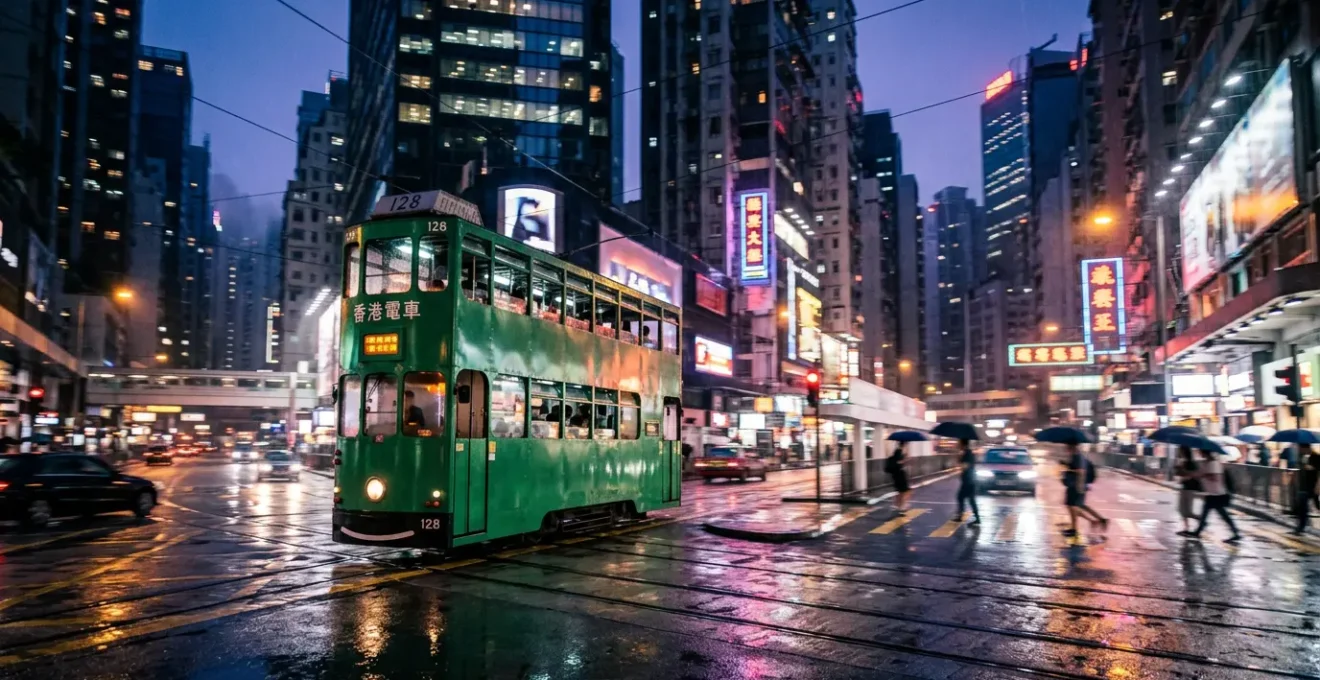
The Hong Kong tram’s real value isn’t its tiny fare, but its unparalleled ability to function as a slow-motion time machine, revealing the city’s true soul.
- It offers an authentic, ground-level view of daily life, unlike curated tourist buses.
- Its historic route physically illustrates the city’s unique geographical and vertical development.
Recommendation: Use the tram not just for transport, but as your primary tool for a deliberate and immersive exploration of Hong Kong Island.
In a city that moves at the speed of light, where vertical towers pierce the clouds and the MTR whisks millions underground, the idea of choosing the slowest form of transport seems almost revolutionary. Most visitors to Hong Kong, faced with the sensory overload of the metropolis, default to efficient subways or pricey hop-on-hop-off buses. They experience the city’s key sights but often miss its connective tissue, the vibrant, chaotic, and beautiful tapestry of everyday life that unfolds at street level.
But what if the key to truly understanding Hong Kong wasn’t about speed, but about slowness? What if the most authentic experience wasn’t in a curated tour, but in a rattling, beloved, century-old metal box? This is the promise of the “Ding Ding,” the iconic double-decker tramway. To ride it is to engage in a form of urban archaeology, peeling back the layers of the city’s history, geography, and culture for less than the price of a coffee. It’s a choice to reject the blur of high-speed transit and instead embrace a kinetic meditation through the heart of the island.
This guide will not only cover the practicalities of riding the tram. It will show you how to use it as a lens to see the city differently. We will explore why this vintage system has survived, how it offers superior value, and how you can use its slow pace to unlock Hong Kong’s most atmospheric and artistic secrets.
To help you navigate this journey, this article breaks down everything you need to know about transforming a simple tram ride into an unforgettable urban exploration. From its historical resilience to its role as a modern-day art shuttle, you’ll find all the insights below.
Summary: Your Guide to Hong Kong’s Iconic Tramway
- Why Has the Tram System Survived Since 1904 Despite Modernization?
- How to Board From the Back and Pay at the Front Without Confusion?
- Public Tram vs Big Bus Tour: Which Offers Better Value for Sightseeing?
- When to Ride the Tram for a Blade Runner Atmosphere at Night?
- The Speed Risk: Why You Should Avoid the Tram if You Are in a Hurry?
- Why Hong Kong Was Forced to Build Upwards Instead of Outwards?
- How Has the Historical Narrative Changed Since the Handover?
- How to Map Your Own Route to See the Best Hollywood Road Murals?
Why Has the Tram System Survived Since 1904 Despite Modernization?
In a city obsessed with the new, the tram’s survival is a minor miracle, powered by a combination of deep public affection and shrewd business sense. It’s more than just transport; it’s a moving landmark. As Hong Kong Tramways Limited officially states, the “tram holds a special place in the heart of Hong Kong citizens and is considered a city landmark.” This sentiment is the bedrock of its endurance. It represents a tangible connection to a shared past that residents are unwilling to let go of, a piece of collective memory that rattles through the modern cityscape.
But nostalgia alone doesn’t pay the bills. The tram’s continued existence is also a story of successful modernization. After its acquisition by French transport giant RATP Dev, the company focused on enhancing the system while preserving its soul. Innovations like real-time data for passengers were introduced, yet the core heritage was protected. This strategy has proven effective; even with intense competition from the MTR, recent statistics show the tram still carries around 134,000 daily passengers. It has found its niche not by trying to be the fastest, but by being the most accessible and atmospheric option for short-to-medium journeys along the island’s northern corridor.
This blend of cultural significance and operational evolution has allowed the tram to thrive. It’s a living piece of history that has adapted to the 21st century without sacrificing its identity, a rare feat in hyper-modern Hong Kong.
How to Board From the Back and Pay at the Front Without Confusion?
Boarding the Ding Ding for the first time is a simple ritual that instantly separates you from the uninitiated. Unlike buses or subways, the tram has its own unique flow: you always enter at the back and exit at the front. The entrance is marked by a set of turnstiles, a clanking gateway into this moving piece of history. There’s no need to pay upon entry; your journey begins on trust.
Once inside, you face a choice. The lower deck is practical for short hops, but the real magic is on the upper deck. The narrow, steep staircase at the rear leads to a vantage point that is arguably the best in the city for street-level sightseeing. Grab any open spot on the classic wooden benches. When your stop approaches, make your way to the front staircase. Here, beside the driver, is the single payment point. You can tap your Octopus card or drop the exact flat fare of HK$3.30 into the coin box—no change is given. After paying, you exit through the front doors, back into the city’s bustle.
This simple, unvarying process is part of the tram’s charm. Here’s a quick breakdown to ensure a smooth ride:
- Enter only through the turnstiles at the rear of the tram.
- Climb the rear stairs to the upper deck for the best views.
- When you are near your destination, move towards the front of the tram.
- Pay the exact flat fare (HK$3.30) at the front when you exit, using an Octopus card or coins.
- Exit only through the front doors.
Public Tram vs Big Bus Tour: Which Offers Better Value for Sightseeing?
When it comes to sightseeing, many tourists are drawn to the perceived convenience of Big Bus Tours. They offer curated commentary and a simple loop of major attractions. However, in terms of pure value—both financial and experiential—the humble Ding Ding is in a league of its own. The most obvious difference is the cost. A regular tram ride is a fixed, tiny fare, whereas a bus tour can be astronomically more expensive, offering little extra for the price hike.
This table breaks down the core differences, but the story it tells is one of authentic immersion versus a packaged product. The tram isn’t a “tour”; it’s a functioning part of the city’s circulatory system. You share your ride with students, shoppers, and office workers, experiencing Hong Kong as it is lived, not as it is presented to tourists.
| Feature | Ding Ding Tram | Big Bus Tour |
|---|---|---|
| Price per ride | HK$3.30 (US$0.42) | HK$150+ (US$19+) |
| Flexibility | Hop on/off anywhere, 120 stops | Fixed tour stops only |
| Frequency | Every 1.5 minutes peak hours | Every 20-30 minutes |
| Experience | Authentic local transport | Curated tourist commentary |
| Route coverage | 13km along north shore | Multiple routes with transfers |
| Operating hours | 6:00am – midnight daily | 9:00am – 6:00pm typically |
The flexibility is another key factor. With stops every 250 meters on average and trams arriving every couple of minutes, you can hop on and off with an impulsiveness that tour buses simply don’t allow. You see a temple, a market, or a curious alleyway, and you can be there in moments. This transforms sightseeing from a passive checklist into an active, spontaneous exploration. You are the director of your own urban film, not just a passenger on a pre-programmed ride. The “value” of the tram is the freedom it gives you to truly discover the city on your own terms.
When to Ride the Tram for a Blade Runner Atmosphere at Night?
By day, the tram is a charming, historical vessel. By night, it transforms into a front-row seat for one of the world’s most cinematic urban experiences. As dusk falls and the city’s millions of neon and LED lights flicker to life, a ride on the upper deck becomes a journey through a real-life sci-fi landscape. The slow, gliding pace is perfect for absorbing the overwhelming visual density, creating an atmosphere reminiscent of films like *Blade Runner* or the works of Wong Kar-wai.
To maximize this cyberpunk aesthetic, timing and position are everything. You need to catch the city at its peak luminescence, when the contrast between the vintage tram and the futuristic glow is most pronounced. A little rain can be a blessing, as the wet streets reflect the neon signs, doubling the spectacle and deepening the mood. Riding west from the dense commercial districts towards the older residential areas offers a stunning visual narrative of Hong Kong’s evolution, all viewed from the privileged perch of the upper deck’s front seats.
Your Action Plan: The Cinematic Night Ride
- Begin your journey at a Causeway Bay tram stop after 8:00 PM to experience the highest density of neon lights.
- Immediately head upstairs and secure one of the front-row seats on the upper deck for an unobstructed, panoramic view.
- Ride westward through Wan Chai, observing the dramatic lighting contrast between old tenement buildings and new glass towers.
- Pass through the Central district between 9:00 PM and 10:00 PM to see the corporate skyscrapers fully illuminated against the night sky.
- For the ultimate Blade Runner effect, hope for light rain, which creates mesmerizing reflections on the wet asphalt, enhancing the neon glow.
This isn’t just a ride; it’s a temporal and visual experience. You are physically moving through a century of architectural and cultural history, all bathed in the electric light of the future. It’s a moment of pure, unforgettable urban poetry.
The Speed Risk: Why You Should Avoid the Tram if You Are in a Hurry?
Let’s be clear: the Ding Ding is not for the impatient. If you have a meeting to catch or a flight to make, the MTR is your friend. The tram’s value proposition is fundamentally opposed to speed. While it can reach a maximum speed of 45 km/h, the tram typically travels at only 25-30 km/h, and that’s before factoring in traffic and frequent stops. To choose the tram is to make a conscious decision to slow down and subordinate your schedule to the rhythm of the city.
However, it’s a mistake to equate this slowness with inefficiency. The system’s genius lies not in velocity but in frequency and accessibility. During peak hours, a tram arrives roughly every 90 seconds. With stops positioned at average intervals of just 250 meters, the network offers an incredibly fine-grained level of access to the entire northern shore of Hong Kong Island. You are never more than a few minutes’ walk from a tram stop.
This model turns the concept of “speed” on its head. While an individual journey is slow, the minimal waiting time and the sheer density of stops mean that for short, spontaneous trips, the tram can feel more convenient than descending into the MTR system. The slowness is not a bug; it’s a feature. It creates an opportunity for kinetic meditation, a state where the journey itself—the sights, sounds, and sensations of the street—becomes the destination.
Why Hong Kong Was Forced to Build Upwards Instead of Outwards?
A ride on the tram is a rolling lesson in urban geography. The route itself tells the fundamental story of Hong Kong’s development: the relentless push upwards. The tram lines run almost exclusively along the narrow, flat strip of land on the island’s northern shore, land that was painstakingly reclaimed from the sea over the last 150 years. Look to one side, and you see Victoria Harbour. Look to the other, and you see the steep, unforgiving slopes of Victoria Peak and the surrounding mountains.
This geographical vise is the primary reason for Hong Kong’s famous verticality. With nowhere to expand outwards, the city had no choice but to grow skywards, creating one of the most densely populated and vertical urban environments on Earth. As one urban planning analysis notes, “The tram route itself runs along the narrow strip of flat, reclaimed land, perfectly illustrating the barrier between the steep mountainside and the harbor that dictated the city’s vertical growth.” From the top deck of a tram, you are perfectly positioned to witness this. You glide at the base of man-made canyons, craning your neck to see the tops of residential towers that seem to scrape the sky.
The tram offers a human-scale perspective on this superhuman density. You see the laundry hanging from windows, the small shops tucked into the ground floors, and the endless layers of apartments stacking one on top of the other. It’s geographical storytelling in motion, a direct visual explanation of the physical constraints that have shaped the city’s very character.
How Has the Historical Narrative Changed Since the Handover?
For much of its life, the tram was seen as a symbol of British colonial efficiency and engineering. It was a tool of the empire, a way to move people and goods through its bustling colony. However, in the decades following the 1997 handover to China, the narrative has undergone a profound transformation. The Ding Ding has evolved from a colonial relic into a fiercely beloved local heritage icon.
This shift in perception became powerfully evident during public movements like the 2006 Star Ferry Pier protests. Citizens rallied to protect colonial-era infrastructure not because of its British origins, but because it had become deeply embedded in their own personal histories and collective Hong Kong identity. The tram is no longer seen through a colonial lens but through a nostalgic one, associated with childhood memories, daily commutes, and the very fabric of the city’s life. It has been re-appropriated as something uniquely “Hong Kong.”
This local identity is reinforced by a simple but powerful fact: the trams are a product of the city itself. In an era of global supply chains, the fleet of around 165 trams are maintained and their iconic bodies built right here in Hong Kong at the Whitty Street Depot. This “Made in Hong Kong” aspect cements its status as a piece of living, local heritage, not a museum piece from a bygone era. It represents continuity and a self-sufficient local pride that resonates strongly in the post-handover period.
Key takeaways
- The tram’s survival is due to a mix of public affection and smart, heritage-focused modernization.
- Its slow speed is a feature, not a bug, enabling an immersive, meditative travel experience.
- The tram’s route provides a live lesson in the geography that forced Hong Kong’s iconic vertical growth.
How to Map Your Own Route to See the Best Hollywood Road Murals?
The tram is the perfect shuttle for an urban art safari. Hong Kong Island, particularly the districts of Sheung Wan, Central, and Wan Chai, is dotted with vibrant street art and massive murals. Using the Ding Ding, you can effortlessly hop between these creative hotspots, using the ride as a moment of rest and observation between your walking explorations. This approach turns the city into your personal art gallery.
Your “urban archaeology” expedition for street art begins in Sheung Wan. Alight at the Western Market tram stop and take a short, 5-minute walk uphill. You’ll soon find yourself on Hollywood Road and the surrounding alleyways, the epicenter of the city’s mural scene. Here you can find famous works by local and international artists. After immersing yourself in the art, simply head back down to Des Voeux Road and catch the next eastbound tram.
Your next stop is Wan Chai, a district known for its local graffiti and more eclectic pieces. Hop off and explore the lanes around the main tram line. When you’re done, continue your eastbound journey to the hyper-modern Causeway Bay. Here, the art takes on a more contemporary, urban feel, often found near the bustling Times Square area. This tram-and-walk strategy is the most efficient and enjoyable way to cover significant artistic ground without getting exhausted. The best time for this tour is on a weekday morning, when the streets are quieter and you can photograph the murals without crowds.
So next time you are on Hong Kong Island, grab your Octopus card, find a window seat on the top deck, and begin your own slow journey of discovery. Don’t just ride the tram—use it to read the city’s story, one rattling, wonderful block at a time.
Frequently asked questions about seeing Hong Kong by tram
Can I see street art directly from the tram?
While some larger murals are visible from the upper deck, most street art requires short walks from tram stops. The tram serves as an efficient connector between art districts.
Which tram stops are closest to major street art areas?
Western Market and Sheung Wan stops for the Hollywood Road area; Wan Chai stops for the Star Street precinct; North Point for emerging local artist spots.
How long should I allocate for a tram and street art tour?
Plan 3-4 hours for a comprehensive tour including tram rides and walking loops to see 15-20 major murals across different districts.