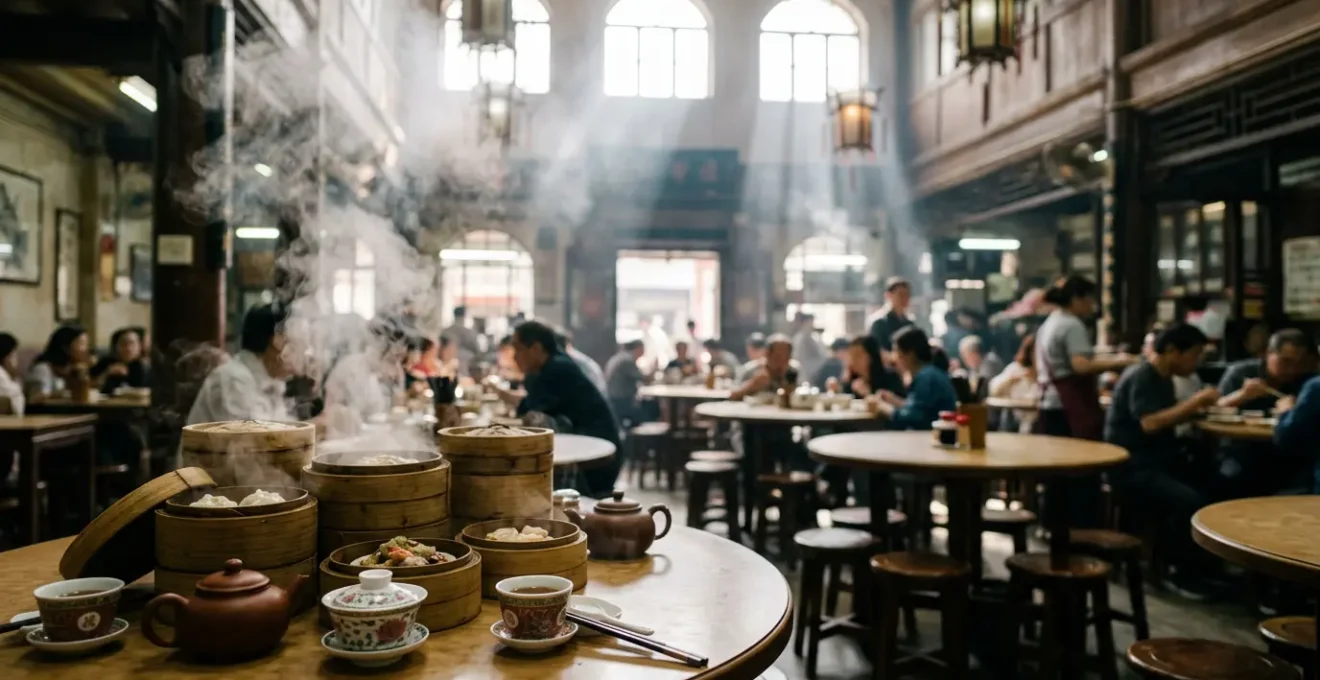
Afraid of looking like a lost tourist in a chaotic dim sum restaurant? The secret to mastering Yum Cha isn’t just knowing what to eat, but understanding the unspoken social choreography of the meal.
- The utensil “washing” ritual is about peace of mind, not actual sanitation.
- Finger tapping is a silent “thank you” that keeps conversation flowing without interruption.
- Order in waves using the “N+1” rule (number of people + one dish) to avoid overwhelming the table.
Recommendation: Embrace Yum Cha as a performance, not just a meal. Observe the flow, participate in the rituals, and you’ll transform an intimidating experience into a deeply satisfying cultural immersion.
The first thing that hits you is the noise—a joyous, chaotic symphony of clattering porcelain, rolling carts, and Cantonese chatter bouncing off the walls. Steam billows from bamboo baskets, revealing tantalizing glimpses of dumplings and buns. For a traveler new to the scene, a traditional Yum Cha restaurant is both thrilling and deeply intimidating. The fear of committing a faux pas, of ordering incorrectly, or simply looking out of place can be overwhelming. Many guides will give you a list of popular dishes or basic chopstick rules, but they miss the most crucial element.
Yum Cha is not just a meal; it is a social ballet, a fluid ritual with a century of tradition encoded in its gestures and flow. Mastering it isn’t about memorizing a rigid list of “don’ts.” It’s about understanding the *why* behind each action, learning the silent language of the table, and moving with the rhythm of the experience. It’s about recognizing the difference between a rule and a ritual. This is how you go from being a timid tourist to a confident participant who can navigate the beautiful chaos like a local. This guide will walk you through the entire performance, from the moment you sit down to the final, respectful fight over the bill.
To help you navigate this rich culinary tradition, we’ve broken down the entire experience into key moments. This structure will guide you through the essential rituals and unspoken rules, ensuring you can enjoy every aspect of your meal with confidence.
Summary: Navigating the Rituals of Dim Sum Like a Pro
- How to Perform the Ritual Washing of Utensils with Tea?
- Why Do Locals Tap Their Fingers on the Table When Tea Is Poured?
- Push Carts vs Order Sheets: Which Experience Is More Authentic?
- The Over-Ordering Risk: How Many Baskets Is Too Many for Two People?
- What Are the ‘Big Three’ Dim Sum Dishes You Must Try?
- How to Use Chopsticks Correctly to Avoid Table Taboos?
- What Makes the ‘Silk Stocking’ Tea Technique So Unique?
- Queue or Reservation: How to Secure a Spot for Afternoon Tea?
How to Perform the Ritual Washing of Utensils with Tea?
One of the first things you’ll notice at a traditional dim sum table is a large bowl placed alongside your teapot. This isn’t for soup or for discarding bones; it’s for a pre-meal ritual that often puzzles outsiders: washing your utensils. Let’s be clear, this is a ritual for peace of mind, not a genuine sanitation step. The practice became more widespread after the SARS outbreak, but its effectiveness is questionable. For the older generation, it’s a customary act that provides a sense of cleanliness and comfort before the meal begins.
To participate in this ritual without fumbling, follow these simple steps. This shows respect for the tradition, even if you know the hot water isn’t boiling. It’s a small performance that signals you understand the local customs.
As you can see, the process is simple and methodical. You’ll pour the hot tea or water into your bowl, use that to rinse your chopsticks and spoon, then hold your teacup over the communal basin and rinse it as well. Once finished, a server will typically remove the large bowl of used tea. Embracing this small act is your first step to blending in and feeling like a participant rather than just an observer.
Your Action Plan: The Utensil Washing Ritual
- Order a pot of tea as soon as you are seated; you can also ask for a pot of hot water (`bak seui`).
- Pour the hot liquid into the large communal bowl provided for rinsing.
- Place your teacup, chopsticks, and spoon into the bowl to give them a thorough rinse.
- Carefully pick up the items and empty the used water from your cup into the large bowl.
- Leave the large bowl on the table; a server will collect it before the food arrives.
Why Do Locals Tap Their Fingers on the Table When Tea Is Poured?
As the teapot makes its way around the table, you’ll witness another key piece of the dim sum ballet: the two-finger tap. When someone pours tea for you, it is customary to tap your index and middle fingers on the table a few times as a silent gesture of thanks. This is more than just polite; it’s a brilliant piece of social fluency. It allows you to express gratitude without interrupting the person speaking or breaking the flow of conversation. It’s a quiet, respectful acknowledgment that keeps the communal energy of the table alive.
The origin of this gesture is steeped in legend. As NextShark explains in an article on the mystery of the ‘two finger tap’, the story traces back to the Qing Dynasty Emperor Qianlong, who was traveling incognito. When the emperor poured tea for his servant, the servant, unable to perform a full kowtow to reveal the emperor’s identity, tapped two fingers on the table to mimic a bowing head and kneeling legs.
Because they didn’t want to give away his royal identity, the subjects would tap two fingers on the table to represent deep kneeling or kowtowing as thanks. That said, it has also been alleged that the practice likely originated from guests thanking each other by knocking on a table during Tang and Song Dynasty banquets.
– Tasting Table, The Two-Finger Dim Sum Gratitude Gesture, Explained
Interestingly, the gesture has its own subtle etiquette. Tapping with two fingers is standard among peers. However, to show a higher degree of respect, such as when an elder pours you tea, you might tap with a closed fist. Conversely, an elder may simply tap one finger when a younger person pours for them. Observing these nuances is part of appreciating the deep cultural layers of the meal.
Push Carts vs Order Sheets: Which Experience Is More Authentic?
When you enter a dim sum restaurant, you’ll generally encounter one of two systems for ordering: the traditional push carts or the modern order sheet. The push cart experience is the classic, cinematic version of Yum Cha. Ladies push steam-filled trolleys through the aisles, calling out the names of the dishes they carry. This method is spontaneous and visual—you see what you get. It’s a high-energy, exciting way to dine, but it can also be high-pressure, and the most popular items may run out quickly.
The order sheet, on the other hand, offers a more strategic and relaxed approach. You are given a paper menu listing all the available items, and you simply mark off what you’d like. The dishes are then made fresh to order and brought to your table. This method ensures you get exactly what you want and that it’s piping hot, but it lacks the chaotic charm and interactive nature of the carts. Some restaurants even use a hybrid model. The choice between them often comes down to personal preference: do you crave nostalgic chaos or calm control? The following table breaks down the pros and cons of each.
| Method | Experience | Advantages | Disadvantages |
|---|---|---|---|
| Push Carts (Traditional) | Spontaneous, visual selection | See items before ordering, authentic atmosphere, immediate service | Limited availability, items may not be fresh, high-pressure decisions |
| Order Sheets (Modern) | Strategic, comprehensive selection | Full menu visibility, fresher items made to order, relaxed pace | Less interactive, requires menu literacy, loses traditional charm |
| Hybrid Model | Best of both worlds | Main dishes made fresh, special items on carts, balanced experience | Can be confusing for first-timers |
While many purists swear by the push carts for authenticity, the order sheet is now far more common, even in Hong Kong. Don’t feel you’re getting a lesser experience with an order sheet; you’re often getting fresher food. The true authenticity of Yum Cha lies in the shared experience with your companions, not just the method of delivery.
The Over-Ordering Risk: How Many Baskets Is Too Many for Two People?
With dozens of enticing options rolling past or listed on the menu, the single biggest mistake a beginner makes is over-ordering. Your eyes get bigger than your stomach, and soon your small table is buried under a mountain of bamboo steamers. So, how do you avoid this rookie error? The key is to order in waves and follow a simple rule of thumb. According to local dining customs in Hong Kong, a good starting point is about 2-3 dishes per person, as most items come with 3 or 4 pieces each.
A more strategic approach is the “N+1” rule: for a group of ‘N’ people, start by ordering ‘N+1’ dishes. For two people, this means starting with just three dishes. This prevents table clutter and food waste, and it allows you to gauge your hunger before committing to more. The beauty of dim sum is its continuous nature; you can always add another dish or two later. It’s a marathon, not a sprint.
A well-balanced first wave for two people might include one steamed item (like har gow), one fried or baked item (like a spring roll), and one specialty item (like cheung fun). After you’ve finished this initial round, you can decide if you’re ready for another small dish or if it’s time to move on to dessert. Remember, dim sum is about sampling a variety of small bites, not feasting on huge portions.
Here is a simple strategy to ensure you order just the right amount:
- Start with the N+1 Rule: For two people, order three dishes. For four people, order five.
- Order in Waves: Never order everything at once. Start with a few items, and add more as you go.
- Balance Your Selection: In each wave, try to get a mix of textures and cooking methods—steamed, fried, baked.
- Save Rice/Noodles for Last: These are fillers. Only order them if you are still genuinely hungry after the main dishes.
What Are the ‘Big Three’ Dim Sum Dishes You Must Try?
If you’re new to dim sum, the menu can feel overwhelming. The best way to start is with the undisputed holy trinity of Cantonese dim sum. These three dishes represent the core flavors and textures of the cuisine and serve as a perfect introduction. According to food experts, Har Gow (shrimp dumplings), Siu Mai (pork and shrimp dumplings), and Char Siu Bao (barbecue pork buns) are the essential starting point. They are the benchmark by which any good dim sum restaurant is judged.
But being an insider means going beyond just ordering the right dishes; it means knowing what makes them *good*. A true regular can spot quality from a distance. When your baskets arrive, don’t just dig in. Take a moment to appreciate the craftsmanship. Is the skin of the har gow translucent enough to see the pink shrimp inside? Does the siu mai stand tall and proud, not slumped over in its steamer? Does the char siu bao have a signature fluffy, cracked top that resembles a smile? These are the hallmarks of a kitchen that takes pride in its work.
To help you develop an expert eye, here are the key quality indicators to look for in the most classic dim sum dishes. Paying attention to these details will not only enhance your appreciation but also help you identify truly exceptional dim sum restaurants for future visits.
Your Action Plan: Quality Indicators for Premium Dim Sum
- Har Gow (Shrimp Dumplings): Look for a translucent wrapper with at least 10-13 delicate pleats. The skin should be unbroken, and the whole shrimp inside should be visible.
- Siu Mai (Pork & Shrimp Dumplings): The dumpling should stand upright in the steamer. It is typically topped with orange crab roe or a single pea, and the wrapper is open at the top, showing off the filling.
- Char Siu Bao (BBQ Pork Buns): The steamed version should have a brilliantly white, fluffy exterior with a characteristic ‘smile’ crack on top, revealing the glossy, red-hued barbecue pork inside.
- Cheung Fun (Rice Noodle Rolls): The rice noodle wrapper should be silky smooth and thin enough to be translucent, but strong enough not to tear when you pick it up.
- Fung Jau (Phoenix Talons/Chicken Feet): A mark of a great kitchen. The feet should be puffy and tender enough to fall off the bone easily, coated in a rich, flavorful black bean sauce.
How to Use Chopsticks Correctly to Avoid Table Taboos?
Chopstick etiquette is fundamental to dining in many Asian cultures, and Yum Cha is no exception. While mastering the grip may take practice, avoiding the major taboos is simple and shows immense respect. The most critical rule, universally recognized, is to never stick your chopsticks upright in a bowl of rice. This gesture resembles incense sticks offered at a funeral and is considered a very bad omen. Similarly, avoid using your chopsticks to point at people or dishes, and don’t use them like drumsticks on the bowls.
When it comes to sharing dishes—the very essence of dim sum—a specific etiquette applies. Many modern restaurants will provide a separate pair of communal serving chopsticks (`gong fai`) for transferring food from the shared platter to your own plate. As The Takeout notes in its guide for beginners, you should always use these if they are provided. If not, you have two polite options.
Use the communal chopsticks if they’re provided, or ask for an extra set to avoid touching shared food with your personal utensils. If you must use those, use the other side of the sticks rather than the side you eat with.
– The Takeout, 11 Tips For Eating Dim Sum Beginners Need To Know
Flipping your chopsticks to use the “clean” upper ends is a clever and widely accepted practice. Lastly, don’t be afraid to ask for a fork. Dim sum restaurants are used to international guests, and the staff would much rather you enjoy your meal comfortably than struggle and make a mess. Showing you know the rules is good; knowing when it’s okay to ask for help is also a sign of confidence.
- Rest your chopsticks on the provided rest or on the side of your plate when not in use. Never place them directly on the table.
- For slippery items like cheung fun, it’s perfectly acceptable to use your ceramic spoon to support the item from underneath as you lift it with your chopsticks.
- Don’t “dig” through a shared dish to find the best piece. Take the one that is closest to you.
What Makes the ‘Silk Stocking’ Tea Technique So Unique?
While the name of this section refers to “Silk Stocking” tea—a specific type of Hong Kong milk tea known for its unique brewing method—the role of tea at a Yum Cha meal is a much broader and more fundamental topic. In fact, the Cantonese don’t say they are “going to eat dim sum.” They say they are going to “Yum Cha” (飲茶), which literally translates to “drink tea.” The tea is not an accompaniment to the meal; the tea *is* the event, and the dim sum are the snacks that go with it. Understanding this puts the entire experience in the correct perspective.
When you sit down, the first question you’ll be asked is what kind of tea you want. This is not the time to ask for English Breakfast. You’ll be presented with a choice of traditional Chinese teas, each with a unique flavor profile that pairs differently with the food. Pu-erh (`Bo Lei`) is a classic choice; its dark, earthy flavor is excellent at cutting through the richness of fried items. For something lighter, you might choose Chrysanthemum (`Guk Fa`) or Jasmine (`Heung Pin`). Choosing the right tea is your first move in the table choreography.
A key piece of tea etiquette is knowing how to signal for a refill. If your teapot is empty, you don’t need to flag down a server. Simply leave the lid of the teapot ajar, resting it partially open on the top of the pot. This is a universal, silent signal to the staff that you require a hot water refill. They will spot it from across the room and attend to your table without a word needing to be exchanged. Here is a guide to pairing some of the most common Yum Cha teas.
This guide to traditional tea pairings, based on a helpful chart from Fodor’s Travel, can help you choose with confidence.
| Tea Type | Cantonese Name | Flavor Profile | Best Paired With |
|---|---|---|---|
| Pu-erh | Bo Lei | Rich, earthy, cuts grease | Fried items, heavy dumplings |
| Oolong | Wu Long | Light, balanced | Steamed seafood dumplings |
| Chrysanthemum | Guk Fa | Floral, refreshing | Sweet dim sum, desserts |
| Jasmine | Heung Pin | Fragrant, delicate | Light steamed items |
| Iron Buddha | Tik Kwun Yum | Roasted, sweet finish | Char siu bao, meat dishes |
Key takeaways
- Yum Cha is a social ritual centered on tea; the food is secondary. Master the gestures to master the experience.
- Silent communication is paramount. The finger tap for “thanks” and the open teapot lid for a refill let you communicate without interrupting the conversation.
- Order smart, not big. Use the “N+1” rule and order in waves to avoid waste and enjoy a wider variety of fresh dishes.
Queue or Reservation: How to Secure a Spot for Afternoon Tea?
In the world of traditional dim sum, reservations are a rare luxury. For the most popular and authentic establishments, especially during peak weekend hours, the system is simple: you show up, take a number, and wait. This queuing culture is an integral part of the experience. The best strategy is to arrive early, before the main lunch rush. Most restaurants serve dim sum from the early morning until mid-afternoon, but the peak quality time is often between 10 AM and 1 PM, when turnover is highest and the dishes are at their freshest.
If you’re with a small party of two or three, you may be asked if you are willing to “share a table” (`daap toi`). Saying yes can drastically reduce your wait time. You’ll be seated at a large round table with another party, but don’t worry—you are not expected to interact. It is simply a practical way to maximize seating in a crowded restaurant. Think of your half of the table as your own private space.
The final ritual of the meal is perhaps the most culturally nuanced: paying the bill. In Western cultures, it’s common to split the bill. In traditional Chinese culture, this is rarely done. Instead, a polite “fight” ensues over who gets the honor of paying for the entire table. This is not a real argument, but a performance of generosity and respect. As a guest, you should make a sincere offer to pay, but if your host insists, allow them to do so graciously. It is considered good manners for them to treat you. Attempting to “go Dutch” can be seen as awkward or distant.
Now that you understand the choreography, the unspoken rules, and the cultural context, the next step is to step onto the dance floor. Go with confidence, observe your surroundings, participate in the rituals, and most importantly, enjoy every delicious moment of the experience.